  1. Home
  2. Space
  3. Emerging Tech
  4. Legacy Archives

SpaceX unveils Dragon V2 spacecraft, complete with 3D-printed engines

Add as a preferred source on Google

SpaceX founder and CEO Elon Musk has unveiled the Dragon V2, a spacecraft he hopes will one day take astronauts to and from the International Space Station (ISS).

At a special event at the company’s Hawthorne, California factory on Thursday, Musk took the wraps off an updated version of the existing Dragon spacecraft, which up to now has made four trips to the ISS, delivering vital supplies for crew members.

Recommended Videos

While the Dragon craft has never taken humans into space, the V2 capsule, which is set to become part of a new generation of spacecraft when it goes into service, can carry up to seven astronauts “for several days.”

Musk promises the new spacecraft, which could go into service as early as 2016, will have far superior landing capabilities to its predecessor, able to put down “anywhere on land with the accuracy of a helicopter.”

The Dragon’s parachutes will remain with the V2, but will only deploy if there’s a problem with the engines or propulsion system prior to landing.
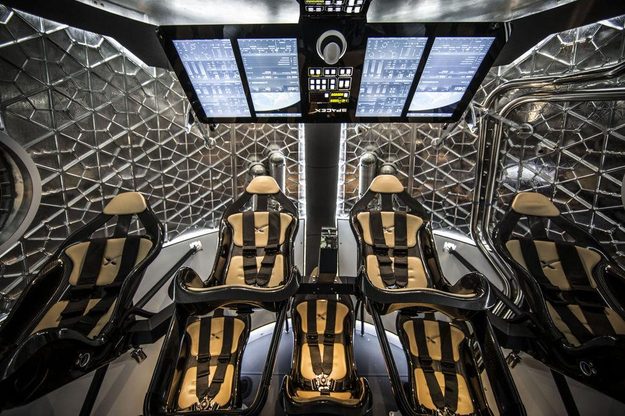
spacex dragon v2 interior
Image used with permission by copyright holder

It can also dock with the space station autonomously, without the aid of the ISS’s arm, an improvement over the Dragon that Musk described as a “significant upgrade.”

The V2’s design allows for rapid reuse of the spacecraft, something the SpaceX boss said was vital for revolutionizing access to space.

“So long as we continue to throw away rockets and spacecraft, we’ll never have true access to space; it’ll always be incredibly expensive,” Musk said.

The presentation gave attendees an up-close look at some of the V2’s components, including its new SuperDraco engines. Whereas each of the Dragon’s Draco engines produces about 100 pounds of thrust, a SuperDraco engine is capable of producing 16,000 pounds of thrust, “hence the ‘super,’” Musk quipped. In addition, the SuperDraco will be the first “fully printed” engine, making it the first such engine to see flight.

The SpaceX team believes its latest spacecraft design is another step forward to bringing down the cost of space flight as it vies for NASA development funds and contracts.

You can check out Musk’s 15-minute presentation below.

Trevor Mogg
Contributing Editor
Not so many moons ago, Trevor moved from one tea-loving island nation that drives on the left (Britain) to another (Japan)…
Blue Origin’s massive New Glenn rocket explodes in a fiery blaze during tests
The incident leaves NASA's Moon Base ambitions and Amazon's Kuiper constellation without their primary launch vehicle at the worst possible moment.
Explosion, Fire, Nuclear Explosion

Blue Origin's New Glenn rocket exploded during a static fire test at Launch Complex 36 in Cape Canaveral, Florida. The incident took place on the night of May 28, 2026. 

The explosion was captured on a live stream by NASASpaceflight.com and footage of the explosion spread rapidly across X. The Space Launch Complex 45 has confirmed in an official statement (shared by Spaceflight Now on X) that all personnel have been accounted for and there have been no injuries or fatalities.

Read more
Orbot Robotics’ space robot has four arms, but its Goro physique has a purpose
This four-armed robot could make routine space-station work easier for astronauts
Robot with four arms

Helios is a new four-armed robot from Zurich-based Orbit Robotics, and at first glance, it reminded me of Goro from Mortal Kombat. But unlike the prince from Outworld, Helios is not built for combat. It is designed to help astronauts on space stations with the repetitive, time-consuming work that keeps life in space running.

Orbit Robotics says that in microgravity, legs are not much help. Instead of walking or standing, Helios needs to move through tight station interiors, hold itself steady, and handle cargo, tools, or equipment. Its four-arm design turns extra limbs into both mobility aids and working hands.

Read more
A billionaire crypto bro will lead humanity to Mars atop Musk’s Starship
Chun Wang could become one of the first humans to travel toward Mars
Chun Wang in a space suit

Neil Armstrong and Buzz Aldrin became the faces of the Moon landing era. Elon Musk’s Mars era may get a very different public face in Chun Wang, a cryptocurrency billionaire whose fortune traces back to Bitcoin mining.

Wang is expected to lead a future SpaceX Starship mission that would fly past Mars and return to Earth. SpaceX has not announced a launch date, and the plan still depends on Starship proving it can safely carry humans far beyond Earth's orbit.

Read more