
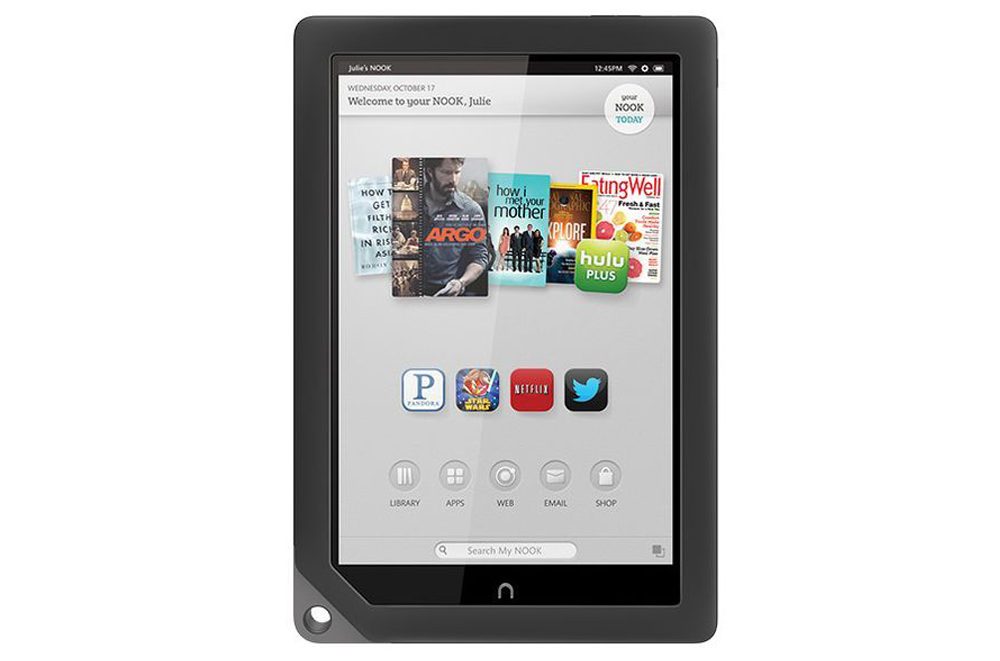

“The Nook HD+ is an excellent choice for people who want a simple, easy tablet experience focused on consuming books, video, and other media.”
- Comfortable, lightweight design
- Excellent display
- Good reading experience for magazines, comics, kid's books
- Well-designed interface
- Profiles for multi-user households and kids
- Speedy performance
- Long battery life
- Limited when compared to most Android tablets
- Small app selection
- No cameras
“Why you can trust Digital Trends – We have a 20-year history of testing, reviewing, and rating products, services and apps to help you make a sound buying decision. Find out more about how we test and score products.“
Barnes & Noble invented the low-cost, basic tablet category with the Nook Color, a paired-down Android slate aimed at people who love e-books. Since the Color, the Nook has evolved into ever more sophisticated tablets and has now grown in size. The Nook HD+ is the company’s first 9-inch model and the tablet that B&N feels can stand up to the major players in this market. The HD+ is not just competing with the Kindle Fire HD 8.9, it wants to be seen as a real boy tablet.
Can the Nook HD+ stand up to the iPad and the Nexus 10? It has a 1080p HD display, good design, and multimedia chops. But it also has a small app store and a restrictive interface. Does it strike the right balance?
Look and Feel
The Nook HD+ is one of the better-looking tablets and one of the most comfortable to hold. It shares more design language with the Nook Tablet than the Nook HD, keeping the little notch at the corner as well as the more rectangular shape. The faux-metallic coating is gone from the front, replaced by a matte finish that compliments the soft-touch back and adds to the comfort and holdability of the tablet. It also helps that the HD+ is light for a 9 incher and comes in a couple of ounces lighter than the Kindle Fire HD 8.9.


The tablet balances well in the hand both in portrait and landscape. The half-inch-wide bezel around the display gives you a place to rest your thumbs that’s not glass, which cuts down on fingerprints. The power and volume buttons on the edge are easy to find and press and placed in such a way that they don’t get in the way no matter the orientation. Though not rugged, the bezel, recessed display, and flat edge offer a small amount of protection from minor falls.
The stylized ‘n’ button below the display is a bit awkward to press with the thumb in portrait mode; not a big deal since the interface is designed to use mostly on-screen buttons and navigation tools.


Barnes & Noble went the Apple/Samsung route with a proprietary 30-pin port instead of the proprietary Micro USB of the last generation. At least this port makes it possible to add dongles for HD output and opens the Nook up to future docking possibilities. Other than this port, you get a microSD card slot and a headphone jack.
What’s missing? Cameras. B&N maintains that their audience is meh about cameras on a tablet. Considering the sad state of tablet cameras, this doesn’t feel like a huge loss.
Display
The 9-inch IPS display on the Nook HD+ is both beautiful and pixel dense with a 1920 x 1280 pixel resolution. As with the Nooks that came before it, the screen on the HD+ is top quality – wide viewing angles, great color contrast and depth, doesn’t easily pick up fingerprints. It’s bright enough to be sunlight-readable to a degree at 100 percent. You won’t need to keep it up that high normally since it’s plenty bright at 50 percent or less.
The Reading Experience
 The e-reading experience remains at the center of the Nook HD+ and shaped many of B&N’s design decisions, including the 9-inch size and the high-resolution screen. The result is a tablet that’s perfect for reading digital magazines, comics, and kid’s books. Full layout magazine pages don’t need to be zoomed if you have good eyes since even small text is crisp and readable. If small text isn’t for you, ArticleView offers a text-only way to read with the same text options as e-books. Comics don’t require zooming, either, and some come equipped with an engine for enlarging panels automatically as you read. Nook Kids books continue to incorporate rich media elements that keep them engaging and help with reading and comprehension skills.
Reading regular e-books is about the same as doing so on the 7-inch Nook HD. Owners benefit from a wealth of options for customizing how books look inside. On this size screen you can fit more text on a page while still giving yourself generous margins, wide line spacing, or a bigger font. One drawback is that the HD+ is heavier than the Nook HD and the 9-inch size harder to use one-handed. If you’re more into e-books than e-magazines or read a lot while commuting, a smaller size might serve better.
Barnes & Noble added digital catalogs to their offerings with the launch of the HD+ and the interface there is similar to magazines. Catalog pages have an additional feature: direct shopping links. Tap on a product you like to get more information and tap once more to go right to the website where you can buy it.
One of the best new features introduced with the HD+ is Scrapbooks. Now users can “tear” pages from catalogs and magazines and add them to customizable books. There’s no limit to how many pages a scrapbook can have or how many you can create. Inside, they act just like magazines except there’s no ArticleView, unfortunately.
Multimedia
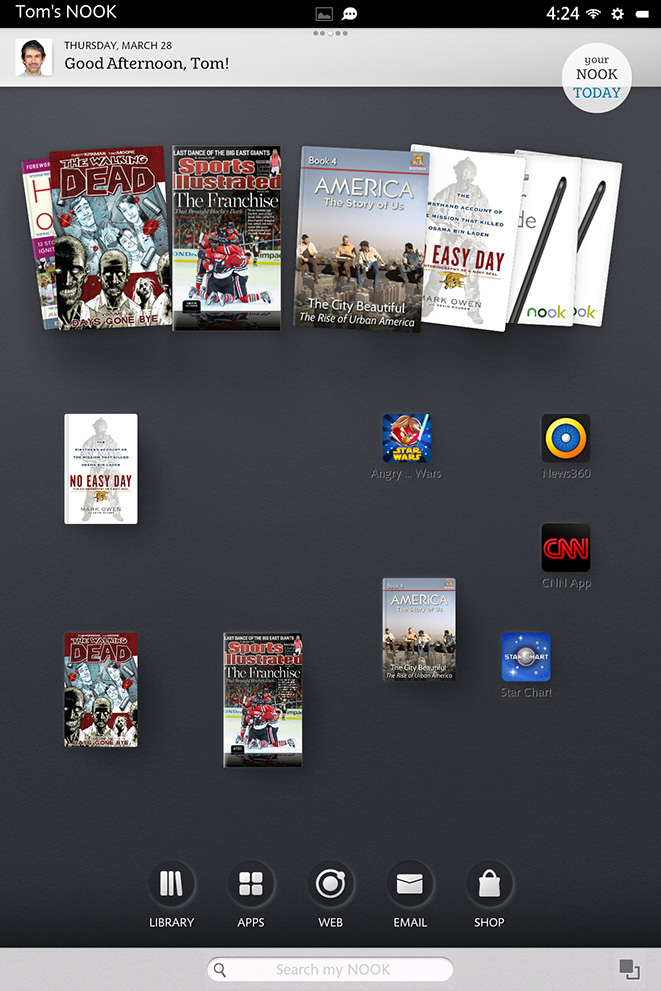 Despite the legacy, the HD+ isn’t just about digital reading. B&N is positioning it as a capable multimedia tablet as well. The high-resolution display serves this aspect of the tablet and allows for watching full HD video without losing a pixel. Games also look great, and all of the titles we downloaded and used fit the screen and resolution with no issues.
That’s not the entire story, though. Previous versions of the Nook lacked Bluetooth connectivity or a way to output to a larger screen; the Nook HD+ has both. The speakers on the back of the device actually impressed us in the volume department, but the audio quality isn’t as round as we’d like nor will it satisfy when watching a full-length movie. Audio through headphones or output to Bluetooth speakers came out much better; you get real depth and directionality (depending on the quality of your audio gear). An optional HDMI dongle will let you connect the HD+ to a TV or monitor so you can enjoy movies, games, or anything else on a bigger screen.
You can load your own videos onto the HD+ as long as they’re the right format and don’t have DRM. However, many consumers prefer an on-device content store to take the hassle out of the process. The new Nook Video service has both movies and TV episodes for sale or rent (movies only) at prices comparable to what you’ll find on iTunes or the Google Play store. The selection, while not as vast as iTunes, is well-stocked with new releases. One bonus: customers with an Ultraviolet account can sync their library to the HD+. If you’ve already bought an Ultraviolet-compatible movie and that title is in the Nook Video catalog, you can watch it for free on your Nook HD+. And when you connect the device to Ultraviolet, you can then watch movies purchased on the HD+ on other Ultraviolet-compatible apps and services. The videos you buy are still somewhat restricted by DRM, but not solely tied to once device.
There’s no Nook Music store to complement the video one, so you’ll have to load your DRM-free MP3s to the tablet yourself.
Apps
 One of the biggest roadblocks to the Nook HD+ quest to becoming a full-fledged tablet is the app selection. Currently there are about 8,500 apps in the store, which is a small fraction of what’s available in the Amazon app store or on Google Play. This wouldn’t be as big a problem if more of the top apps available on other platforms were also here. The current selection of popular apps is likely enough to satisfy customers who are more focused on reading or who only use a few. Customers who download apps more often than they change socks won’t find the selection fulfilling.
The positive aspect of the limited choice and tight-reigned curation approach B&N is taking is that all the apps available to the HD+ are guaranteed to work well with the interface and the screen.
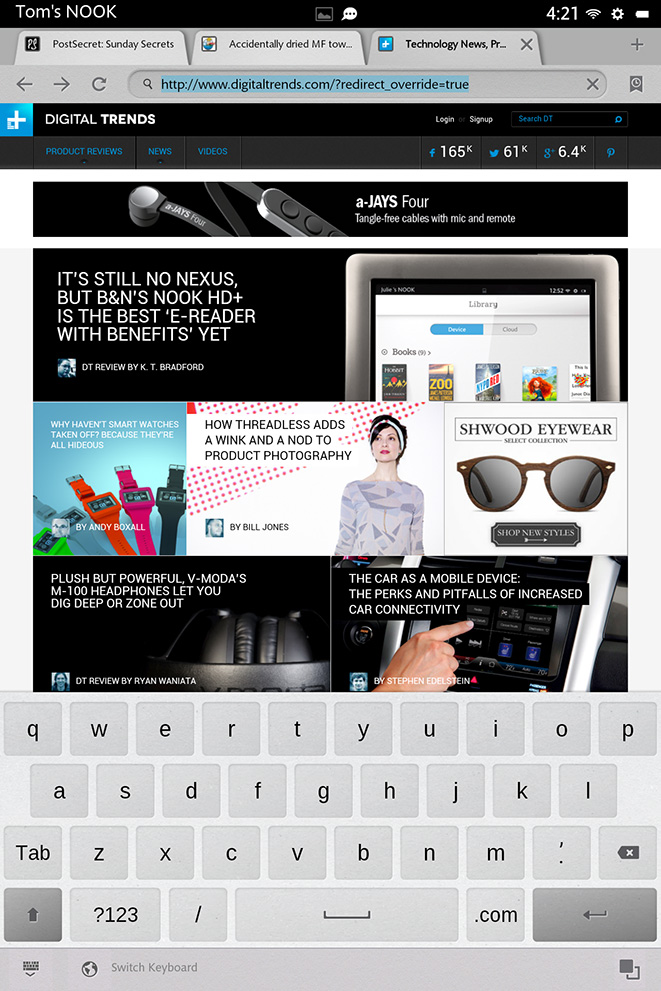
Barnes & Noble vastly improved its own stock apps. The browser now includes an ArticleView button as well that simplifies websites, taking away the layout and just presenting the text. This way you don’t have to bother with zoom and have all the font and text options from the e-book side. The email client supports Exchange Active Sync for corporate mail alongside Gmail, Yahoo, and other web-based services as well as calendar sync.
Interface and Operating System
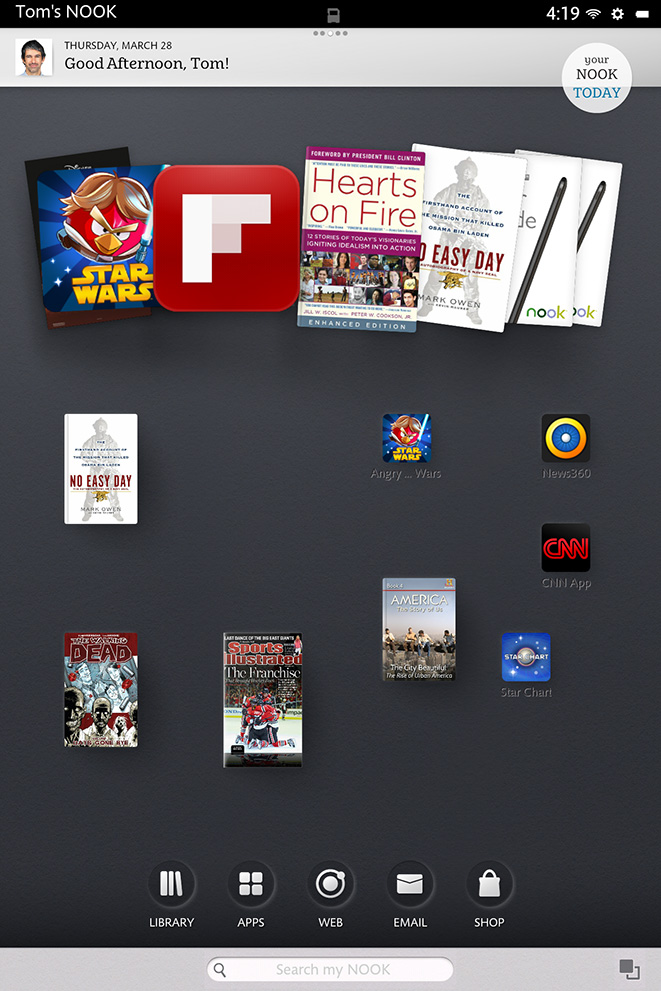 The Nook HD+ runs on Android 4.0 with a custom interface on top that almost completely obscures the operating system underneath. There are pros and cons to this, the major pro being that the interface is very intuitive and easy to use if you’re not very tech-savvy (or if you are). With so much content to keep track of – books, magazines, comics, movies, apps, and more – the Nook interface does a good job of keeping it organized without overwhelming the user. Unlike the Kindle Fire interface, users can customize their Home screens with favorite content and even widgets, just like regular Android.
The weakness of the interface is that it’s limited when compared to “normal” Android tablets. The walled garden approach is reminiscent of Apple and just as frustrating. Basic things we’d like to do, such as replace the stock keyboard or side-load our own apps, aren’t possible on the Nook HD+. The balance between keeping things simple and straightforward and stifling Android too much is a delicate one, and the HD+ wobbles a bit depending on the user.
Profiles and Parental Controls
The best aspect of the interface is the ability to create profiles, a feature still not available on most popular tablets. Everyone in the family can share one Nook HD+ yet won’t have to wade through someone else’s books and magazines and apps to find the ones they want to read or use. Most importantly, kid profiles make it possible to restrict younger users from inappropriate content on the Web, in books, apps, and more. The Nook will stop kids from making purchases without approval or from seeing the content adults have in their profile. Profiles can be password protected or not, and it’s easy to switch right from the lock screen.
Hardware and Performance
 Inside the Nook HD+ is a 1.5GHz OMAP4470 dual-core processor backed by 1GB of RAM and 16 or 32GB of internal storage. For connectivity there’s b/g/n Wi-Fi and Bluetooth on the wireless side and a 30-pin port for USB and HDMI (with dongle).
Just as with the smaller Nook HD, the HD+ is speedy and responsive and impressed us with good performance. Though the screen is large and hi-res, everything from turning pages in magazines to games went smoothly and we noted high framerates and solid graphics performance. Multitasking also proved to be no problem. We opened over a dozen apps across profiles and the HD+ didn’t slow noticeably. Switching between profiles took a few seconds, but that was the only time we had to wait for the HD+.
Barnes & Noble rates the battery at up to 10 hours while reading and 9 hours watching video. In heavy usage, which included three hours of movie watching, reading books and magazines, and playing games, the HD+ had only used up 70 percent of the battery. We were also impressed by how little power the tablet used when in sleep mode. Under normal usage, the HD+ will last a whole day of off-and-on use and maybe up to two depending on how it’s used.
Conclusion
Barnes & Noble wants you to think of the Nook HD+ as a regular tablet, not an e-reading tablet with benefits. What holds it back from that? The lack of certain hardware elements like a camera, GPS, fancy sensors (barometers, thermometers, a gyroscope), NFC, and the like. Restricting owners to one content store and limiting some of Android’s features also brings the HD+ into question. However, we don’t think that the HD+ necessarily needs to play in the big leagues to be successful. If you’re looking for the pure Android experience, you’re going to buy the Nexus 10, anyway. The Nook HD+ is for people who want a streamlined, easy to use and understand tablet that has all the big, important things like apps and videos, and games. It’s also for people who prioritize e-reading and want one place for all their magazines, books, and comics.
The Nook HD+ is an excellent choice for people who want a simple, easy tablet experience focused on consuming books, video, and other media. At $270, it’s a better value than the Kindle Fire HD 8.9, which costs $285 without ads, doesn’t perform as well, and isn’t as nicely designed.
Highs
- Comfortable, lightweight design
- Excellent display
- Good reading experience for magazines, comics, kid’s books
- Well-designed interface
- Profiles for multi-user households and kids
- Speedy performance
- Long battery life
Lows
- Limited when compared to most Android tablets
- Small app selection
- No cameras


