As society hunkers down in an attempt to stop the spread of COVID-19, commonly known as the coronavirus, people are taking stringent precautions to keep themselves from catching the disease, including self-quarantining and disinfecting commonly touched surfaces. As such, hand sanitizer, rubbing alcohol, and other disinfectants are currently in short supply.
With man-made sanitizers in limited supply, many are turning to nature’s disinfectant: ultraviolet light. UV irradiation has long been used to sterilize objects and rooms, so it makes sense to wonder: Can UV light kill coronavirus?
How UV light kills microbes
Viruses don’t reproduce on their own, but they do have genetic material, either DNA or RNA. They reproduce by attaching to cells and injecting their DNA. Some viruses burst out of the infected cell (this form of reproduction is called the lytic cycle), while others merge into the infected cell, reproducing every time that cell divides (lysogenic).
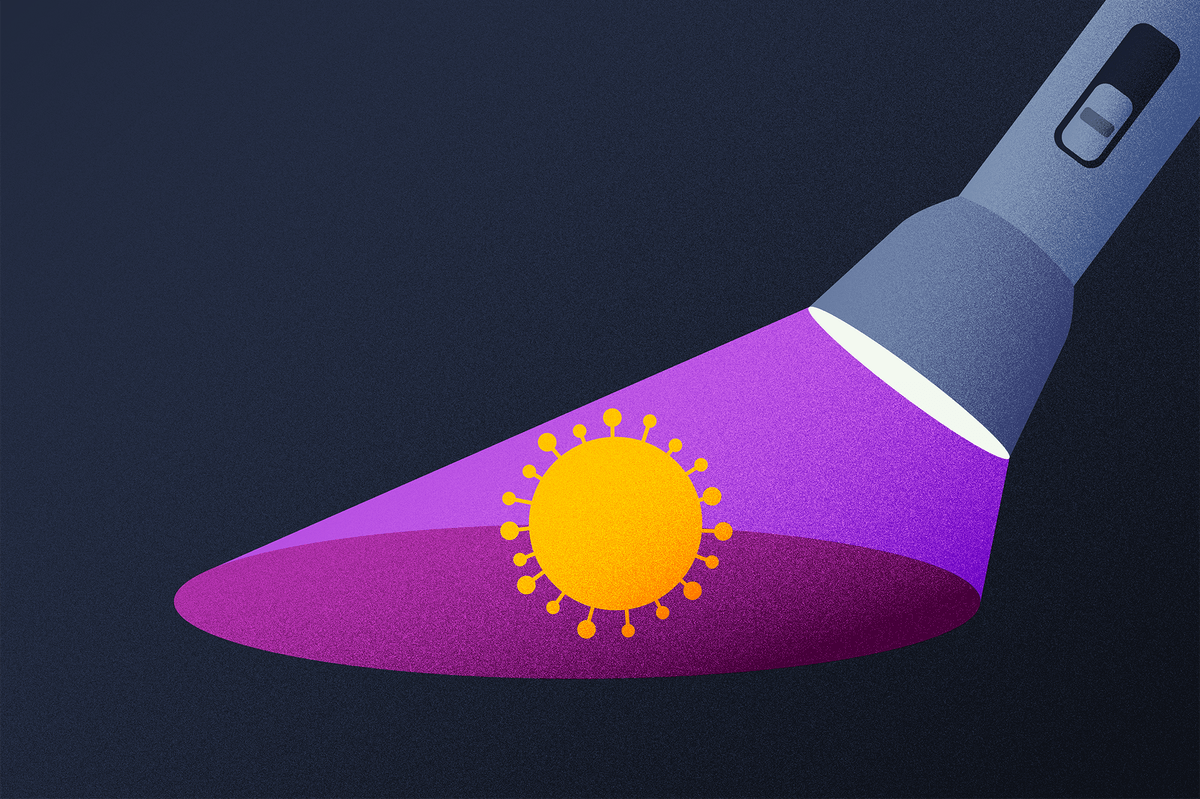
If you’ve ever gotten a sunburn, you’ve had a taste of how UV light kills viruses: UV light can damage DNA. A DNA molecule is made of two strands bound together by four bases, adenine (A), cytosine (C), guanine (G), and thymine (T). These bases are like an alphabet, and their sequence forms instructions for cells to reproduce.
UV light can cause thymine bases to fuse together, scrambling the DNA sequence and essentially throwing a wrench into the machinery. Since the DNA sequence is no longer correct, it can no longer replicate properly. This is how UV light annihilates viruses, by destroying their ability to reproduce.
Will it work on the coronavirus?
COVID-19 is a new breed, and as such there is a dearth of studies on its resistance to UV. That hasn’t stopped people from rolling out UV devices to thwart the virus, however. Companies that produce UV devices are seeing a notable boost in sales, and hospitals are using UV-equipped robots to disinfect hospital rooms; even face masks are getting the UV treatment.
We can look to previous coronaviruses, such as SARS and MERS, for insight. Studies on both SARS and MERS show that UV light could inactivate the viruses, so it’s not unreasonable to expect that it will have a similar effect on COVID-19.

That said, don’t warm your hands by the light of a UV lamp! As mentioned earlier, ultraviolet radiation can also damage human DNA, causing health problems such as skin cancer or cataracts in the eyes.
A particular spectrum of ultraviolet light, far UV-C, “efficiently inactivates bacteria without harm to exposed mammalian skin,” according to a study published in Nature. “This is because, due to its strong absorbance in biological materials, far-UVC light cannot penetrate even the outer (non living) layers of human skin or eye; however, because bacteria and viruses are of micrometer or smaller dimensions, far-UVC can penetrate and inactivate them.”
Research like this Nature study shows that far-UVC lamps can eradicate even airborne viruses without harming people, and so we can imagine a world in which walking through airport security or entering a hospital involves passing through a UV decontamination chamber.
For now, feel free to stick your phone in a UV-emitting cleaning chamber (and be sure to clean all your gadgets daily if you use them often) — but as for personal hygiene, you should probably stick to soap and water.