1. Home
  2. Trash
  3. News

Thanks to lidar, archeologists discovered a giant new Mayan ruins site

Add as a preferred source on Google
Promotional image for Tech For Change. Person standing on solar panel looking at sunset.
This story is part of Tech for Change: an ongoing series in which we shine a spotlight on positive uses of technology, and showcase how they're helping to make the world a better place.
 

Lidar is best known as the technology that enables self-driving cars to make sense of the world (and lately as the scanning tech that showed up in this year’s iPad Pro refresh). But the tech, which uses pulsed laser light to measure range, is also utilized in other ways — such as helping uncover ancient Mayan relics from the sky.

That’s what researchers at the University of Arizona in Tucson recently managed when they used an airborne lidar system to discover the oldest ceremonial ground in the Maya area in southeast Mexico. This turned out to also be the largest in the entire prehispanic history of the region — about 1.4 kilometers in length and 15 meters in height. Aguada Fénix, as it’s known, was constructed somewhere between 1,000 and 800 BC, according to a Bayesian analysis of radiocarbon dates carried out by researchers on the project. That pre-dates the construction of the Mayan pyramids.

“Lidar emits laser beams from an airplane,” Takeshi Inomata, professor in anthropology at the University of Arizona, told Digital Trends. “Some laser beams penetrate through tree canopies, and reveal the shape of the ground surface. The site was not known because it is so large horizontally that if you walk on it, it just looks like a part of natural landscape. Its rectangular shape became clear with the bird-eye view of lidar.”
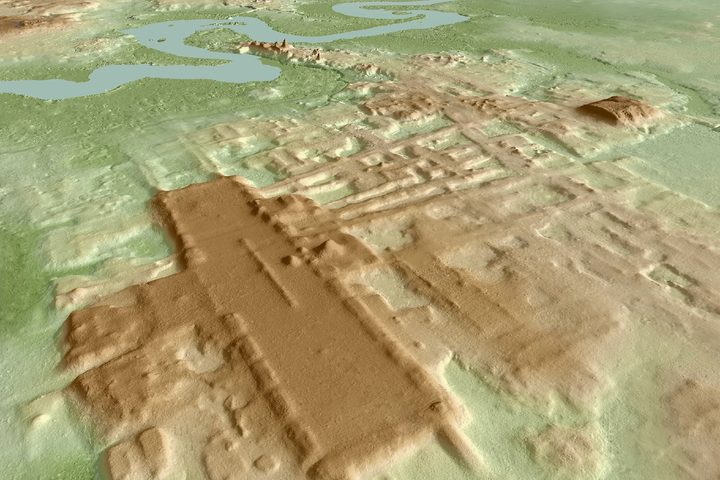
3D lidar map Mayan settlement
Takeshi Inomata

As Inomata points out, traditional mapping on the ground level would have taken significantly longer to carry out. Using lidar, however, they were able to create a 3D map of the surface by flying a plane overhead, while scanning the ground below. This helped reveal the enormous size of the site, which reportedly would have taken around 10 to 13 million person-days to construct and likely involved thousands of people moving up to 4.3 million cubic meters of earth.

This is not the first time lidar has played an important role in similar research. In 2016, scientists used airborne lidar to create a map of a long-lost city hidden beneath the jungle in Cambodia. Meanwhile, the Earth Archive — launched by two professors at Colorado State University — is an ambitious project that seeks to use lidar scanning to scan the entire planet to generate maps of cultural, geological, and environmental artifacts at risk in the face of climate change.

A paper describing the recent University of Arizona project was published in the journal Nature.

Luke Dormehl
I'm a UK-based tech writer covering Cool Tech at Digital Trends. I've also written for Fast Company, Wired, the Guardian…
The Digital Trends App Bundle is yours to try for a whole week, free
Digital Trends App Bundle

Recently, we've entered an exciting collaboration with Maple Media, creating a bundle of 17 apps worth having on your phone. From relaxed fun to serious productivity boosts, these apps cover all your bases and provide a fun boost to your phone. Normally, the bundle is $9.99 per month (far lower than the cost of using the apps individually), but for your first 7 days you can get access to the bundle for free. View the full Digital Trends App Bundle for a complete list of the apps, or read on for a summarized take.

Start your free trial

Read more
The Galaxy S26 Ultra might not see much of a battery upgrade after all
It looks like it will stay the same as the last five years.
The back of the Samsung Galaxy S25 Ultra.

What's happened? This week, China's Quality Certification Center released information about a battery (EB-BS04898ABY) with a maximum capacity of 4,855mAh. That's the same capacity as was previously seen in the Samsung Galaxy S25 Ultra, and fans have taken this certification to mean the Galaxy S26 Ultra will not see a capacity increase after all.

The Samsung Galaxy Ultra models have had the same battery capacity for the last five years.

Read more
The Galaxy Tab S10 Lite is official, and it’ll be here sooner than you think
Galaxy Tab S10 Lite

What's happened? Samsung has officially announced the Galaxy Tab S10 Lite, a budget-friendly alternative to the Galaxy Tab S10. The device has been rumored for months, but this is the first time Samsung has officially acknowledged its existence.

The Galaxy Tab S10 Lite will have a 10.9-inch display and a peak brightness of 600 nits — a bit on the lower side, versus the iPad Pro's maximum brightness of 1,600 nits.

Read more