For a long time, the most popular cultural conception of archery came from the likes of Robin Hood: Hollywood imaginings of medieval folk tales featuring technology no more complex than a simple wooden bow and corded bowstring. More recently, a generation corn-fed on Marvel movies has had a new go-to archery hero in the form of Hawkeye with his high-tech bow and arrow setup.
This, as it turns out, is more in line with what real sports archery — of the kind practiced at the Olympics — is like. While it may be lacking some of Hawkeye’s more outlandish gadgetry (no grappling hook or hacker arrows here), the archery tech that’ll be on display at the 2020 Tokyo Games is certainly closer to the high-tech MCU than the world of Robin of Locksley.
“Archery equipment has changed a lot from the wooden stick and string that most people picture,” Anjalie Field, an accomplished, certified level 3 USA Archery Coach, told Digital Trends. “Most high-end bows have very little wood and are primarily made of aluminum and carbon fiber. These materials are strong and light-weight, allowing archers to put a lot of pressure on them when pulling back on the string.”
Not your grandpappy’s bow and arrow

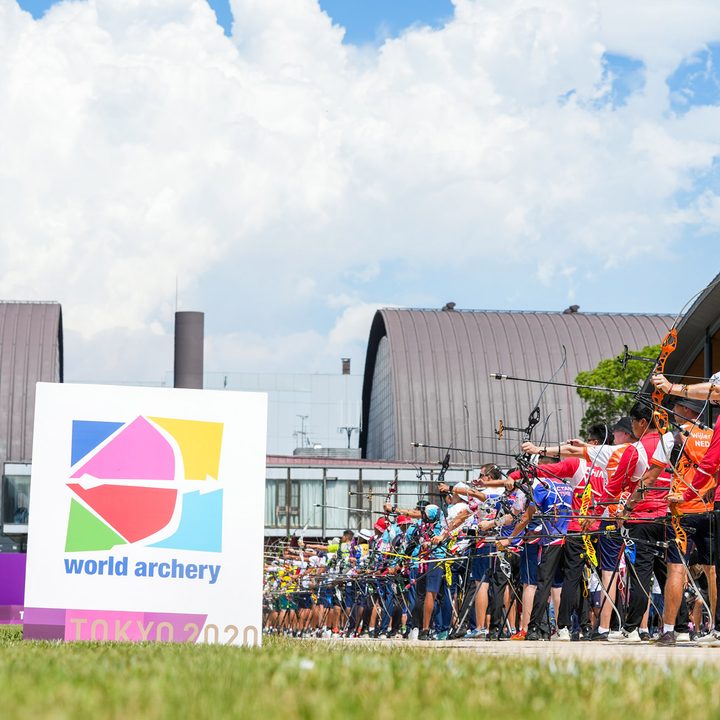
It’s not only the material of the bow that differs from the classical simplicity of the traditional yew longbow, either. For instance, archers are allowed to use a pistol-like sight scope for aiming. Wonder what those giant rods sticking out of the bow are when it comes to top-level archery equipment? “Those rods are called ‘stabilizers,’ and are, essentially, a stick with a weight on the end,” Field explained. “These weights add inertia, so it’s easier for archers to hold their bows steady while aiming. They also absorb vibrations when the archer releases the string.”
Popular bows include the likes of the Hoyt Prodigy and Hoyt Formula Recurve Riser. Their streamlined design offers the kind of precision you couldn’t dream of from a traditional bow and arrow. A top-of-the-line recurve bow can easily cost upward of $1,000.
For Olympic archery, virtually everyone uses arrows made of ultra lightweight carbon for shooting outdoors. The official Olympics archery target distance is 70 meters (230 feet) from the archers. For indoor archery, where targets are 18 meters (60 feet), aluminum arrows are popular, since they are “a little more forgiving,” although too heavy to travel far.
The gold standard (or, to be more accurate, high-strength carbon fiber bonded to a 7075 precision standard) arrows are called Easton X10s. These carbon fiber arrows, with a thin-wall aluminum core have been used to win every single Olympic Medal since the Atlanta Games in 1996. Even a quarter-century later, no significant advance has been made when it comes to topping these arrows.
The majority of archers don’t have genuine feathers on their arrows, but rather use plastic feathers they call vanes, which are lighter than feathers and waterproof. “In the Olympics, you’ll see most archers using arrows that have curly vanes,” said Field. “They are designed to encourage arrows to rotate in the air, which helps stabilize them and make them fly faster.”
The latest technology

For all the tech-induced changes that make the tools of the trade for Olympic archery a different beast to its antecedents, however, that’s nothing on the changes seen in bows used for hunting. These hunting bows are called compounds and boast a pulley system that makes it easier to pull back the drawstring and get maximum power. This, in turn, also makes it easier to hold the bow steady while shooting, thereby increasing accuracy. Heck, they can even use laser rangefinders. World championships exist for compound bows, but there is no Olympic division covering them.
Ultimately, though, Field said that anyone looking to get into archery for fun shouldn’t feel the need to automatically gravitate to the latest technology (or, at least, the best they can afford).
“A lot of people who are shooting for fun like using fun equipment, where it’s about doing the best you can with different types of bows and not about using the best equipment allowed by competition rules,” she said. “At one of the ranges where I worked, it was not uncommon for someone to walk with a traditional Mongolian horse bow, and a few times people came in with bows they carved themselves from trees in their backyard. You won’t hit as many bullseyes with equipment like that — but you’ll have a lot of fun!”