Wearable robot exosuits don’t have to look like the ones found in science fiction movies like Aliens or Live Die Repeat: Edge of Tomorrow. In fact, the ones which truly change lives for the better are more likely to look like the soft exosuit developed by researchers from Harvard and Boston University. Designed to be more minimalist in style, the soft robot exosuit was recently put through its paces to showcase how it could be worn by stroke patients to enable them to walk faster and further than they would otherwise be able to.
“For people with neurological conditions, wearable robotics hold great promise to restore mobility,” Lou Awad, one of the researchers on the project, told Digital Trends. “With soft robotic exosuits, our cross-disciplinary team has integrated clinical and engineering expertise to take a ‘less is more’ approach. Heavier device components — [such as] electronics, batteries, [and] motor — are all located in a small pack worn at the waist, leaving garment-like components and lightweight cables and sensors on the legs.”
The team’s wearable exosuit can be applied either to one or both legs. Awad noted that it is not a solution that can help patients who require full bodyweight support to walk. However, it could effectively augment the abilities of people who are already able to walk but need assistance — which is the majority of people post-stroke.
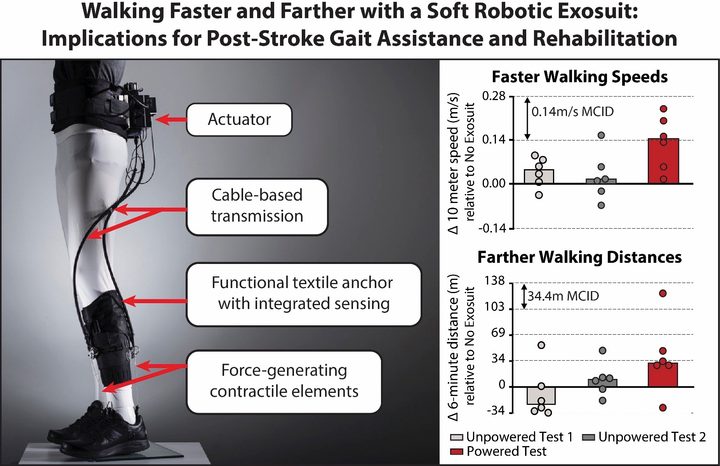
“Our first studies of the soft robotic exosuit technology were done in a motion capture laboratory and on an instrumented treadmill,” Awad said. “They focused on evaluating, in a controlled way, the effects on the mechanics of walking after stroke and the energy cost of walking. In [our latest] study, we took people with post-stroke hemiparesis out of the lab and tested how far and fast they could walk. The ability to walk faster and farther after physical therapy is an important outcome desired by both patients and clinicians, and the level of improvement that we saw in the small cohort included in our study exceeded our expectations.”
In the study, one of the participants wearing the suit was able to walk 100 meters farther than they would otherwise have been able during a six-minute walk test.
The researchers’ next plan to further develop the exosuit so that it can help to “retrain” people to walk in a way that will not require them to wear it indefinitely. An alternate approach might involve developing a smaller, less obtrusive version of the existing wearable.
A paper describing the work was recently published in the IEEE Open Journal of Engineering in Medicine and Biology.