1. Home
  2. Trash
  3. News

Now-retired Spitzer telescope produces one last breathtaking image

Add as a preferred source on Google

NASA’s Spitzer Space Telescope, which captured beautiful images of the sky for sixteen years, has produced one final image from data collected before it was retired earlier this year. It shows the California Nebula, located 1,000 light-years away from Earth.

Spitzer imaged in the infrared wavelength, meaning it could see through clouds of dust that would be opaque in visible light wavelengths. As structures like nebulae have large amounts of warm dust in them, being able to see through this gave a whole new view of what was going on inside.
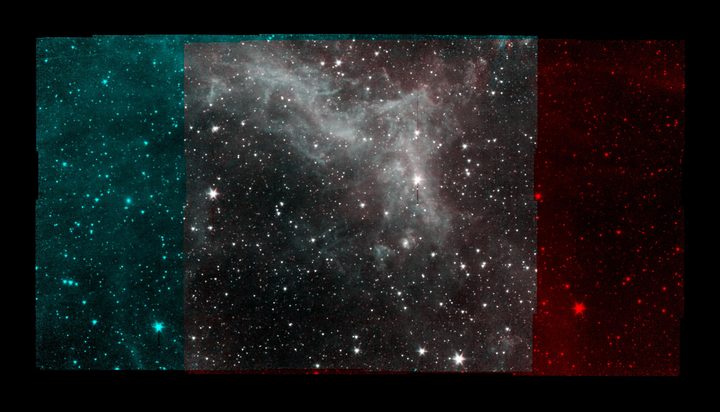
NASA's Spitzer Space Telescope took this image of the California Nebula on Jan. 25, 2020, five days before the spacecraft was decommissioned. The red and blue bands on either side of the image represent two different wavelengths of light; the gray area shows both wavelengths.
NASA’s Spitzer Space Telescope took this image of the California Nebula on Jan. 25, 2020, five days before the spacecraft was decommissioned. The red and blue bands on either side of the image represent two different wavelengths of light; the gray area shows both wavelengths. NASA/JPL-Caltech

This final image is a mosaic, showing images captured at different wavelengths. On the left, in the cyan section, the infrared light was captured at the 3.6-micrometer wavelength. On the right, in the red section, the light was captured in the 4.5-micrometer wavelength. In the middle, in the grey section, both wavelengths are combined to create an image that has more detail that could be achieved by imaging in any one single wavelength.

The images were captured on January 25 this year, just a few days before the telescope was officially decommissioned on January 30. The scientists managing the Spitzer project wanted to make the best use of the last days of the telescope, so they chose this nebula to image because it had not been imaged before and it has interesting features that were viewable in infrared.

Although the telescope will no longer be capturing any more images, it does leave behind a trove of publicly-accessible data which astronomers will be able to comb through to continue making new discoveries.

“Sometime in the future, some scientist will be able to use that data to do a really interesting analysis,” Sean Carey, manager of the Spitzer Science Center at Caltech, and one of the team members who chose this location to be imaged, said in a statement. “The entire Spitzer data archive is available to the scientific community to use. This is another piece of the sky that we’re putting out there for everyone to study.”

Georgina Torbet
Georgina has been the space writer at Digital Trends space writer for six years, covering human space exploration, planetary…
The Digital Trends App Bundle is yours to try for a whole week, free
Digital Trends App Bundle

Recently, we've entered an exciting collaboration with Maple Media, creating a bundle of 17 apps worth having on your phone. From relaxed fun to serious productivity boosts, these apps cover all your bases and provide a fun boost to your phone. Normally, the bundle is $9.99 per month (far lower than the cost of using the apps individually), but for your first 7 days you can get access to the bundle for free. View the full Digital Trends App Bundle for a complete list of the apps, or read on for a summarized take.

Start your free trial

Read more
The Galaxy S26 Ultra might not see much of a battery upgrade after all
It looks like it will stay the same as the last five years.
The back of the Samsung Galaxy S25 Ultra.

What's happened? This week, China's Quality Certification Center released information about a battery (EB-BS04898ABY) with a maximum capacity of 4,855mAh. That's the same capacity as was previously seen in the Samsung Galaxy S25 Ultra, and fans have taken this certification to mean the Galaxy S26 Ultra will not see a capacity increase after all.

The Samsung Galaxy Ultra models have had the same battery capacity for the last five years.

Read more
The Galaxy Tab S10 Lite is official, and it’ll be here sooner than you think
Galaxy Tab S10 Lite

What's happened? Samsung has officially announced the Galaxy Tab S10 Lite, a budget-friendly alternative to the Galaxy Tab S10. The device has been rumored for months, but this is the first time Samsung has officially acknowledged its existence.

The Galaxy Tab S10 Lite will have a 10.9-inch display and a peak brightness of 600 nits — a bit on the lower side, versus the iPad Pro's maximum brightness of 1,600 nits.

Read more