The U.S. Army tends to be a pretty high-tech, state-of-the-art kind of organization, which is why it’s no surprise to hear that it’s heavily involved with a cutting-edge emerging tech field like 3D printing. Even so, the scale of what it’s working on is pretty impressive.
According to a report from New Scientist, the U.S. Army is utilizing a giant, high-speed 3D printer for the production of large, “ultra-high-strength steel” components, such as armor, weapons, and even entire parts for military vehicles — to create instant spares near to the front line in combat situations.
This printer, commissioned from 3D Systems in South Carolina for a reported $15 million, is able to manufacture objects of up to a volume of 1 x 1 x 0.6 meters (3.3 x 3.3 x 2 feet). Its creators hail it as the largest, fastest, most precise steel printer that has ever been made.
While the first working prototype printer won’t be operational until this summer (pandemic complications notwithstanding), once it is fully operational it could be used to print steel alloy that is an impressive 50% stronger than the same material when forced or cast. That is due to the differing microstructure of the 3D-printed alloy, created by layering powdered metal and then fusing these layers together with a laser.
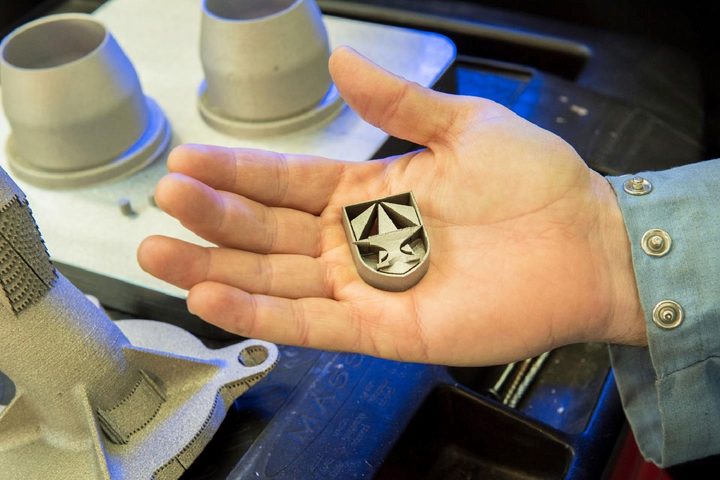
“Current commercially available laser powder bed printing machines have limited size for the build envelope which limits the applicability of the technology to a limited set of small — by Army standards — parts,” Dr. Brandon McWilliams, metals additive manufacturing lead at the Army Research Laboratory, told Digital Trends. “A larger format machine opens up a much wider range of applications for increasing capability of the Army through the benefits of additive manufacturing for everything from manned and unmanned ground vehicles to next-generation munitions, [such as] warheads, missiles, [and] hypersonics.”
McWilliams said that 3D printing gives the U.S. Army the ability to more rapidly develop new materials, evaluate novel designs, and transition new capabilities to the soldier. This ultra high strength steel is just one example of the unprecedented properties of 3D-printed materials, which can be used in various applications by the Army.
“This material allows us to decrease the amount of steel used in a part which reduces weight and cost while increasing performance,” McWilliams said.