  1. Home
  2. Wearables
  3. Emerging Tech
  4. News

L’Oreal’s fingernail wearable tells users when they’ve had too much sun

Add as a preferred source on Google

A team of engineers at Northwestern University have teamed up with cosmetics company L’Oreal to create a fingernail wearable that lets users know when they’ve had too much Sun. UV Sense is small enough to stick on your nail, simple enough to work without batteries, and sophisticated enough to record cumulative UV exposure to help wearers avoid skin cancer.

At last check, nearly 77,000 people were diagnosed with skin cancer in the United States, making melanoma the most common form of cancer in the country. It’s not hard to see why. We tend to worship the sun like ancient Egyptians, spending entire days basking in its rays, too often neglecting the fact that a dark tan can lead to cancer.
Northwestern University

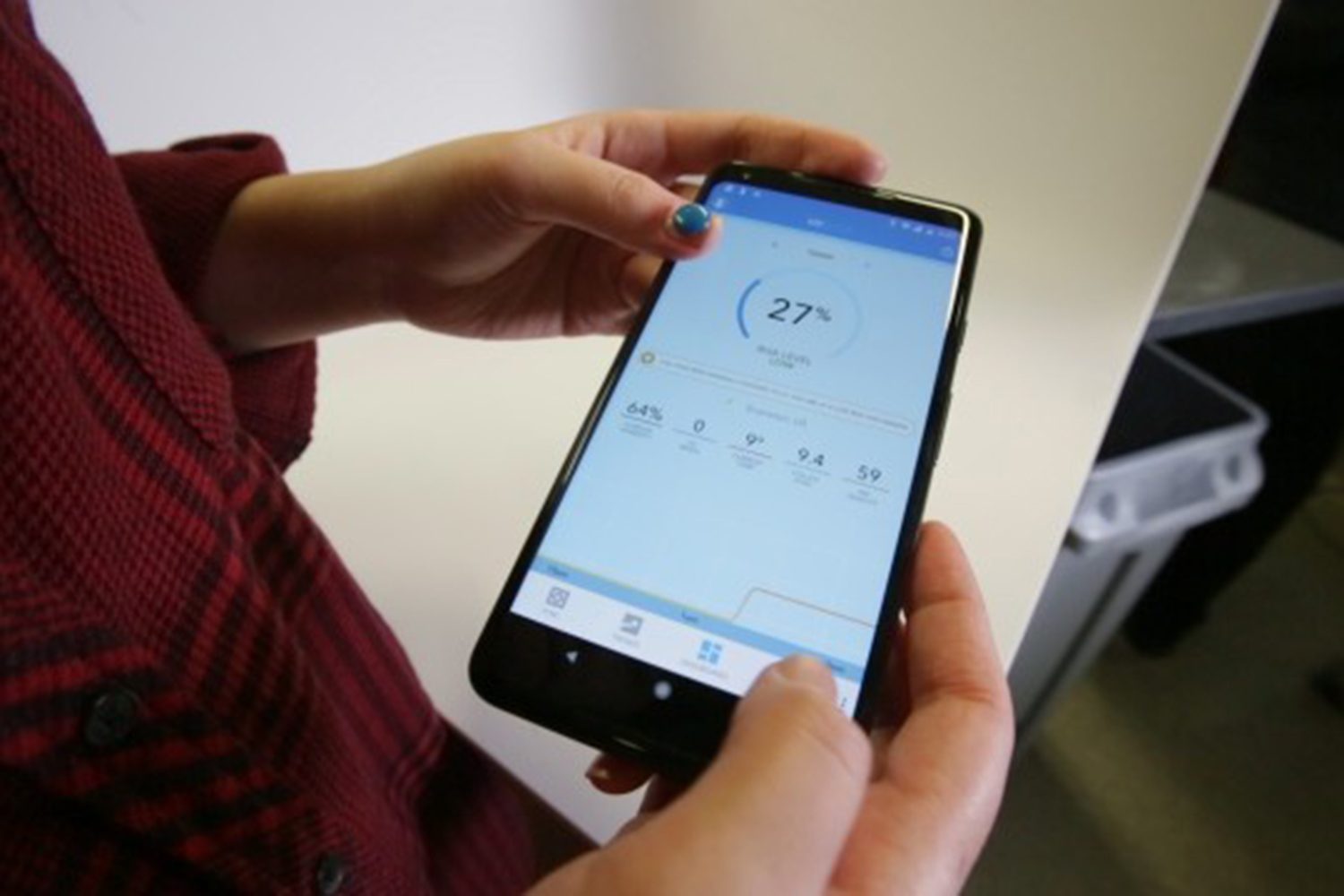
With UV Sense, L’Oreal wants to make monitoring UV exposure easy. No wider than a dime and as thick as an M&M, the solar-powered device has no battery, moving parts, or buttons. It sticks on your fingernail — or necklace, shirt button, or bracelet — and uses a sensor to measure UV exposure.

Recommended Videos

It’s not as feature-rich and flashy as most other wearables, but that’s kind of the point. Just stick it on and periodically swipe it over your phone, which wirelessly collects its measurements and shows them in an app, complete with a UV report and advice on how to avoid the sun. As a L’Oreal device, expect recommendations on L’Oreal products to purchase as well.

“UV exposure is so key to skin health and appearance,” John Rogers, a Northwestern engineer who led the technical development, told Digital Trends. “From a user standpoint, it’s hard to imagine anything simpler, in the sense that you never have to worry if you’re battery is charged up, since it doesn’t need one. There are no moving parts or buttons, and no physical interfaces to the device. It all happens wirelessly to the phone.”

One of the biggest challenges Rogers and his team faced in developing UV Sense was the antenna design and electronic circuit design that enable such a small device to interface with a phone. Solving those issues, “opened up the ability to mount technology in places that were previously not considered,” he said. Like the fingernail.

It also means Rogers and his research can experiment with other miniaturized sensors to monitor things like heart rate, respiration rate, blood oxygen levels. “You can do all of that from the nail,” he said.

UV Sense should be available in time for summer and will retail for under $50, The Verge reports.

Dyllan Furness
Former Contributor
Dyllan Furness is a freelance writer from Florida. He covers strange science and emerging tech for Digital Trends, focusing…
Sony’s new luxury headphones could fix the XM6’s biggest problem
Electronics, Headphones

We recently reported that Sony could be working on a new pair of premium headphones that might make even the AirPods Max feel relatively affordable. Now, fresh leaked renders shared by Steve H. McFly, in collaboration with Android Headlines, are giving us our first proper look at what’s reportedly called the ColleXion headphones. And honestly? They look very Sony. The Black and White variants instantly reminded me of the Sony WH-1000XM6, especially with the clean, understated design language. Sony seems to be leaning even harder into minimalism this time around, and personally, I think that works in its favor. A lot of headphones today try too hard to look futuristic or flashy. These, at least from the renders, feel far more refined and grown-up.

What is more interesting, though, is the hinge redesign. The XM6 received its fair share of criticism over hinge durability concerns, and according to the report, Sony is reportedly trying to address that with an entirely new hinge mechanism on the ColleXion. From the renders alone, the design does look noticeably different, so there is a good chance Sony is finally taking those complaints seriously.

Read more
Apple wants you to verify your identity before you get Education discount on products
Apple moving the US Education Store off the honor system also seems about making a globally consistent verification infrastructure that could eventually support more aggressive Education Store expansion.
Computer, Electronics, Laptop

Getting an Apple Education discount in the United States used to be as simple as claiming you’re a student or a teacher; it didn’t need a formal verification. That era is officially over. 

Starting May 8, 2026, Apple now requires formal identity verification for all Education Store purchases in the US, ending the informal honor system that was in place for years (via MacRumors). 

Read more
You can finally avail an education discount on the Apple Watch
It's Apple broadening its ecosystem play into a segment that previously had no wearable entry point, and that could meaningfully accelerate Apple Watch adoption among younger first-time buyers.
Side view of Apple Watch Series 11.

Apple’s Education Store has always been a reliable shortcut to cheaper Macs and iPads for students and teachers. However, for years, Apple Watch wasn’t allowed into the story, making people wait for third-party sales or discounts to get their hands on the smartwatch. 

That’s changing, with effect from May 8, 2026. Apple has quietly added the Apple Watch to its Education Store for the first time. The Watch Series 11, SE 3, and the Ultra 3 are now available at discounted education pricing across 21 markets, including the US, UK, India, Canada, and Australia. 

Read more