“Why you can trust Digital Trends – We have a 20-year history of testing, reviewing, and rating products, services and apps to help you make a sound buying decision. Find out more about how we test and score products.“
Gadgets today perform more than one job — our smartphones double as a camera, and our cars can even double as a smartphone. We get used to having such versatility from products we buy. On the other hand, eyewear traditionally does one job. It helps us see, or stops us squinting in the sunlight. However, choose the right pair of glasses from eyewear-maker Jins, and that changes. Jins has proven its tech credentials in the past with the Meme smartglasses, and the latest Jins Frontswitch is a pair of prescription glasses that performs three functions. The prescription lenses make sure we don’t bump into things; and they protect our eyes from both blue light and sunlight. For extra tech-cool, they are made by a robot.
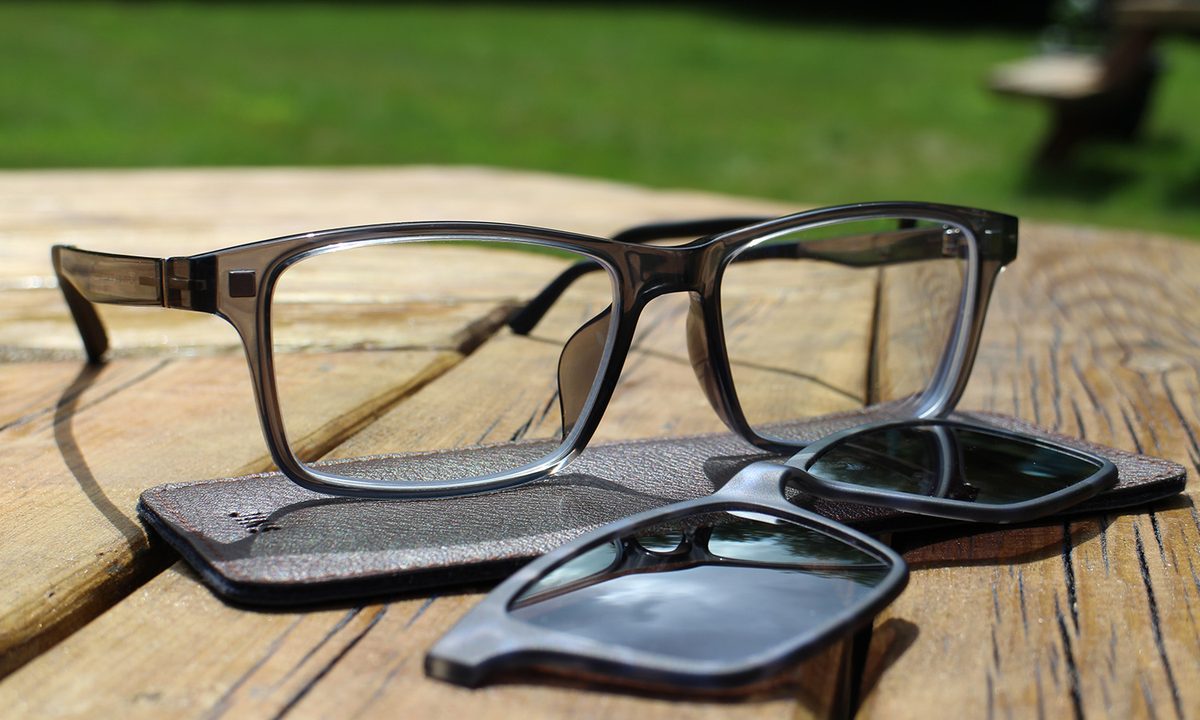
Clipping sunglass lenses over your eyeglasses isn’t new, but the experience has never been great. There’s usually a big, ugly hinged clip, or big, ugly magnets on the side of the frames. Jins wanted to streamline this method of wearing sunglasses, so it embedded tiny square magnets in the front of the arms. Here, they look like the pins that hold the arms to the frame itself, that we’re used to seeing already. Then, it slimmed down the sunglass attachment, and matched it exactly to the frame shape for a wonderfully seamless style.
It’s impossible to tell the Frontswitch aren’t regular sunglasses when the front panel is attached.
The magnets hold the sunglass lens cover in place, without the need for any external parts at all. The result is it’s impossible to tell the Frontswitch aren’t regular sunglasses when the front panel is attached. We chose to add the Jins Screen blue light filter to our Jins Frontswitch glasses, which block out 25 percent of the blue light emitted by our smartphones and other screens. Blue light causes eye strain, and can make it difficult to fall asleep naturally if you’re using a device at night. Combined, the Frontswitch protects our eyes in two situations, and the prescription lenses correct our faulty vision.
Our Frontswitch glasses came from Jins store in San Francisco, which is important, as that means they were made by Kanna, the name given to the company’s lens edging robot. The conveyer-belt like ‘bot automates the lengthy task of producing prescription lenses, and the time it takes to produce a pair falls to just 30 minutes when Kanna’s in control. Store visitors get to see Kanna in action, and benefit from the incredibly speedy process at the same time.

Versatility and a cool robot doesn’t mean anything if the glasses are uncomfortable, or the sunglass panel falls off in a stiff breeze. So what are the Jins Frontswitch like? The frames are plastic, and we chose the grey Frontswitch 371 design, which has a smoked, see-through look in real-life. The arms have a grippy, textured coating at the end which stop them slipping. But the arch didn’t sit on the bridge of our nose, which did mean the oversize grip sections on either side did most of the “holding” — resulting in the glasses feeling a tiny bit heavier than expected.
We love the look of the Frontswitch 371 design, and liked the sunglass panel’s different contrasting finish, giving them more style and a look most of us want from sunglasses. The magnets are strong enough that the sunglass panel won’t fall off, but not so strong that you have to use both hands to take it off. The mirrored surface looks excellent, and provided plenty of protection when out in the sun. The Jins Screen blue light protection does add a slight tint to the regular lenses, but nothing that’s distracting. It’s difficult to say if we noticed an improvement in sleep patterns; but if you’re really worried about it, there’s the Jins Screen Night lens coating, which blocks out 60 percent of blue light.
The Jins Frontswitch have been a hit with everyone that has seen them.
The sunglasses are super light, and although they do add a little weight to the front, it’s never uncomfortable. However, they did slip forward a little more often than normal eyeglasses. I took the Jins Frontswitch along to an optician, who had expressed an interest in seeing them when I collected my prescription ahead of ordering. She was familiar with all the other sunglass attachment methods, and was genuinely impressed with Jins’ method, describing it as an exceptionally neat solution. Other people who I’ve shown have also been surprised at the convenience, and commented on the invisibility of the attachment system. The Jins Frontswitch have been a hit with everyone that has seen them.
Anyone who wears glasses will know the pain of swapping them over for a pair of prescription sunglasses many times a day. You still have to do some swapping with the Jins Frontswitch, but there’s no messing around with cases, you can do it with one hand, and there are no moments between-glasses where you can’t see — important if the transition is taking place when you’re driving. It’s a simple solution to a problem most glasses-wearers encounter, and adding in the blue light protection makes them even more attractive to tech fans concerned their smartphone love is ruining their sleep.
Jins Frontswitch glasses start at a very reasonable $150 with the standard, clear lenses, and are sold through the company’s stores or online. Adding the Jins Screen protection takes the cost to $210, which is the version we tested, and that includes shipping. There are various other lens options, including polarised lenses, and coatings suitable for people who do a lot of driving.
We love Jins’ approach here. There’s no need to be satisfied with third-rate options, or be forced to buy a pair of regular glasses, a pair of sunglasses, and a third pair of glasses for looking at a screen at night. The Frontswitch does it all-in-one. The tech-world often talks about “disruption,” a hateful buzzword attached to noisy companies doing something to shake-up an established industry. Jins is much more subtle, yet deserves similar plaudits.