  1. Home
  2. Wearables
  3. Emerging Tech
  4. News

New voice ID system reads throat vibrations to determine who’s speaking

Add as a preferred source on Google

We live in a world in which technology that can recognize and respond to spoken words, whether it’s smart speakers like Google Home or dictation services on our PCs, is an everyday matter. But while there have been attempts to make systems that will respond only to one person’s voice, these are not infallible.

That’s an issue that a new research project carried out at the University of Michigan sets out to resolve. Investigators there have created an authentication technology called VAuth, which promises accurate person-specific voice recognition that no talented impressionist, recording or voice-mimicking A.I. is going to be able to get past. It does this via a wearable accessory — which currently takes the form of either a necklace, ear buds, or a glasses attachment — and that uses an accelerometer to measure the subtle skin vibrations in a person’s face, throat, or chest when they talk. It’s these vibrations, combined with the sound, which then provides a unique identifier for each person. In other words, it doesn’t just confirm that these are your own words, but that they are emerging from your own throat, too.
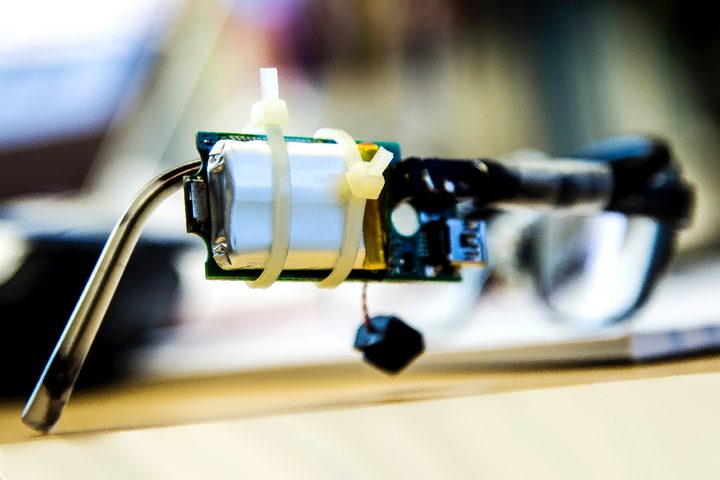
Image used with permission by copyright holder

“VAuth does not rely on voice identification, rather it complements voice identification technologies by providing a physical assurance using the vibrations collected from the user’s body,” Kang Shin, a professor in the electrical engineering and computer science department, told Digital Trends. “That’s a departure from relying only on a voice biometric which, similar to a fingerprint, is not easy to keep protected. From a few recordings of the user’s voice, an attacker can impersonate the user by generating a matching ‘voice print,’ such as WaveNet from DeepMind. In such a case, the users can do little to regain their security as they cannot simply change their voice.”

Recommended Videos

In tests involving 18 users and 30 different vocal commands, VAuth was able to demonstrate an accuracy of 97 percent, regardless of a person’s accent, language, or whether they were moving at the time. It also fended off tests to spoof it — such as playback of a person’s actual voice or impersonations.

“There are already many commercial voice assistant products and services, and we expect a lot more to come in future,” Shin continued. “A solution like VAuth is therefore essential. We have built a prototype using off-the-shelf components, which were not designed for our purpose, and tested the VAuth functionality and accuracy. [Next] we are planning to commercialize VAuth. To this end, we are planning to miniaturize the device, and conduct a more thorough evaluation for its robustness and accuracy for various use-cases and environments.”

Luke Dormehl
I'm a UK-based tech writer covering Cool Tech at Digital Trends. I've also written for Fast Company, Wired, the Guardian…
Apple wants you to verify your identity before you get Education discount on products
Apple moving the US Education Store off the honor system also seems about making a globally consistent verification infrastructure that could eventually support more aggressive Education Store expansion.
Computer, Electronics, Laptop

Getting an Apple Education discount in the United States used to be as simple as claiming you’re a student or a teacher; it didn’t need a formal verification. That era is officially over. 

Starting May 8, 2026, Apple now requires formal identity verification for all Education Store purchases in the US, ending the informal honor system that was in place for years (via MacRumors). 

Read more
You can finally avail an education discount on the Apple Watch
It's Apple broadening its ecosystem play into a segment that previously had no wearable entry point, and that could meaningfully accelerate Apple Watch adoption among younger first-time buyers.
Side view of Apple Watch Series 11.

Apple’s Education Store has always been a reliable shortcut to cheaper Macs and iPads for students and teachers. However, for years, Apple Watch wasn’t allowed into the story, making people wait for third-party sales or discounts to get their hands on the smartwatch. 

That’s changing, with effect from May 8, 2026. Apple has quietly added the Apple Watch to its Education Store for the first time. The Watch Series 11, SE 3, and the Ultra 3 are now available at discounted education pricing across 21 markets, including the US, UK, India, Canada, and Australia. 

Read more
Whoop’s response to Fitbit Air and Google Health is real doctors, not just an AI chatbot.
In the race to own your health data, Google chose an AI, and Whoop chose a doctor. That single decision may define which fitness tracker serious health users reach for in 2026 and beyond.
A person wearing the Whoop 5.0.

Recently, Google launched the Fitbit Air as a direct rival to the Whoop screenless fitness band, rebranded the Fitbit app to Google Health, and released a Gemini-powered AI coach. Exactly one day later, Whoop has responded with on-demand video consultations with licensed clinicians for US users. 

The contrast is hard to ignore. While Google is betting on AI as your general health advisor, Whoop is doubling down on real, licensed doctors, and making the case that they can serve its fitness-focused users considerably better (via CNBC).

Read more