  1. Home
  2. Emerging Tech
  3. News

‘Largest structure in the universe’ undermines fundamental cosmic principles

Add as a preferred source on Google

Just in time for the hype surrounding No Man’s Sky, the game that takes cosmic scale to the extreme, a team of astronomers say they’ve discovered what might be the largest structure in the observable universe. The tremendous feature consists of nine gamma-ray bursts (GRB), forming a ring that is streaking across some 5 billion light years through space, according to a paper published in Monthly Notices of the Royal Astronomical Society.

“We were totally surprised…we did not expect to find it.”

Recommended Videos

The ring’s diameter stretches more than 70 times that of the full moon as seen from Earth. And, as the GRBs each appear to be about 7 billion light years away, the probability that these features are positioned in this way by chance is just one in 20,000, according to lead author Professor Lajos Balazs from the Konkoly Observatory in Budapest.
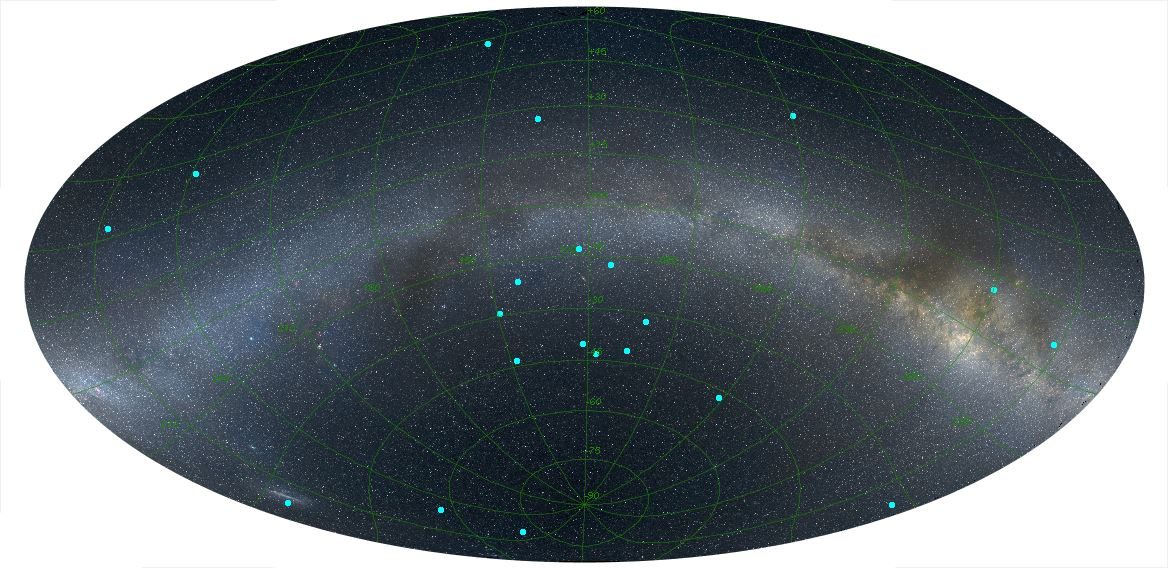
Image of the distribution of gamma-ray bursts (blue dots).
Image of the massive feature as a distribution of gamma-ray bursts (blue dots). L. Balazs

Amazingly, the team of astronomers discovered the cosmic ring by accident. “Originally, we studied the space distribution of gamma ray bursts,” Balazs told Digital Trends. “GRBs are the most energetic transients in the universe and the only observed objects sampling the observable universe as a whole. In general, we were interested to conclude whether the universe is homogeneous and isotropic on large scale.

“We were totally surprised,” he added, “because we did not expect to find it.”

However, there are reasons to step back and reconsider the discovery — it seems to undermine our established understanding of how the universe developed.

“We still don’t quite understand how it came to exist at all.”

According to the cosmological principle, the structure of the universe is uniform at its largest scale and its largest structures are theoretically limited to 1.2 billion light years across. This new discovery pushes that limit nearly five-fold.

Balazs and his team used telescopes in space and observatories on Earth to identify the structure. They will now investigate whether the cosmological principle and other processes of galaxy formation can account for the ring structure. If not, theories about the formation of the cosmos may need to be rewritten.

“If we are right,” Balazs commented in a press release, “this structure contradicts the current models of the universe. It was a huge surprise to find something this big – and we still don’t quite understand how it came to exist at all.”


Dyllan Furness
Former Contributor
Dyllan Furness is a freelance writer from Florida. He covers strange science and emerging tech for Digital Trends, focusing…
DeepSeeek V4 is out, touting some disruptive wins over Gemini, ChatGPT, and Claude
An open-source model that beats GPT-5.4 on Codeforces and costs a fraction of Claude isn't just a news story; it's a pricing ultimatum to the entire AI industry.
DeepSeek AI chatbot running on an iPhone.

China’s DeepSeek has a habit of showing up, uninvited, to Silicon Valley’s AI party, and this time, it has done so with the long-awaited V4 preview. The Hangzhou-based company has released its latest AI model, which beats popular American models in certain areas. 

DeepSeek has launched two new models: V4-Pro (Expert mode) and V4-Flash (Instant mode). While the former is a massive 1.6 trillion parameter model, the latter is at a more manageable 284 billion parameters. However, both of them have a one-million-token context window. 

Read more
The days of ugly solar panels could finally be over. Say hello to artsy colorful tiles!
These colorful solar panels can blend into almost any building.
ShadeCut-solar-panel

Solar panels are great for the planet, but have long been a headache for architects, homeowners, and historic preservation boards. That tension between sustainability and aesthetics may finally have a real solution.

Researchers at the Fraunhofer Institute for Solar Energy Systems ISE in Germany have developed a technology called ShadeCut, which applies colored, patterned films to solar modules that can convincingly mimic roof tiles, masonry, or even custom logo designs.

Read more
Sony’s table tennis robot made me think about what happens when AI gets a body
Ace starts as a flashy sports demo and quickly turns into a preview of AI moving from screens into factories, hospitals, farms, and homes
Ball, Sport, Tennis

I wanted to dismiss Sony’s table tennis robot as another expensive lab flex. A machine that can rally against elite players is impressive, sure, but it also sounds like the kind of demo built to make executives clap in a room where everyone already agreed to be impressed.

But table tennis is a nastier test than it looks. The ball is small, fast, spinning, and rude enough to change direction the moment it hits the table. Sony’s system faces something less forgiving than calculation. It has to see, predict, and act before the point is gone.

Read more