It’s been a year since Tesla boosted its solar catalog with new panels that blend into your roof with no visible hardware. The low-profile panels have been coming out of the Panasonic factory in Buffalo, New York, at Tesla’s Gigafactory 2 since the summer of 2017. Now, Electrek reports, the first of these roofs have been installed, and better yet, is connected to the grid and fully functional.
The panels are rated at 325 watts and will be in addition to, not a replacement for the 160- to 250-watt panels Tesla has available from other manufacturers. At full capacity, the solar system is rated at 9.85 kW, and a customer recently took a screenshot from his Tesla mobile app showing that the system was producing 5 kW and sending 300 watts to the house, while simultaneously charging the Tesla Powerwall at a rate of 4.7 kW.
According to Tesla, these new panels “exceed industry standards for durability and lifespan.”
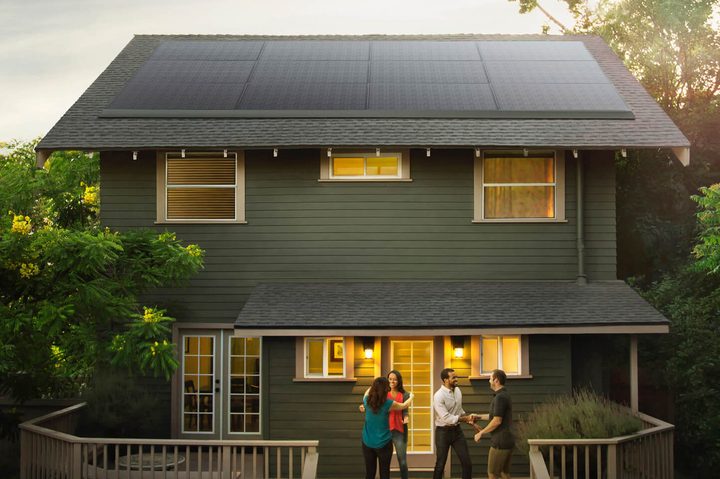
Tesla’s new solar panels will achieve their sleeker, low-profile look with integrated front skirts. The skirts help conceal the panel mounting hardware so the whole installation does not draw attention to itself.
Older style solar panels with their bulky, industrial appearance and time-consuming installation technologies gave Tesla’s Solar Systems Product Design team a ripe opportunity to rewrite the rule book for rooftop solar.
Daniel Flanigan, the team’s senior director, was a co-founder of Zep, a company SolarCity purchased before last year’s SolarCity acquisition by Tesla. Zep’s original team, many of whom still work with Flanigan, worked on mounting systems focused on faster, better looking, and less expensive solar panel system installations.
Tesla’s strategy in building a mega company around the concept of renewable energy has been in improving each of the component parts technically and aesthetically with a constant emphasis on cost efficiency. Tesla’s focus on aesthetics for solar panels plays well with what had previously been ugly, cumbersome solar boxes. The masterful aspect of the new panels is they not only look better than older models, they are also designed to ease and speed up installation.
Tesla wants to add solar energy harvesting to every home. The vision includes Tesla solar roofs announced in the fall of 2016 for new or replacement roofs and these low-profile panels for roofs that don’t need replacement to collect the sun’s energy. The further extension of the energy vision is connecting a Tesla Powerwall in every home to store the energy harvested by the solar roofs or panels. Thus far, that vision appears to be coming to fruition.
Updated on April 4: The first Tesla solar panel roofs have been installed and are working.