
Chalk it up to a misspent youth watching movies like Tron and The Lawnmower Man if you want, but the concept of scanning real people into the digital world still seems excitingly futuristic.
Over the years, 3D scanners have gotten much better at creating the three-dimensional models of real-world objects needed to make this technology mainstream. It’s been used for smaller inanimate objects and at disappointingly low resolutions, however. Germany’s Fraunhofer Institute for Applied Optics and Precision Engineering hopes to change that with a new device that promises to render people and objects in higher resolution, taking multiple three-dimensional images per second.
“We developed a high-resolution 3D scanner with a resolution of 1,000 by 1,000 pixels at 36 3D images per second,” Dr. Kevin Füchsel, Head of Department Strategy and Marketing for Fraunhofer Institute, told Digital Trends. “To avoid light irritations for humans, we developed an NIR [near-infrared spectroscopy] system, consisting of two near-infrared cameras, one camera for color information, and a specially developed NIR projector. One of the main challenges was to create images continuously without a break. Now we’re able to create the impression of a moving 3D color image in high-resolution to the viewer.”
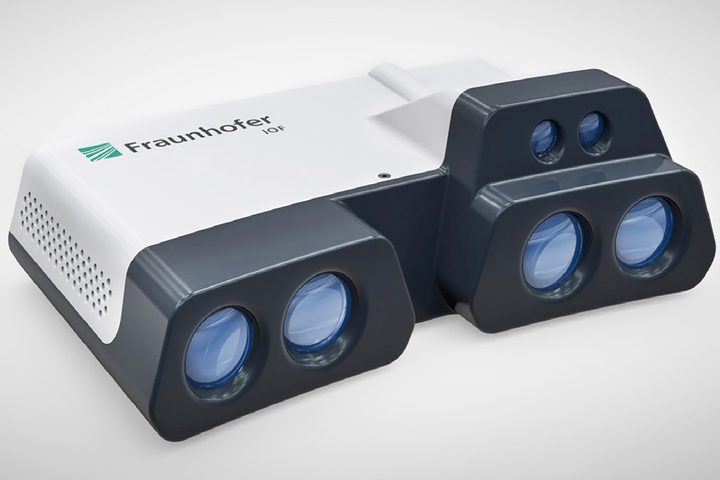
Fraunhofer’s scanner doesn’t use lasers like a lot of 3D scanners but instead employs an invisible near-infrared pattern that is projected onto the object or person for scanning. This mesh of different points of measurement is then sent back to the cameras so that the information can be used to quickly construct a 3D digital image — a process that takes mere milliseconds.
That tech is similar to the way Microsoft’s Kinect device works but promises to be a lot more precise than the infrared 3D scanners used in video games — with a moving resolution of 1 million pixels and some extra smart real-time data processing.
Video games sound like one possible application for the technology, but Füchsel said that the possible use-cases go way further.
“At the moment, we are focusing on three application scenarios,” he said. “In the field of medical rehabilitation try to develop a system which could indicate whether the patients perform exercises correctly or incorrectly. The second scenario will be in the field of human-machine interaction. Robots or highly autonomous systems would be able to detect gestures and facial expression and could respond to humans in a more natural way. Due to the irritation-free systems, our system also matches perfectly in the field of security technologies, especially biometric body characteristics.”
No price has been announced yet, but a demo unit is set to be shown off at the Stuttgart Control Trade Fair next week.
“Next steps will be the further miniaturization of the whole system,” Füchsel explained. “We are also looking forward to our real-life tests within this year, especially with our partners in the field of medical rehabilitation.”


