Monday is an important day for many people across the world, and in the United States in particular. An exceedingly rare event has occurred, and it’s sure to capture the imagination of millions. Yes, that’s right – Intel has released the details of its 8th-Gen Intel Core launch.
Oh, and there’s also a total eclipse.
Joking aside, Intel’s announcement is a big deal. The company says its new processors are up to 40 percent faster than those before it. Karen Regis, Intel’s mobile marketing manager, boasted of the figures, and wasn’t afraid to drop a pun to make her point. “This is a huge gain […] it will eclipse anything in the industry,” she said during a press call, adding “this is arguably a once-in-a-decade kind of a leap.”
It is, indeed, a huge gain – much larger than any generation-over-generation improvement announced in the past five years. How did Intel achieve it? Simple. They added more cores.
Four cores are better than two
Intel only spoke about four specific processors, which we’ve arranged into a table for your browsing pleasure. The processors are all part of the U-Series, which is Intel’s line of mainstream laptop chips. You’re probably familiar with the U-series, even if you don’t know it. The chips power most modern laptops – if yours is a dual-core, it’s probably from the Intel U-Series.
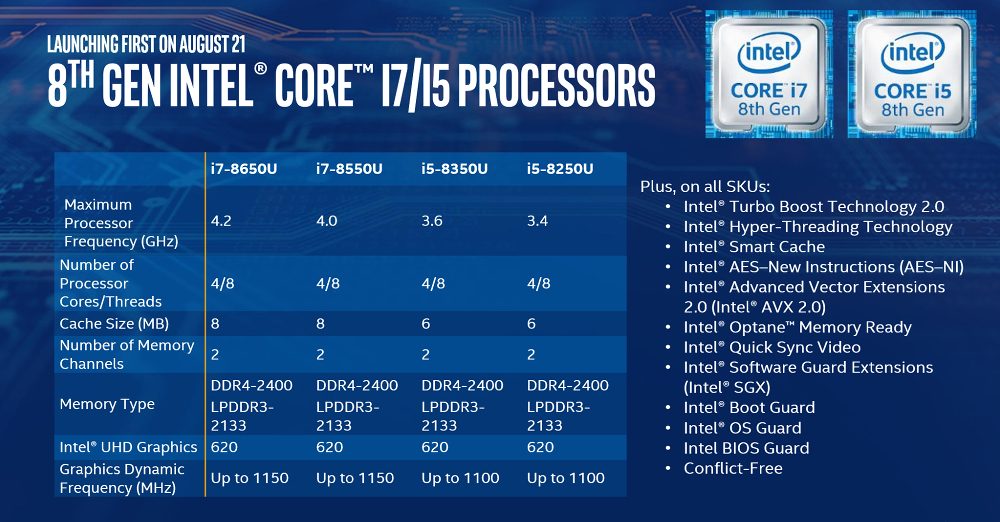
Intel’s 8th-generation Core for mobile isn’t a difficult upgrade to understand. The company has doubled the core count of its basic U-Series hardware. Everything else is essentially the same. Maximum processor speeds remain high, Intel UHD 620 graphics remain standard, and the chips still fit within a 15-watt Thermal Design Power.
That last bit is important, because it means these new quad-cores will theoretically fit into the same designs as 7th-gen dual-cores. One leak ahead of the announcement suggested we’ll see the new quad-core processors in Dell’s XPS 13, one of the smallest 13-inch laptops on the market. That’s a big change. Previously, quad-core processors were mostly found in big laptops. Systems like the Razer Blade and Dell XPS 15 were as small as quad-core laptops could be.
A laptop based on 8th-generation core, then, should look and function just like one based on the 7th-generation core. It’ll just have two more cores – and be a lot quicker as a result.
Simplicity hides complexity
Intel’s simple lineup makes the relevance of this announcement easy to understand. Double the core count is going to mean big gains in multi-threaded applications, which are the most demanding you might run. It’s most of what makes the “up to 40 percent” performance improvement possible, though Intel insists that production and architecture tweaks have helped, too.
The simple lineup obscures coming complexity. While Intel did not announce any desktop processors during the call, or confirm any details about the platform 8th-gen Intel Core desktop chips will run on, the company did say that the new generation will be a mixture of chips based on the Kaby Lake+ architecture, and chips based on the Coffee Lake architecture.
If you’re confused, that’s because it’s confusing. In the past, Intel has tried to make its line-up easier to understand by tying the generation of the Core brand to architecture updates. No matter your level of PC hardware knowledge, upgrading from a 2nd-gen Core to a 4th-gen Core meant you were leaping forward two architectural generations.
Intel started to abandon that simplicity with its fastest chips, which often cranked up the core count on older architectures instead of using the newest. The recently announced Intel Core X-Series, for instance, uses both the older Skylake architecture and the newer Kaby Lake architecture, depending on the chip. Skylake debuted as 6th-generation Core, but with the X-Series, it’s found in 7th-generation processors.


It appears that strategy will become mainstream. Intel’s statements at least suggest we’ll see a combination of Kaby Lake+ and Coffee Lake chips branded as 8th-generation Core, though only the latter of the two represents a major step forward in architecture.
For now, the new 8th-generation quad-core chips use the same architecture, and are built on the same manufacturing process, as the previous 7th-generation hardware. The branding has moved forward, but the architecture has not. Intel’s justification is based on performance. A 40 percent gain is massive, and the company says it’s worth branding as a new generation.
More coming this fall
Monday’s announcement is just the beginning. As usual, Intel will be slowly rolling out the new generation across a variety of devices.
The first laptops based on Intel’s 8th-gen Core processors will be announced in the coming weeks. We expect many of them will appear at IFA 2017, and be available in September or October. If history proves a guide, most systems will be high-end laptops priced at $1,000 and above.
That will be followed by additional announcements in the fall. Intel said we can expect to hear more about Coffee Lake, as well as 8th-gen for desktop, which heavily hints that desktops will be first to receive the new architecture.
Intel also confirmed that the new generation will bring its Optane storage to laptops. However, we won’t see laptops with Optane until spring 2018.
Small launch, big changes
Intel’s launch of the 8th-gen Core is more of a timid step forward. Only four processors have been revealed, they won’t be available in laptops until at least September, and they won’t use a new architecture.
Despite that, this launch is a big deal for two reasons. First, it shows that Intel is fully embracing many-core processors as the future, with quad-core becoming the new standard. That seems an obvious response to AMD’s Ryzen, which also relies on many cores for high-end performance.
Second, it represents a complete abandonment of previous engineering and marketing cadence. Intel is no longer trying to make every update an architecture change, and it’s no longer trying to match architecture changes up to the launch of new Core generations.
Taken together, the latest information confirms what was already suspected — Intel is heading in a new direction. Instead of showcasing architectural changes, it plans to lean heavily on branding. Each generation of Core will include a variety of hardware. That will make the specifics of each chip harder to figure out. Intel clearly thinks that consumers won’t mind — so long as their laptops are quicker than ever before.