Tech firms don’t understand what makes us want to buy a watch. It’s not the latest Qualcomm processor, it’s not a heart-rate sensor, and it’s not a complex calendar app to help plan your day. We buy a watch because of how it makes us feel when wearing it. A watch — in fact, any wearable device from glasses to brooches — is a piece of jewelry. We wear it because it makes us feel good.
Tech is notoriously bad at replicating the emotion we get from a painstakingly well-chosen piece of clothing or accessory, yet the fashion and tech worlds continue to clunkily converge, just with little impact. Almost no-one is getting it right, and it’s because manufacturers haven’t made a smartwatch that tugs at our heart strings like it should.
Where is the, “Absolutely, positively, really, must-have-it” smartwatch? It seems such an obvious thing, so why is it proving so difficult?
Tech is impersonal
Time to roll out the excuses. The first one is that old standby: It’s a piece of tech, and it’s never going to be personal. The rationale is your smartphone, fridge, TV, and almost every other product you plug in or charge up has been mass produced, and is therefore one-in-several-million. There wasn’t much love put into its creation, and it almost certainly wasn’t hand-crafted by an artisan with skills passed down from generation to generation, in a century-old atelier somewhere in Switzerland. It has no soul. How, then, could you hope to form an attachment to it?
Personality has become a marketable selling point for smartphones.
I don’t accept this. Yes, it applies to your fridge, because unless you’re deranged, Samsung doesn’t expect you to fall in love with it. It will come as no surprise to any company that we can form attachments to the more personal items, however, particularly things we wear. Hardly a trade secret. It just seems so ripe for exploitation.
What’s more, personality has become a marketable selling point for smartphones and Internet of Things hardware over the past couple of years, due to the rise in virtual assistants. Whether it’s the Rock hitting his goals with Siri, or Alexa waking us up with an amusing alarm call, tech companies want these products to be a part of the family.
We’re being pushed into a relationship with our tech this way, yet all the while the same industry is searching for a way to get us buying wearable tech. The understanding is there. Why then, isn’t there a range of smartwatches we’re rushing out to buy?
It’s because smartwatches don’t have a use
The problem lies with how smartwatch projects are being greenlit. The general public is apparently confused about why they would need, or want, smartwatch. It’s not just regular people either, Huawei’s CEO said exactly the same thing, and apparently questions his team when they present a new smartwatch idea, challenging them to provide a, “tangible need” for the device. He’s correct in doing so, but isn’t yelling the right question at the engineers. Hint: It has absolutely nothing to do with a “need.”
Fulfilling a need is an engineer’s dream, and the tech way of doing things. Conjure up a list of features, and needs everywhere will be satisfied. Wrong. Digital Trends Editor in Chief Jeremy Kaplan correctly said recently, “manufacturers will need to concentrate on people, not products,” to grow the wearables market. He suggested devices need to solve a specific problem, or enhance our lives. He’s right, but care is needed because this can easily lead to us all being buried under a list of newly proposed features. Let’s be very clear: Features are not the answer.
Learn from the masters
People’s desire, not needs, are the answer. A smartwatch should be something we can’t stop ourselves wanting to buy. We see it, we love it, picture it on our wrist, and start counting out the pennies until it’s ours. For that to happen, tech companies need to learn from the masters in Switzerland. Swiss watchmakers get it right because they understand that presentation, design, and — you’ve guessed it — desirability sells the product, not features. Yes, horologists will bang on about heritage and movements; but most people don’t really care. They care about it looking good, and making their heart beat a little faster. They want that all important dopamine fix.
A better question may be, when’s the last time you saw a smartwatch you wanted to buy at all?
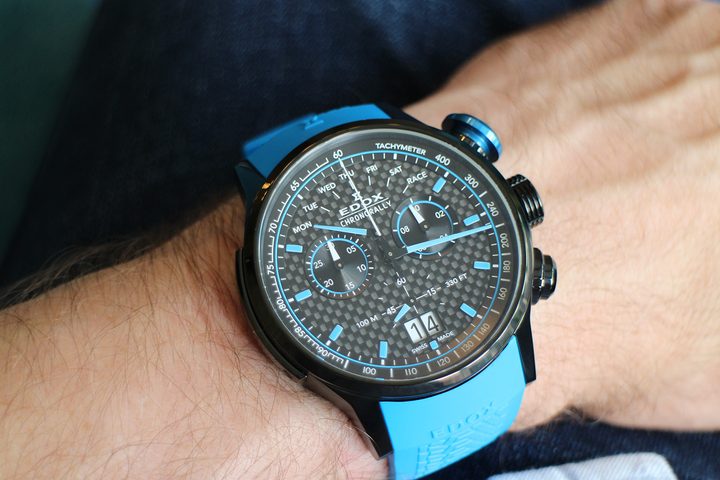
I know only too well. I attended Baselworld 2017 earlier this year, where I saw hundreds of watches, both smart and analog. Of the many I saw, one in particular stayed in my mind. The Edox Chronorally wasn’t the most expensive I saw, or the cheapest; but it felt right when I handled it, and I adored the way it looked on my wrist. The color was “me,” it’s a limited edition which appeals to my inner collector, and it has just the right amount of tech-cool about it to keep me interested. After wearing it just for a few moments five months ago, I now own one. I got to choose the limited edition number, it arrived in a huge presentation box, and I have been treated as nothing but a valued customer by the company.
Have you seen a smartwatch and still wanted to buy it five months later? A better question may be, when’s the last time you saw a smartwatch you wanted to buy at all? The answer shouldn’t be never, because ultimately, a smartwatch and an analog watch are very closely related. We don’t need either, so we should be presented with ones we just desperately want. Tech companies need to chat more with Swiss watchmakers, and there’s plenty the Swiss watch industry can , so it’ll be a fair knowledge swap.
We’re getting closer
To me, there’s absolutely no good reason why a smartwatch can’t be a buying decision made with the heart. Made, designed, and marketed correctly, a carefully considered smartwatch has the same chance of success as any number of “proper” watches. Don’t start on about handing it down to future generations either. Fashion analog watches — from Swatch to Armani, by way of Diesel and Invicta — sell by the truck load, and arguably they have an equally limited “lifespan,” just due to the high-fashion design, rather than battery life.

Montblanc, Movado, Porsche Design, Louis Vuitton, and various other companies have made smartwatches. They’re fine, but they’re still pushing tech ahead of style. They’re also monstrously expensive for what is a relatively ordinary product. Where’s the excitement? I’m supposed to crave the joy of wearing one of these watches, not feel like I’m buying a new edition of Microsoft Office. I want Swiss style with a beautiful high resolution touchscreen, some sapphire glass, a properly stylish body, a selection of straps, and enough power to smoothly run the operating system. No pointless garnish, no rubbish software features. Spend the money on design and materials please. So far, only Tag Heuer comes close.
Cool designs, smashing presentation, and drop-dead good looks sell products. When we put them on and feel great, we associate that confidence with that device. It encourages us to wear it, and to buy another one in the future, often from the same company. GPS tracking and wrist-made contactless payments aren’t selling points for watches. They’re selling points for phones. The sooner tech companies understand this, the more people will be tempted to buy a smartwatch.