
Lane-keeping assist and lane departure warning are electronic driving aids that help keep your car in a straight line. While that sounds easy, these technologies are helpful on narrow roads, or during a long and tedious drive. They’re becoming increasingly common, too; you no longer need a six-figure budget to get a car with either (or both).
Here’s what they do, how they work, and the difference between the two.
Lane-departure warning: What to look for
Lane-keeping assist and lane departure warning are industry terms for tech that focuses on keeping a car from drifting out of its lane. Lane departure warning systems merely alert the driver when the car is leaving its lane, while lane-keeping assist actually works to keep the car from moving out of the lane. These systems are often bundled with tech that performs other functions, such as adaptive cruise control and autonomous emergency braking.
Lane departure warning systems scan the road to determine where the lane markers are. If the car drifts over these markers, the system lets the driver know, usually by beeping or displaying a warning message on the dashboard. It’s then up to the driver to take corrective action. If you’re looking to buy a car and want to know if it’s available with lane-departure warning, you can check the National Highway Traffic Safety Administration’s (NHTSA) safety ratings.
Lane-keeping assist takes things a step further by allowing the car to steer itself in the right direction. Some systems apply the brakes on one side of the car to try to nudge it into the correct position, but many newer systems use steering. The amount of steering input can range from gentle nudges meant to guide the driver, to full-on interventions. Some automated steering systems — like the ones offered by Mercedes-Benz and Porsche, among others — follow gentle curves on highways or initiate lane changes.
Because the capabilities of this tech vary from system to system it’s important to know the limitations of your particular car before relinquishing lane-keeping duties to the machines. And while some cars can steer themselves to a limited degree in certain situations, remember that none of this tech comes close to fully-autonomous driving. These are assists meant to make driving safer, but they are no substitute for an attentive human driver.
Lane-departure warning: Who does it best?
Honda

Lane-keeping and lane departure warning are bundled into the Honda Sensing suite of driver-assistance systems currently available on most of the Japanese automaker’s models. But Honda goes a step further than most with its Road Departure Mitigation System. This detects when a car is drifting close to the side of the road without a turn signal activated, and applies both steering and braking inputs to keep the car from going off the road. Certain models also get Honda’s LaneWatch system, which adds cameras to the passenger-side exterior mirror. Anytime the driver signals right, a video feed from the camera is displayed on the car’s dashboard screen, thus increasing visibility. However, Honda is expected to discontinue this feature in favor of cheaper blind-spot monitoring.
Infiniti

Nissan’s luxury brand gets the prize for the most complex solution to lane-keeping tech. Infiniti’s Direct Adaptive Steering system actually severs the connection between the steering wheel and the road. This drive-by-wire system can work with lane-keeping assist to make minor steering corrections to keep the car centered in its lane. This also gives the steering an alien feel when you actually want to be in control. Interestingly, Infiniti also offers automated lane centering as part of the ProPilot Assist system, but not in combination with Direct Adaptive Steering. Infiniti models either have one system or the other.
Mercedes-Benz
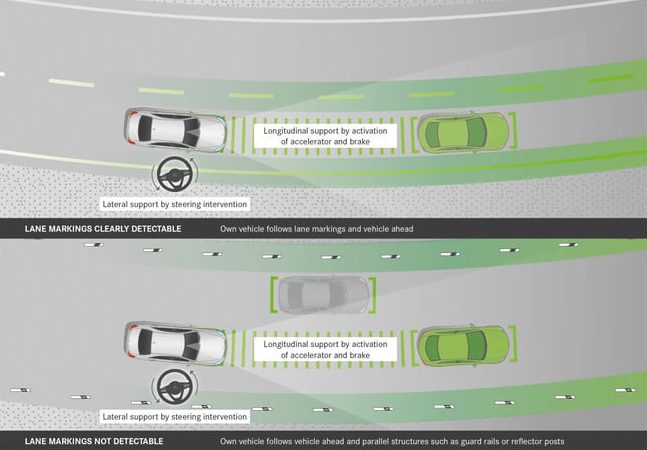
Mercedes offers a lane-keeping assist system that brakes individual wheels to herd a car back into its lane. But the German automaker also has a steering-assist system that can keep a car centered in its lane through steering inputs. The system works at speeds of up to 124 miles per hour, on both straight sections of road and gentle curves. It primarily relies on lane markings, but it can also “follow” the vehicle in front of you. The blind-spot monitoring system on some Mercedes models will also try to steer the car back into its lane if the driver moves over while another car is in his or her blind spot.
Tesla

A steering-assist feature that keeps the car from veering out of its lane is one facet of Tesla’s much-discussed Autopilot system. Autopilot allows the car to make significant steering inputs, although Tesla advises drivers that they should be ready to take over at all times. While most systems are meant to keep the car in its lane, Autopilot can also help when its time to change lanes; it can execute automated lane changes at the flick of a turn signal.


