  1. Home
  2. Phones
  3. Apple
  4. Mobile
  5. News

Is Apple really slowing down old iPhones to make you buy a new one?

Add as a preferred source on Google

It’s one of the oldest conspiracy theories in tech: Every time Apple releases a new version of iOS, there are complaints from users that their older model iPhones are slowing down. And they speculate that Apple intentionally slows down older models to incentivize users to upgrade to newer, more expensive models. The concept of planned obsolesce is nothing new, and has been around since long before smartphones. While there is a grain of truth to the theory in general, a new study proves it false in the case of Apple.

TechCrunch reports that Futuremark, the maker of numerous pieces of benchmarking software, has concluded a years-long test involving more than a hundred thousand iPhones, and the data refutes the old rumors that Apple is deliberately slowing things down.

Recommended Videos

Futuremark tests involved the Phone 5s, 6, 6s, and 7 and found that there was no evidence of deliberate slowdowns. In the case of the iPhone 5s, which was released in 2013, GPU and CPU performance remained consistent from iOS 9 to the recently released iOS 11. There were some minor variations, but those all fell within normal ranges.

In the case of the other models, GPU performance remained consistent over time, but there was a slight drop in CPU performance. Futuremark noted that these could have been influenced by iOS updates, but stressed that normal users would be unlikely to notice them in regular use.
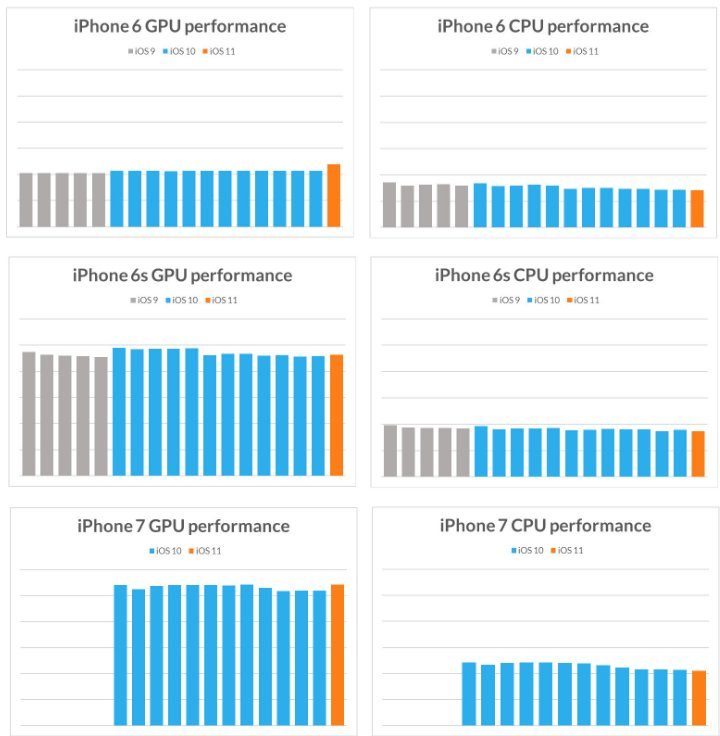
Image used with permission by copyright holder

As far as the origins of these rumors, Futuremark offered a few theories. For starters, apps may be one of the biggest contributing factors to actual slowdowns. Older apps might not optimized for the newer version of iOS, resulting in less optimization. On the other hand, apps designed for new devices might not run as well on older smartphones though that is on the app developers rather than Apple.

Futuremark did concede that one area in which iOS updates may be responsible for slowdowns is the addition of new features. New versions of iOS may add new features that take up more processing power, causing older phones to slow down.

Overall, however, Futuremark concluded that rather than slowing down their old devices, Apple was actually doing a good job of supporting them by providing updates which maintain a consistent level of quality across multiple versions of the OS.

Eric Brackett
Former Digital Trends Contributor
Google Photos on Android finally gives your custom stickers a home
A new dedicated Stickers folder in Collections saves every custom sticker you create, so you never have to hunt for them again.
Google Photos Stickers folder on phoneGoogle Photos Stickers folder on phone

After debuting a nifty sticker-creating feature on iOS last year, Google Photos extended it to Android users this February. The feature lets you quickly create stickers with a simple long-press gesture, making it incredibly easy to share custom stickers with friends and family. Now, Google is adding one more layer of polish to the experience: a dedicated folder that automatically stores every sticker you've ever made.

Where to find the Stickers folder

Read more
Leaked Pixel 11 wallpapers hint at what color options you’ll likely get to choose from
The full wallpaper collection for the Pixel 11, Pro, Pro XL, and Pro Fold has leaked, offering clues about the colorways Google may announce at launch.
Google Pixel 10 Pro in the official silicon case

The Pixel 11 series isn't due until August, but a steady stream of leaks has already revealed details ranging from design to specs across all four upcoming devices. The latest addition gives us a look at the wallpapers Google may ship with the lineup, and they offer a strong hint at the color options likely at launch.

A toned-down palette across the board

Read more
Got a missed call from an unknown number? Malwarebytes’ new free tool will tell you if it’s a scam
With $21 billion stolen from Americans last year through phone scams, a free no-friction reverse lookup removes the guesswork entirely.
Business Card, Paper, Text

Missed calls from unknown numbers used to be easy to ignore, but now they’re harder, especially since scammers spoof real local numbers and clone familiar voices with AI. Malwarebytes has launched a direct answer to that problem.

A free, standalone reverse phone lookup tool that tells you whether a number is safe, suspicious, or a known scam, so that you don’t call it back unnecessarily. It’s called Scam Number Check and it is available now at malwarebytes.com/scam-check/phone. The best part is that you don’t need an account or subscription to access it. 

Read more