  1. Home
  2. Computing
  3. Gaming
  4. Virtual Reality
  5. News

The Pimax 8K VR headset isn’t actually 8K, but it’s still pretty cool

Add as a preferred source on Google

Sometimes it feels like CES is all about big numbers — whoever plants their flag in the biggest, most impressive spec, wins. Pimax is a Chinese startup company which made waves in 2017 with its virtual reality headset that it claimed was the first 8K VR headset. The promise of the highest-resolution VR experiences won over nearly 6,000 backers invested more than $4.2 million into the Kickstarter campaign.

Here at CES 2018, we got to try out the newest iteration of the company’s VR headset. It still promises an 8K resolution, but now includes head-tracking technology this time around, which was missing in previous models.

Recommended Videos

Before we move any further, it is important to point out the marketing trick being used surrounding the phrase “8K VR headset.” The actual resolution of the headset is a pair of 3,840 x 2,160 LCD displays. Now if you add those up, you might get 8K — but as we all know, that’s not how 8K or virtual reality works! So while the marketing might be a little suspect, the experience of VR in the two 4K displays is certainly still something special.

We tried out the popular VR app TheBlu, which puts you into a deep sea environment. What we noticed right away was just how incredibly crisp the images were. It was most noticeable when something like a massive jellyfish floated right by our vision. The amount of detail you can make out in VR really is stunning. But the resolution isn’t actually the most exciting thing about Pimax’s VR headset: It’s the field of view.

At 200 degrees, it’s got the widest field of view of any VR headset we ever used. Compared to other premium headsets, the wider view makes it feel like you’re much more present in the scene, and less like your looking through a black box. The human eyes’ natural field of view is 220 degrees, so the Pimax headset gets closer to that experience. The result is quite impressive.
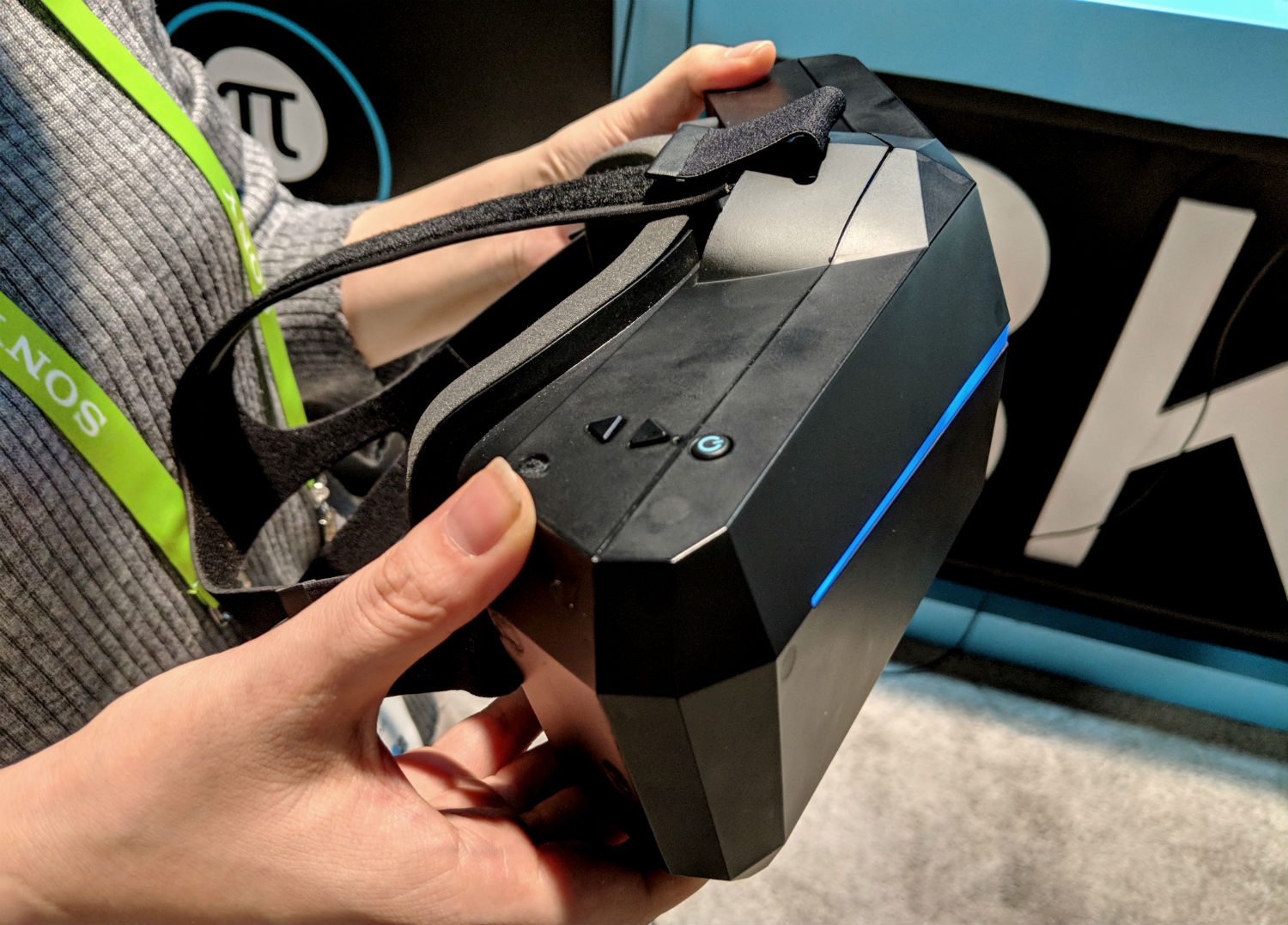
Image used with permission by copyright holder

The closest competitor in terms of pure specs was also announced this year at CES: The Vive Pro. On its high-end Vive, HTC bumped the resolution to 2,880 x 1,600, which still doesn’t quite hit 4K. Furthermore, its field of view is only 110 degrees.

All that said, it should be noted that the Pimax still very much feels like a prototype. The head strap is a made of a stretchy rubber, which was probably a cheap way to make sure it fits heads of most sizes. The trade-off, of course, is comfort. Compared to something like the Vive Pro, the Pimax headset is definitely not the kind of thing you want to have on your face for long periods of time.

Pricing and shipping details for the Pimax 8K headset have not been announced, but shipments for the Kickstarter backers are currently set for May.

Luke Larsen
Former Senior Editor, Computing
Luke Larsen is the Senior Editor of Computing, managing all content covering laptops, monitors, PC hardware, Macs, and more.
These new Alogic displays are basically a touchscreen Mac workaround
Alogic’s Studio Display alternative gives Mac users touch and stylus support
Computer, Electronics, Tablet Computer

Apple still has not released a touchscreen Mac, though macOS 27 Golden Gate suggests the company is at least preparing its desktop software for more touch-friendly interactions. Until that turns into actual Mac hardware, Alogic is trying to fill the gap with a new lineup of external displays that bring touch and stylus controls to macOS and Windows setups.

The company unveiled the products at InfoComm 2026 in Las Vegas, including the Fokus wall-mounted touchscreens, Aspekt Touch 27-inch monitor, Folio portable displays, and Active Stylus. Windows users have had plenty of touchscreen monitor options for years, but Mac users usually need extra software to get similar behavior from an external display. Alogic says its software allows users to tap through the interface, mark up content, draw, and use a stylus on supported screens.

Read more
After social media ban, AI bans could be next for school kids
Norway is restricting AI in schools, and other countries could follow
Generative AI

Artificial intelligence is rapidly becoming part of everyday life, and that includes classrooms. Students are turning to tools like ChatGPT for homework, research, writing assistance, and even basic questions. But a growing number of educators, researchers, and policymakers are questioning whether introducing children to AI at such a young age could do more harm than good.

Norway appears to agree. The country has announced a near-total ban on generative AI tools for elementary school students, arguing that children need to develop fundamental reading, writing, and math skills without relying on AI. The move could become an early sign of a broader trend, especially as governments around the world take a tougher stance on children's use of technology.

Read more
Asus just priced its RTX 5080 gaming laptop higher than a last-gen RTX 5090 model
The last-gen RTX 5090 model is actually $200 cheaper on Amazon.
Computer, Electronics, Laptop

Asus has quietly added an RTX 5080 option to the ROG Zephyrus G16 (2026) for buyers in the US, and it is priced at $4,799. 

That’s odd because last year's ROG Zephyrus G16 with a more powerful RTX 5090 is currently sitting on Amazon for $4,599. Somehow, Asus has priced a less powerful GPU at a higher price than its predecessor with a better GPU.

Read more