
While the media has spent the last few years gushing over OLED TV tech, Samsung has steadfastly pushed the advancement of conventional LED/LCD TVs through its own take on the format, QLED. By using quantum dot technology to wring performance out of LCD panels that rivals OLED, Samsung has managed to create a highly competitive line of TVs, distinguishing itself from its competitors.
Samsung full line of 2018 QLED TVs is extremely impressive.
Notably, Samsung’s 2017 flagship TV, the Q9F, was the best LCD TV we had seen. Until now. At a global launch event in New York, Samsung unveiled its full line of 2018 QLED TVs, and, once again, we find ourselves extremely impressed. In fact, we think Samsung’s 2018 Q9F has what it takes to be the best TV of the year.
What makes this year’s line of QLED TVs so special are some significant improvements to picture quality. While an excellent line of TVs, the 2017 QLEDs still suffered the same poor off-angle performance and compromised black levels common to all LED/LCD TVs. But this year, it is starkly apparent Samsung has cracked a code no other TV manufacturer has managed to decipher.
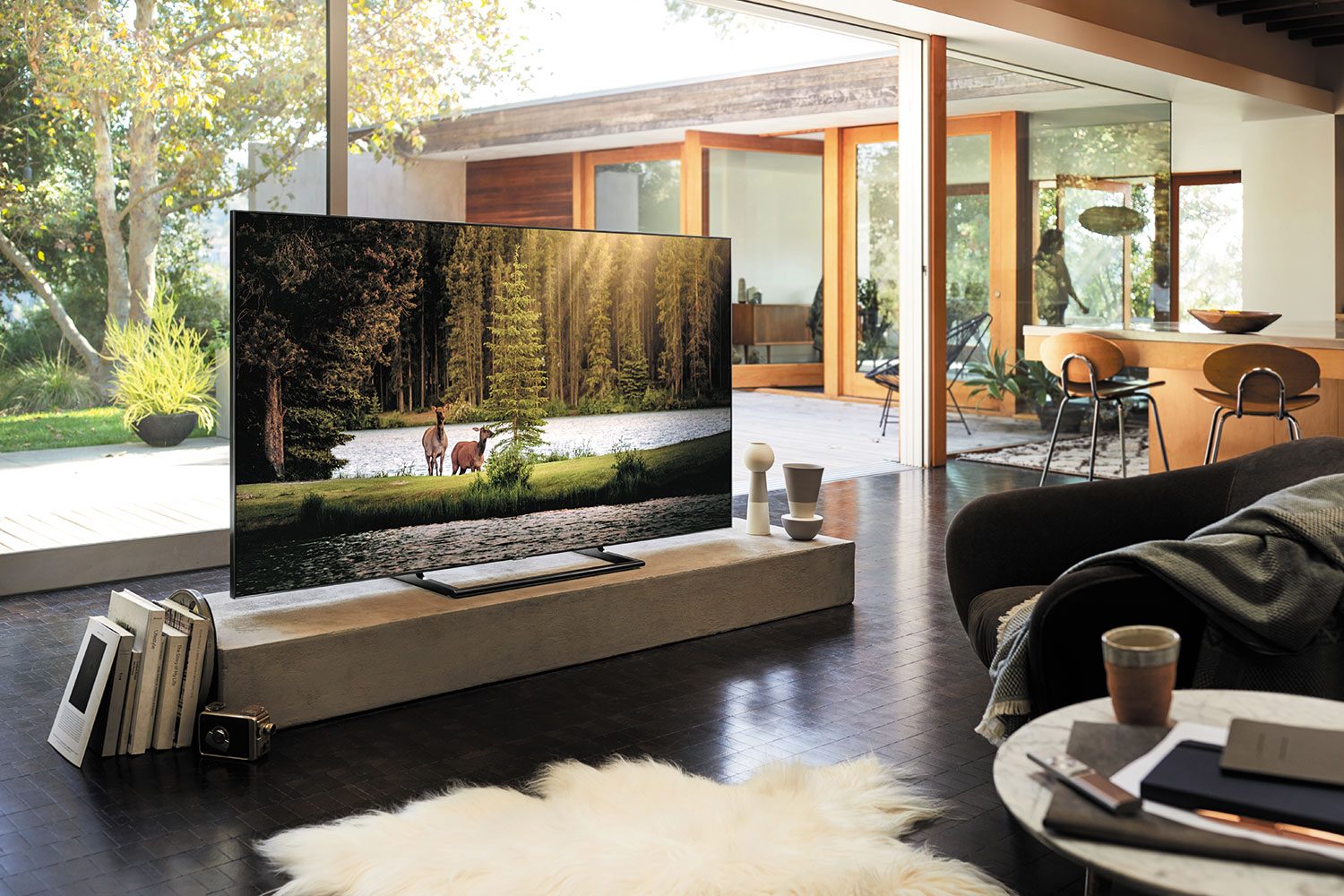
The 2018 QLED TVs exhibit off-angle performance and black level performance which come dangerously close to OLED, while maintaining distinct advantages in the areas of luminance and color brightness. In short, they are the most impressive LED/LCD TVs we’ve ever seen, and while we do our best to show them off in our video above, you’ll need to see the 2018 QLED line in person to believe it yourself.
A rival to OLED
Aside from picture quality, Samsung has also improved on what we consider to be the most user-friendly TV line on the market. Last year saw the introduction of the Samsung One Invisible Connection cable, a nearly invisible fiber-optic signal cable which allowed users to connect all components to a stand-alone One Connect box, then run the video signal through a fishing line-like cable which virtually disappeared on the wall or could be easily run through a wall for an extremely clean installation.
There is literally one connection point with the TV and it is virtually invisible.
Our only complaint was that the TV itself still needed to be plugged into a power outlet. This year, Samsung has folded power into its One Invisible Connection wire, meaning there is literally one connection point with the TV, and it is, again, virtually invisible. The One Invisible Connection cable is now also available in a 15-meter length (approximately 49 feet), making it possible to install components far away in a closet or adjacent room.
The out-of-box setup experience has also been improved. Not only will QLED TVs automatically detect the sources connected to them — be it a cable box, game console, or Blu-ray player — and instantly program the remote to control those devices, but the TV virtually sets itself up.

Owners of Samsung phones or those who have Samsung’s Smart Things app installed on their devices will find the TV is automatically detected and monstrousto Wi-Fi with no need to enter password information. This hands-off setup experience will continue to the QLED TVs built-in apps as well, as the TV detects various apps like YouTube and Hulu (and eventually Netflix and others) installed on the user’s device and automatically logs the TVs apps in — again, no need to go through the hassle of inputting usernames and passwords.
For as beautifully designed as Samsung’s 2018 QLED TVs are, the company has gone to great lengths to make it possible for them to virtually disappear. A chameleon-like feature called Ambient Mode is included in the QLED line which allows the TV to mimic its surroundings on-screen.
In a demonstration at the First Look event, a Samsung phone was used to take a picture of a QLED TV and the brick wall around it. After a moment of processing, the TV rendered a copy of the wall color and texture on-screen, allowing it essentially disappear into the wall.
Samsung says fine color and texture control can be made by users to get the exact look desired. The TV can also overlay weather information, news, or photos — and the photos look like real photo prints, not a televised version of a digital photo.
Other new features include a Universal Guide which lets you browse through streaming apps and live TV in one convenient place, as well as Bixby voice capabilities and compatibility with Samsung’s SmartThings app, which allows for integration with smart home devices.
2018 QLED TV lineup details
The QLED line includes the Q9F, Q8F, Q7F, Q7C (a curved variant) and the Q6F. The Q9F and Q8F offer full-array local dimming, while the balance of the QLED lineup use edge-lighting technology and are therefore slightly slimmer in form. The entire QLED TV lineup includes anti-reflective technology which increases off-angle picture performance and black level performance. All QLED TVs will support HDR10 and include processing to wring HDR-like performance from non-HDR sources.


The Q9F flagship is available in 75- and 65-inch screen sizes, while the Q8F will come in 55-, 65-, and 75-inch screen sizes. The Q7C will include 55-, and 65-inch offerings, while the Q7F will come in 55-, 65-, and 75-inch variants. The Q6 will start at 49-inches and ramp all the way up to a monstrous 82-inch model.
The Q9F will also be compatible with a custom Samsung wall-mount which positions the TV almost flush against the wall for an extremely clean installation. Samsung also offers a variety of attractive brushed-aluminum floor stands and entertainment cabinet stands.
Pricing for the full range of Samsung’s 2018 QLED lineup, aside from one model, is listed on the company’s website. The most expensive model is the Q9F at $20,000, which is pricier than LG’s W8 OLED, but also larger, at 88 inches compared to the W8’s 77. The one most buyers will be more interested in is likely the 65-inch Samsung Q9FN, at $3,800, which is more affordable and still offers great picture and a packed feature set; in our review, we called it “the best TV Samsung has ever made.” Pricing for the entire 2018 lineup is below.
| Model | Screen Size | Price |
| Q9FN | 75-inch | $6,000 |
| Q9FN | 65-inch | $3,800 |
| Q8FN | 75-inch | $4,800 |
| Q8FN | 65-inch | $3,000 |
| Q8FN | 55-inch | $2,200 |
| Q7FN | 75-inch | $4,000 |
| Q7FN | 65-inch | $2,600 |
| Q7FN | 55-inch | $1,900 |
| Q7CN | 65-inch | $2,700 |
| Q7CN | 55-inch | TBA |
| Q6FN | 82-inch | $4,500 |
| Q6FN | 75-inch | $3,500 |
| Q6FN | 65-inch | $2,200 |
| Q6FN | 55-inch | $1,500 |
We will wait until we have been able to perform in-depth in-house reviews of the QLED TVs, but we anticipate the Q9F will offer performance that rivals and possibly even exceeds OLED TVs from LG and Sony this year. Check back with Digital Trends as we provide more coverage of the QLED line as well as Samsung’s flagship Dolby Atmos soundbar.
Originally published on March 7. Updated on March 20 with additional pricing information.


