

Whether it’s the Power Loader from Aliens or Marvel Comics’ amazing Iron Man armor, science fiction has long painted a rose-tinted picture when it comes to the possibility of wearable exoskeleton suits. Like upgraded knights’ armor, these robotic exosuits are promised to transform ordinary fleshy mortals into augmented beings with man-made superpowers: capable of moving faster, lifting heavier and working longer than would ordinarily be humanly possible.
Today, such exosuits are no longer confined to the pages of comic books or far-future science fiction flicks directed by James Cameron. The military is actively investigating the technology for enhancing its soldiers, Edge of Tomorrow-style. On construction sites, exosuits are being used to help workers carry out their job with greater efficiency and minus the wear-and-tear that would normally come along with it. Heck, robot exosuits could even make you a better skier. Ever wanted to shred the slopes like a cyborg? Now you can!
But such tools may not be quite the magic bullet many have hoped for. If the concept of wearing a suit that upgrades your abilities like the Six Million Dollar Man sounds a little too good to be true… well, unfortunately, that may well be because it is.
Exosuits are no longer confined to the pages of comic books or far-future science fiction flicks.
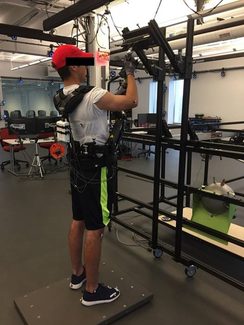
In a new research project carried out by researchers at Ohio State University’s Spine Research Institute, participants were tested in a study involving a commercially available exoskeleton — consisting of a mechanical arm attached to a harness — which is used by workers to help them carry heavy objects hands-free.
The idea is that doing so can greatly reduce the amount of stress put on workers’ arms. However, while the augmented exosuit did indeed manage to achieve this goal, it didn’t entirely erase the wear-and-tear on wearers’ bodies — but instead displaced it onto other parts of their body.
Better, stronger, faster?
“We conducted a biomechanical study on an exoskeleton that was initially designed to help offload the upper body, [particularly the] shoulders and arms,” Eric Weston, a graduate research associate in Ohio State’s Integrated Systems Engineering department, told Digital Trends. “What we were particularly interested in assessing was the potential trade-off that exists with the low back with the use of this device. We saw that such a trade-off does indeed exist. The loads on the discs of the spine in the low back increased by up to 53 percent when the exoskeleton was used compared to if the tasks tested were performed without the intervention.”

While a 53 percent increased load on the back is bad enough, though, the researchers found that stress on different muscles in the torso actually increased anywhere from 56 percent to 120 percent while users were wearing the exosuit. That should certainly be enough to worry anyone who’s asked to wear an exosuit to carry out heavy work, regardless of what industry they work in!
The study involved 12 subjects who were asked to simulate working using both a torque wrench, a relatively light tool weighing 10 lbs, and a heavier impact wrench, weighing around 30 lbs. The experiment was carried out in a laboratory setting with users wearing and then not wearing the industrial exoskeleton.
“The loads on the discs of the spine in the lower back increased by up to 53 percent when the exoskeleton was used compared to if the tasks tested were performed without the intervention.”
“We recorded how the subjects moved, how they activated their muscles to do the task, and ultimately used a biomechanical model of the low back to predict the forces that were being produced by the trunk muscles and the loads inside their spines,” Weston continued.
“To us, the results were not particularly surprising,” he said, referring to the displacing — rather than eliminating — of impact on the wearers’ body. “Though the subjects no longer need to support the weight of the tool with their upper body when wearing the exoskeleton, this potentially heavy tool is located much further from the back, and the back muscles need to compensate for this by producing more force. This will also create a greater load on the spine.”
Amazing potential, but more work needed
This isn’t to suggest that exosuits aren’t capable of carrying out some genuinely amazing feats, of course. Some have allowed individuals with partial paralysis to rise from their wheelchairs and walk again — or even to compete in sports. That’s absolutely phenomenal, and should not be sold short.
Over the long run, the underlying technologies in exosuits will also no doubt continue to be honed so as to produce lighter, cheaper, more versatile and durable wearables able to assist individuals in a range of pursuits.
But, right now at least, it seems that some of the report cards are more likely to read “good first effort” or “must try harder.”
“As researchers, we often talk about solving problems using a systems approach — meaning that solving one problem within a system should not create another problem elsewhere, ” Weston noted while explaining lessons he hopes manufactures will learn. “The results of this study highlight the need to design industrial exoskeletons considering how loads might be shifted or transferred with their use. It is important that the exoskeleton truly supports its wearer as opposed to pushing or pulling on them in ways that force them to fight it.”
Other co-authors on the Ohio State study include Gregory Knapik, Mina Alizadeh and Xueke Wang. Their research paper was published in the journal Applied Ergonomics.


