
NASA’s newest Mars mission lifted off in the fog atop an Atlas V rocket from Vandenberg Air Force Base at 4:05 a.m. local time Saturday morning. It was a rare treat for space enthusiasts in California, as it’s the first interplanetary mission ever to launch from the West Coast.
And we have liftoff! #Mars, here I come! 6 months and counting to the Red Planet. pic.twitter.com/wBPYdZVUlt
— NASA InSight (@NASAInSight) May 5, 2018
InSight (short for Interior Exploration using Seismic Investigations, Geodesy, and Heat Transport) will travel more than 300 million miles on a six-month journey to Mars. It’s scheduled to land on the red planet on November 26.
Previous Mars missions have studied the topography and atmosphere of the planet in depth, but nothing like InSight has ever been done before. Equipped with an array of sophisticated monitors, the car-sized mobile laboratory will probe deep beneath the surface of Mars, explained JPL Director Michael Watkins. It will collect data on “marsquakes,” monitor heat flow deep beneath the surface, and measure how the planet wobbles as it rotates. The mission was delayed for two years after leaks were found in the seismometer.
“InSight will help us unlock the mysteries of Mars in a new way, by not just studying the surface of the planet, but by looking deep inside to help us learn about the earliest building blocks of the planet,” Watkins said.
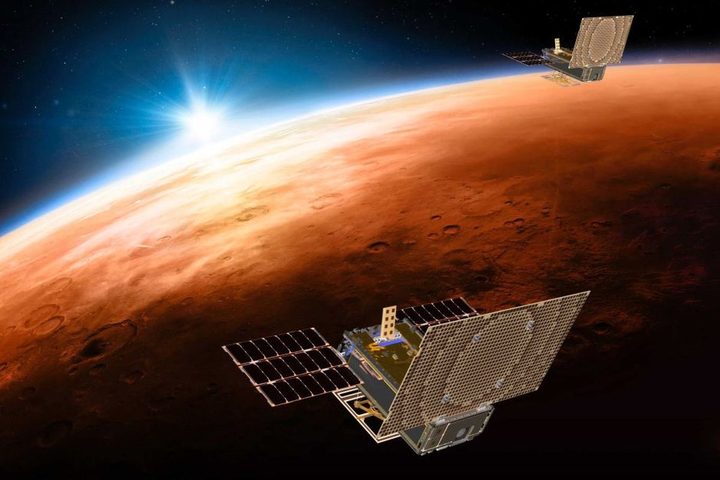
A couple of tiny hitchhikers will also be going along for the ride. Two CubeSat satellites nicknamed “Wall-E” and “Eva” will follow the spacecraft all the way to Mars. Officially named Mars Cube One, or MarCO, the duo is an experimental addition to the mission that’s designed to send data back to Earth as InSight lands on the planet’s surface. This is the first time the laptop-sized CubeSats will be used outside of an Earth orbit.
“These are our scouts,” said JPL engineer Andy Klesh. “CubeSats haven’t had to survive the intense radiation of a trip to deep space before, or use propulsion to point their way towards Mars. We hope to blaze that trail.”
The satellites are named after the animated Pixar characters because they use compressed gas commonly found in fire extinguishers for propulsion.
Once it arrives at Mars, the 1,340-pountd InSight will enter the thin atmosphere at 13,200 miles per hour. After deploying a supersonic parachute to slow itself down, it will jettison the heat shield and the lander itself will finally emerge. Its 12 descent engines will then guide the lander to a safe touchdown just a few minutes later.
Bruce Banerdt of JPL has been waiting a long time for this moment. “Scientists have been dreaming about doing seismology on Mars for years,” he said. “In my case, I had that dream 40 years ago as a graduate student, and now that shared dream has been lofted through the clouds and into reality.”


