Elevate, Uber’s light-aircraft ridesharing project, has partnered with government and private industry groups to help develop the service, USA Today reports.
On Tuesday, May 8, Uber released more details about UberAir at Elevate Summit 2018 in Los Angeles, the second annual convergence of “the foremost on-demand aviation leaders in industry, government, and academia.”
Uber announced an agreement with NASA to investigate air traffic control issues. The study would focus on the Dallas area but did not specify whether it would employ real light aircraft or use simulations. Uber Elevate will also work with the Army Research Lab on stacked co-rotating propellers for a quieter ride, USA Today reported.
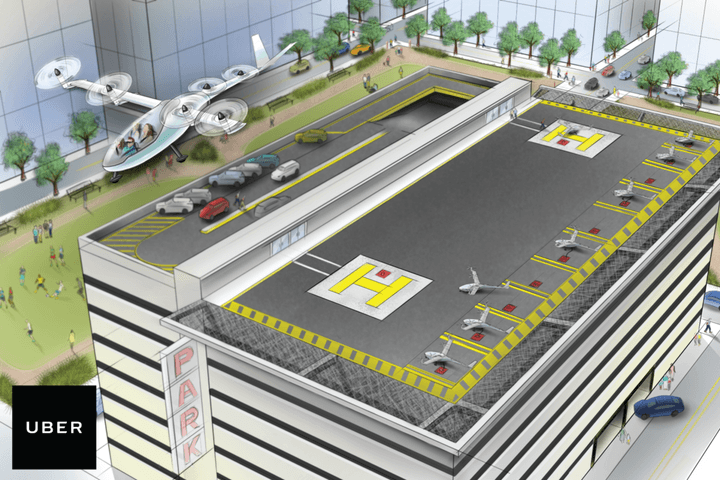
Uber Elevate also released new concept images of its future flying taxis. Uber refers to the vehicle in the images as “electric vertical takeoff and landing vehicles common reference models, or eCRM,” according to Fortune.
An Uber statement stressed safety, comfort, convenience, and efficiency in the eCRM design and operational system. Flying speed will be between 150 mph and 200 mph while flying from 1,000 to 2,000 feet above the ground. The aircraft’s electric batteries will be good for up to 60 miles, but Uber said recharging till take just five minutes, Fortune reported.
Uber had a lot to say about passenger and pedestrian safety in a statement issued on May 8, the day before Elevate Summit 2018 began.
“The eCRM design is pedestrian friendly, as the propeller blades are as high as possible, leaving ample room for individuals to board and deplane without having to duck,” Uber’s statement read, according to Fortune. “The high placement of the wings provides shaded entry into the cabin, shielding riders from light rain as they board. Finally, point of entry into the eCRMs is limited to one side, simplifying ground crew operations and reducing confusion for riders when they approach their eVTOL vehicle.”

Putting a date on the plans, Uber said Dallas, Dubai, and Los Angeles would all have UberAir flying vehicles overhead by 2020. Initial flights will have human pilots, but Uber Elevate’s grand plan envisions pilotless light planes winging passengers from pickup to destination.
Uber Elevate first came to light in 2016 in a white paper on the company website. After the initial jokes about what to call a potential ridesharing air transportation service, the concept spurred discussion of the practicality and challenges of flying cars.
Uber’s concept employed small, fixed-wing planes called VTOLs (vertical takeoff and landing), but the white paper suggested other possibilities in the future. When Uber hired Mark Moore, a former NASA advanced aviation engineer, to lead Uber Elevate engineering in early 2017, the flying taxi service crossed the line from speculation to a still-undefined but possible future project.
In late 2017, Uber Elevate released a teaser video for UberAir that featured this claim: “The reality of urban air transportation is closer than you think. In fact, Uber Elevate has already started exploring the barriers we’ll need to overcome to make vertical takeoff and landing a reality and bringing UberAir to Dallas and Los Angeles by 2020.”
Updated on May 8: Added information about work with Army Research Labs.