  1. Home
  2. Space
  3. Emerging Tech
  4. News

InSight lander successfully places its seismometer onto the surface of Mars

Add as a preferred source on Google

Another update from the surface of Mars, as NASA’s InSight lander has successfully deployed its first instrument onto the planet’s surface. This week the lander placed its copper-colored seismometer onto the ground in front of it, from where the instrument can gather data about vibrations deep within the planet.

Placing the seismometer, formally known as the Seismic Experiment for Interior Structure (SEIS), was a delicate operation because it needed to be positioned just right, on level ground and avoiding any large rocks or other potential hazards. The NASA team made use of a model in the JPL test bed to make sure that the commands that they sent to the lander would result in the correct movements to place the instrument. They also used images gathered by the lander’s Instrument Deployment Camera to check the surface was clear of obstructions before the instrument was lifted off the lander body and placed onto the ground.

Recommended Videos

Another issue was that the lander is sitting in a sand-filled hollow that is at a slight angle, and the seismometer needs to be placed on level ground. The ground on which it currently sits is at a very slight angle of two to three degrees, but the team is confident that they can level it within the next few days.
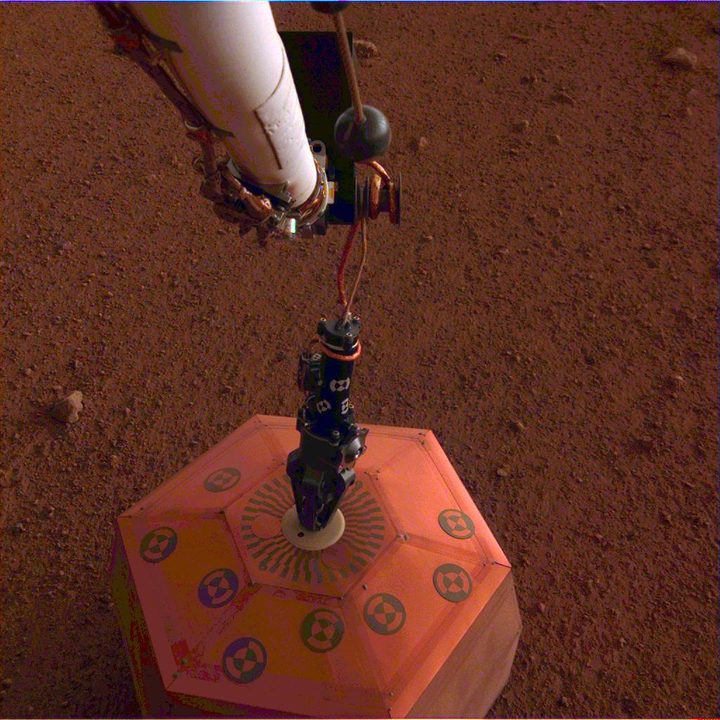
NASA’s InSight lander placing its seismometer on Mars NASA/JPL-Caltech

The seismometer is InSight’s most important instrument, being required for three quarters of the mission’s science objectives. Its function is to listen for vibrations from within the ground of Mars, which are known as marsquakes. When a marsquake occurs, it acts like a flashbulb, allowing scientists to see the planet’s interior by looking at the way that the seismic waves pass through the different layers of the planet. With this information, the scientists can make determinations about the size of the layers inside the planet and the materials that they may be composed of.

Philippe Lognonné, principal investigator of SEIS, described the instrument as like an audio-capturing device — appropriate given that it captured the sounds of Martian winds recently. “Having the seismometer on the ground is like holding a phone up to your ear,” he said. “We’re thrilled that we’re now in the best position to listen to all the seismic waves from below Mars’ surface and from its deep interior.”

Georgina Torbet
Georgina has been the space writer at Digital Trends space writer for six years, covering human space exploration, planetary…
Astronauts reportedly took shelter after work on Russia’s leaky ISS module triggered concerns
The ISS really picked a stressful time to start leaking again
The International Space Station.

Astronauts aboard the International Space Station reportedly took precautionary shelter measures after maintenance work on a long-troubled Russian module raised fresh safety concerns about air leaks aboard the orbiting laboratory.

According to reports, the incident involved Russia’s Zvezda service module, which has experienced recurring air leak problems for several years. During repair work and pressure tests connected to the leak investigation, astronauts were instructed to isolate themselves in safer sections of the ISS as engineers monitored the station’s integrity and pressure stability.

Read more
Blue Origin’s massive New Glenn rocket explodes in a fiery blaze during tests
The incident leaves NASA's Moon Base ambitions and Amazon's Kuiper constellation without their primary launch vehicle at the worst possible moment.
Explosion, Fire, Nuclear Explosion

Blue Origin's New Glenn rocket exploded during a static fire test at Launch Complex 36 in Cape Canaveral, Florida. The incident took place on the night of May 28, 2026. 

The explosion was captured on a live stream by NASASpaceflight.com and footage of the explosion spread rapidly across X. The Space Launch Complex 45 has confirmed in an official statement (shared by Spaceflight Now on X) that all personnel have been accounted for and there have been no injuries or fatalities.

Read more
Orbot Robotics’ space robot has four arms, but its Goro physique has a purpose
This four-armed robot could make routine space-station work easier for astronauts
Robot with four arms

Helios is a new four-armed robot from Zurich-based Orbit Robotics, and at first glance, it reminded me of Goro from Mortal Kombat. But unlike the prince from Outworld, Helios is not built for combat. It is designed to help astronauts on space stations with the repetitive, time-consuming work that keeps life in space running.

Orbit Robotics says that in microgravity, legs are not much help. Instead of walking or standing, Helios needs to move through tight station interiors, hold itself steady, and handle cargo, tools, or equipment. Its four-arm design turns extra limbs into both mobility aids and working hands.

Read more