  1. Home
  2. Space
  3. Emerging Tech
  4. News

See our galactic neighbor, the orderly Triangulum galaxy, in high definition

Add as a preferred source on Google

Take some time out of your day to ooh and ahh at the beauty of the universe — Hubble has shared another stunning image of a nearby galaxy.

The Hubble Space Telescope has produced this gorgeous high resolution image of the Triangulum galaxy (M33), made up of 25 million viewable stars. Triangulum is one of the closer galaxies to Earth at approximately 3 million light-years distance, and is located in a region called the Local Group. Triangulum is one of the three biggest galaxies in the group, along with Andromeda and our Milky Way. It is thought that Triangulum might be a satellite of Andromeda because of the way that the two galaxies move around each other and because they are so close together.
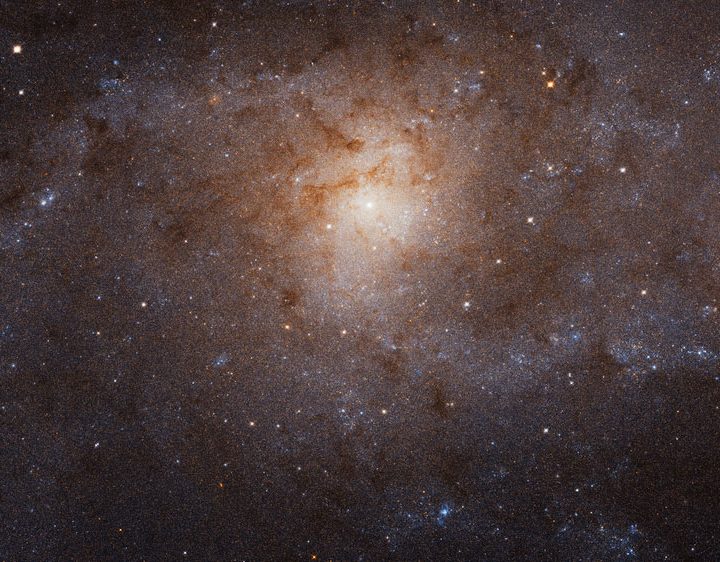
A view of the Triangulum galaxy (M33) captured by Hubble NASA, ESA, and M. Durbin, J. Dalcanton, and B.F. Williams (University of Washington)

In the Hubble’s image of Triangulum you can see the full spiral face of the galaxy, composed of a stitching together of 54 images captured by the telescope’s full field of view and totaling an area of more than 19,000 light-years across. Part of the reason that the image is so striking is that Triangulum forms stars at a very fast rate, with star formation occurring ten times faster than in the nearby Andromeda galaxy. This vigorous star formation creates lots of light and clouds of gases which are illuminated in the image.

Recommended Videos

Another unusual feature of Triangulum is that it has an unusually orderly spiral, with dust distributed evenly throughout the spiral arms which makes it easy to see the galaxy’s shape. Astronomers believe that the galaxy has evolved this way because it has had minimal interactions with other galaxies, meaning that it could continue producing stars without interference and could retain an organized spiral pattern. Researchers hope that this image can help us learn more about how galaxies develop over time.

You can find high resolution versions of the Triangulum image to pore over in detail on the Hubble website. And the video below shows a zoom in on the Triangulum galaxy, in a three million light-year trip that hones in on the most detailed image of the galaxy ever captured, showing the glowing gas clouds and the spiral arms of the galaxy in stunning detail:

Zooming in on the Triangulum Galaxy
Georgina Torbet
Georgina has been the space writer at Digital Trends space writer for six years, covering human space exploration, planetary…
Artemis II crew preps for lunar orbit – and Orion’s cosmic commode
'It's the one place we can go during the mission where we can actually feel like we’re alone.'
The Orion spacecraft's toilet.

Four astronauts are about to embark on a historic voyage that will take them around the moon in a spacecraft about the size of a large camper van.

During the Artemis II mission, NASA astronauts Reid Wiseman, Victor Glover, and Christina Koch, and the Canadian Space Agency’s Jeremy Hansen, will spend 10 days inside the Orion capsule after being blasted to space by the SLS rocket from the Kennedy Space Center in Florida, hopefully next week.

Read more
It’s here! NASA reveals full livestream schedule for crewed moon mission
The coverage starts on Friday.
NASA's SLS lunar rocket on the launchpad at the Kennedy Space Center, with the moon shining brightly in the background.

The excitement is building with NASA now just a few days away from sending four astronauts on a voyage around the moon.

On Wednesday, the space agency shared its schedule for coverage of the final buildup and main event, including a Q&A with the astronauts this Friday, blast off on Wednesday, April 1, and regular updates as the crew make their way to the moon.

Read more
Peek inside NASA’s Mars habitat where humans train for life on the red planet
Four volunteers are staying in isolation for more than a year.
A scene inside NASA's Mars simulation habitat.

NASA has offered a sneak peek inside its Mars simulation habitat where four volunteers have now spent 150 days isolated from the outside world.

By living within the confines of the 1,700-square-foot Mars Dune Alpha habitat at the Johnson Space Center in Houston, Ross Elder, Ellen Ellis, Matthew Montgomery, and James Spicer are helping NASA to better prepare for long-duration missions that will take humans into deep space.

Read more