  1. Home
  2. Emerging Tech
  3. News

Underground volcanoes could explain possible liquid water on Mars

Add as a preferred source on Google

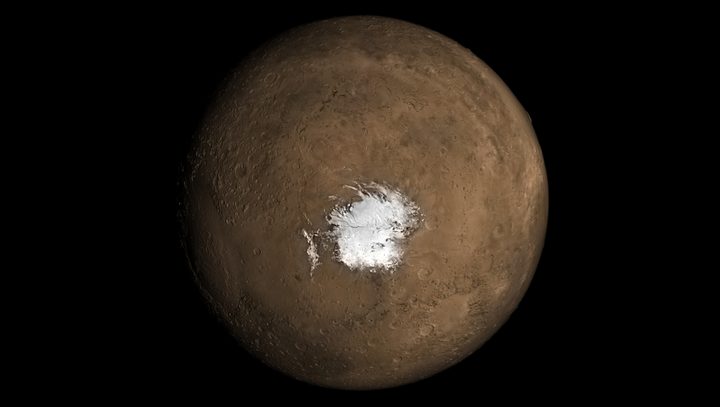
The Martian South Pole, which measures about 12.5 miles across and is believed to hide a lake of liquid water beneath the ground. NASA

Scientists last year discovered that there could be liquid water on Mars, located beneath the polar ice cap, one mile from the surface of the planet. Now a different team of researchers has argued that for there to be liquid water, there must be an underground source of heat — and they believe that underground volcanoes could be responsible.

Recommended Videos

The new team from the Lunar and Planetary Laboratory at the University of Arizona, looked at what temperatures in the subsurface would be required for there to be liquid water beneath the polar ice cap. They did consider the role of salts that are present in the martian rocks, as these lower the melting point of ice, making liquid water possible at colder temperatures. But even with the presence of salts taken into consideration, they found that the conditions on Mars were too cold for there to be liquid water unless there was an undergrounds heat source.

A plausible heat source would be magma moving in the planet’s subsurface that rose up out of the deep interior and toward the surface around 300,000 years ago. Unlike an erupting volcano, when hot magma breaks through the surface of a planet, this magma did not break through and so it formed a magma pocket under the ground. The magma was so hot and cooled so slowly that heat from the chamber is still reaching the water beneath the ice cap today.

There is previous evidence of volcanic activity on Mars, but this study suggests that the activity could have taken place relatively recently and could even still be ongoing.

“This would imply that there is still active magma chamber formation going on in the interior of Mars today, and it is not just a cold, sort of dead place internally,” Ali Bramson, postdoctoral research associate and co-lead author of a paper on this theory said in a statement. “We think that if there is any life, it likely has to be protected in the subsurface from the radiation. If there are still magmatic processes active today, maybe they were more common in the recent past, and could supply more widespread basal melting. This could provide a more favorable environment for liquid water and thus, perhaps, life.”

Georgina Torbet
Georgina has been the space writer at Digital Trends space writer for six years, covering human space exploration, planetary…
DJI’s first 360° drone offers 8K video recording and a freakishly long transmission range
From omnidirectional obstacle sensing to 42 GB of onboard storage, the Avata 360 is DJI doing what DJI does best: raising the bar for everyone else.
DJI Avata 360° drone.

DJI has officially entered the 360° drone arena with the launch of the Avata 360. It’s the company’s first-ever fully immersive FPV drone, and a direct shot at the Antigravity A1, a rival built by an Insta360-incubated brand. Looks like the drone wars just got more interesting. 

What makes the Avata 360 worth looking at?

Read more
I transferred all my chats from other AI apps to Gemini — and it works flawlessly
Google Gemini Graphics Featured

You know that moment when AI assistants like ChatGPT, Gemini, or Claude suddenly lose the plot mid-conversation and start hallucinating like they’re absolutely sure they’re right? Yeah…it’s equal parts funny and painfully annoying. My usual reaction is switching between apps, hoping one of them gets it right. But the real problem is that I have to start over every single time. It feels like I’m stuck in a loop explaining my life story to different AIs, one after the other.

Now with Gemini, I can now jump in from other AI apps without that whole reset conversation. Finally, the Google gods have blessed us. I tried it out expecting the usual hiccups, but it was surprisingly smooth and quick.

Read more
Google expands Search Live globally with voice and camera AI
The feature is now available in 200+ countries with multilingual support
Google Search Live

Google is taking another big step toward turning Search into a full-blown AI assistant. The company has officially expanded Search Live globally, making the feature available in over 200 countries and territories, along with support for dozens of languages.

https://twitter.com/google/status/2037201891130523917

Read more