  1. Home
  2. Emerging Tech
  3. News

Italian researchers discover what they believe is a lake under ice cap on Mars

Add as a preferred source on Google

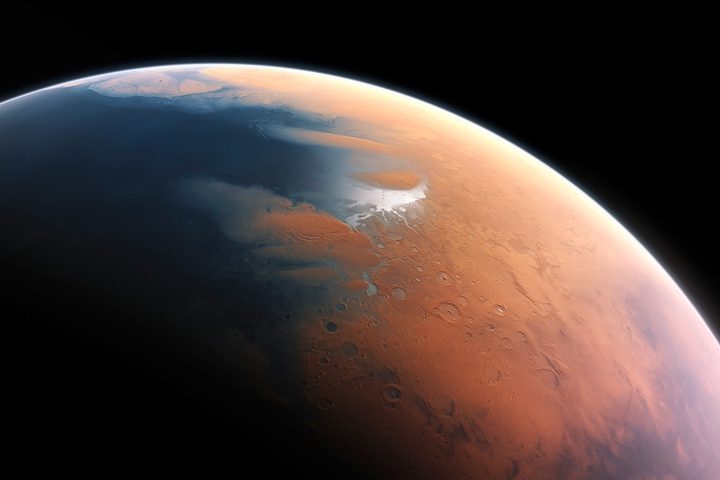
An artist’s impression of how Mars may have looked four billion years ago. ESO/M. Kornmesser

Drop everything and take a seat. We humans may have a new home. Or at the very least, a prerequisite for a new home.

Recommended Videos

Scientists have discovered what is believed to be a lake located underneath the south polar ice cap of Mars, measuring about 12.5 miles across. While researchers previously found signs that water once flowed across the planet’s surface, this is the first time that a persistent, existing body of water has been discovered.

The lake, located a mile beneath the planet’s surface, is likely still in a liquid form only because it is extremely salty and under a lot of pressure. But still, water is water, and this finding has the capacity to fundamentally change what we know about the Red Planet and, of course, whether or not we will one day be able to inhabit it.
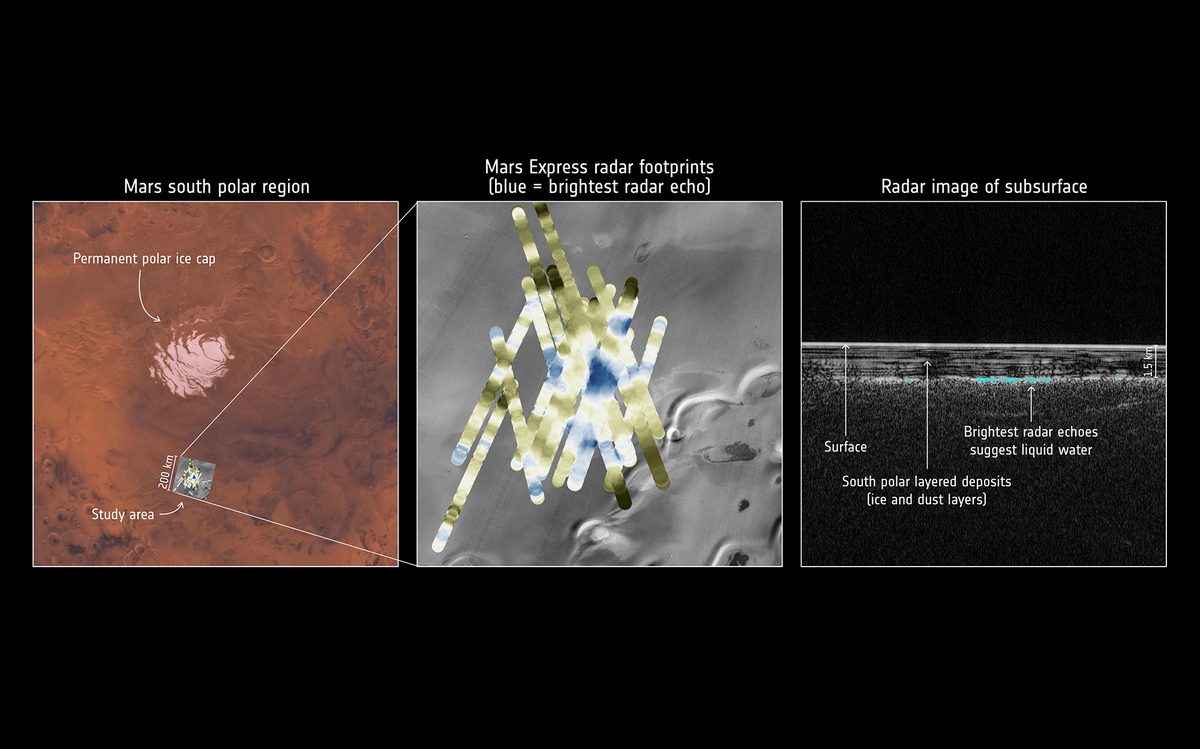
Express detects water buried under the south pole of Mars
Mars Express detects water buried under the south pole of Mars. Context map: NASA/Viking; THEMIS background: NASA/JPL-Caltech/Arizona State University; MARSIS data: ESA/NASA/JPL/ASI/Univ. Rome; R. Orosei et al 2018

Roberto Orosei at the Istituto Nazionale di Astrofisica in Bologna led the research team who drew the groundbreaking conclusions, and the paper detailing their work was today published in the journal Science. The team leveraged data from the Mars Advanced Radar for Subsurface and Ionosphere Sounding, or MARSIS, which is located on the European Space Agency’s Mars Express Orbiter. The scientists examined data between 2012 and 2015 in the area near the planet’s south pole. While this region “does not exhibit any peculiar characteristics,” as the paper notes, it has long been thought that the polar ice caps may contain liquid deposits.

And now, this hypothesis has been proven correct.

“It’s probably not a very large lake,” Orosei told the BBC. While it’s unclear how deep the lake is, the team estimates a minimum of three feet. “This really qualifies this as a body of water. A lake, not some kind of meltwater filling some space between rock and ice, as happens in certain glaciers on Earth,” Orosei added.
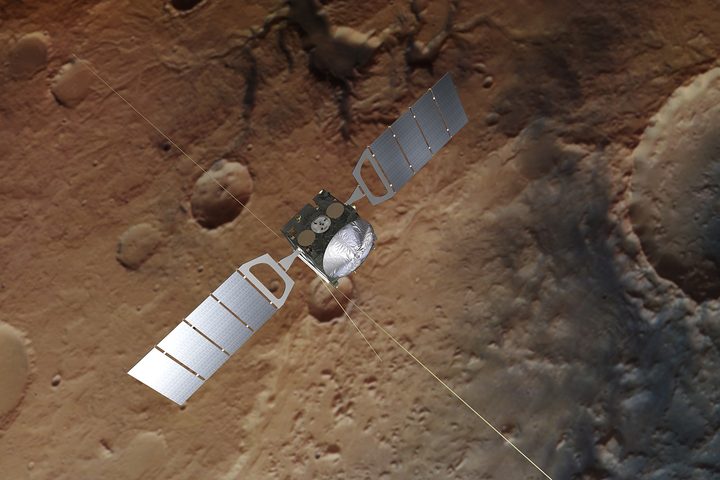
Mars Express
Artist’s impression of Mars Express. The background is based on an actual image of Mars taken by the spacecraft’s high resolution stereo camera. ESA/ATG medialab; Mars: ESA/DLR/FU Berlin, CC BY-SA 3.0 IGO

To be fair, this doesn’t actually imply anything concerning the existence of life on Mars quite yet. As Dr. Manish Patel from the Open University told the BBC, “We have long since known that the surface of Mars is inhospitable to life as we know it, so the search for life on Mars is now in the subsurface. This is where we get sufficient protection from harmful radiation, and the pressure and temperature rise to more favorable levels. Most importantly, this allows liquid water, essential for life.”

Ultimately, while scientists are not any closer to finding actual life on Mars, it does give them a sense of where to look. As Patel explained, “It is like a treasure map – except in this case, there will be lots of ‘X’s marking the spots.”

Scientists are careful to warn, however, that there still is not definitive evidence that this body of water is, in fact, liquid water.

“Getting there and acquiring the final evidence that this is indeed a lake will not be an easy task,” Orosei admitted. “It will require flying a robot there which is capable of drilling through 1.5km of ice. This will certainly require some technological developments that at the moment are not available.”

But here’s hoping that they will be soon.

Lulu Chang
Fascinated by the effects of technology on human interaction, Lulu believes that if her parents can use your new app…
Smart glasses are finding a surprise niche — Korean drama and theater shows
Urban, Night Life, Person

Every year, millions of people follow Korean content without speaking a word of the language. They stream shows with subtitles, read translated lyrics, and find workarounds. But live theater has always been a different problem — you can't pause or rewind it. That's the problem: a Korean startup thinks it's cracked, and Yuroy Wang was one of the first to try it. The 22-year-old Taipei retail worker is a K-pop fan who loves Korean culture but doesn't speak the language. When he went to see "The Second Chance Convenience Store," a touring play based on a Korean novel that was a bestseller in Taiwan, he expected supertitles. What he got instead was a pair of chunky black-framed AI-powered glasses sitting on his nose, translating the dialogue in real time directly on the lenses. "As soon as I found out they were available, I couldn't wait to try them," he said. Wang is part of a growing audience discovering that smart glasses, a category of tech that has struggled to find mainstream purpose for years, might have just found their calling in the most unexpected of places: live Korean theater.

How do the glasses work?

Read more
Amazon thinks you love AI, so it has launched a special storefront for AI-powered gadgets
Google AI mode mockup showing new feature

You're browsing for a new laptop — one has a better processor, another has more RAM, a third says "AI-powered" in bold letters, and you're not entirely sure what that means. But Amazon has noticed you pausing on that third one, and it has thoughts. The company just launched an AI Store on Amazon.in — a dedicated storefront that rounds up AI-enabled gadgets across categories, from smartphones and laptops to refrigerators and washing machines. So, instead of you wading through spec sheets trying to figure out which "AI feature" actually does something useful, the store spells it out for you.

What the AI store actually is

Read more
Gemini now makes personalized images by understanding your taste from Photos library
Logo, Disk, Symbol

Up until now, using Google Gemini meant being very specific. If you wanted an image, you’d spell it all out, the mood, the lighting, the tiny details, just to get something close to what you had in mind. That’s still how most AI tools operate. But this is where things start to shift. With the integration of Nano Banana 2 and Google Photos, Gemini feels much more familiar. It leans on your preferences, what you like, what you usually capture, and the kind of visuals you gravitate towards, and uses that context to shape what it creates for you.

So instead of over-explaining every prompt, you’re nudging it in a direction, and it fills in the rest in a way that feels personal. The goal here is simple: spend less time describing and more time seeing your ideas come to life, almost the way you imagined them, without having to say everything out loud.

Read more