  1. Home
  2. Emerging Tech
  3. News

Cosmic dust bunnies: Scientists find unexpected ring around Mercury

Add as a preferred source on Google

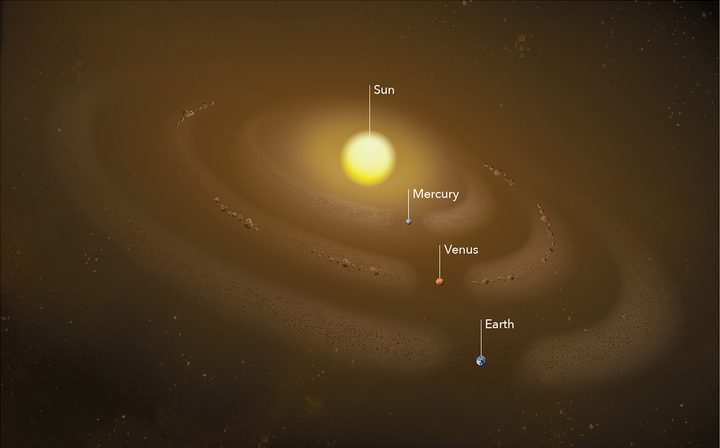
In this illustration, several dust rings circle the Sun. These rings form when planets’ gravities tug dust grains into orbit around the Sun. Recently, scientists have detected a dust ring at Mercury’s orbit. NASA’s Goddard Space Flight Center/Mary Pat Hrybyk-Keith

Dust turns up everywhere — on bookshelves, under the sofa, and now, apparently, in rings around Mercury. Astronomers have made a surprising discovery, finding a ring of cosmic dust in an unexpected place in our solar system.

Recommended Videos

Solar scientists Guillermo Stenborg and Russell Howard from the Naval Research Laboratory in Washington, D.C. did not set out looking for dust. Just the opposite — they were looking for a dust-free region close to the Sun in preparation for the explorations performed by the Parker Solar Probe. Scientists believe there should be a region close to the Sun where the heat from the star would vaporize any dust, and finding the edge of this region would tell us more about what cosmic dust is made of and how planets formed in a young solar system.

Instead, Stenborg and Howard stumbled across a “fine haze of cosmic dust” sprinkled across the orbit of Mercury, which forms a ring that is 9.3 million miles wide. Mercury itself is only 3,030 miles wide, so it floats through a vast sea of dust as it moves around the Sun.

“We’re not really dust people,” Howard said in a statement. His team was trying to remove the effects of dust from images so the Parker Solar Probe can see the Sun more clearly. “The dust close to the Sun just shows up in our observations, and generally, we have thrown it away.” But this time, they realized the dust they were trying to scrub away was far denser and more prevalent than they had expected.

It hadn’t previously occurred to scientists that there could be a dust ring around Mercury, so no one had to thought to look for one before. “People thought that Mercury, unlike Earth or Venus, is too small and too close to the Sun to capture a dust ring,” Stenborg said. “They expected that the solar wind and magnetic forces from the Sun would blow any excess dust at Mercury’s orbit away.”

Now Howard and Stenborg will pass the challenge of investigating Mercury’s dust ring to “dust people,” and will focus back on searching for the dust-free zone as the Parker Solar Probe explores the Sun’s corona.

Georgina Torbet
Georgina has been the space writer at Digital Trends space writer for six years, covering human space exploration, planetary…
DJI’s first 360° drone offers 8K video recording and a freakishly long transmission range
From omnidirectional obstacle sensing to 42 GB of onboard storage, the Avata 360 is DJI doing what DJI does best: raising the bar for everyone else.
DJI Avata 360° drone.

DJI has officially entered the 360° drone arena with the launch of the Avata 360. It’s the company’s first-ever fully immersive FPV drone, and a direct shot at the Antigravity A1, a rival built by an Insta360-incubated brand. Looks like the drone wars just got more interesting. 

What makes the Avata 360 worth looking at?

Read more
I transferred all my chats from other AI apps to Gemini — and it works flawlessly
Google Gemini Graphics Featured

You know that moment when AI assistants like ChatGPT, Gemini, or Claude suddenly lose the plot mid-conversation and start hallucinating like they’re absolutely sure they’re right? Yeah…it’s equal parts funny and painfully annoying. My usual reaction is switching between apps, hoping one of them gets it right. But the real problem is that I have to start over every single time. It feels like I’m stuck in a loop explaining my life story to different AIs, one after the other.

Now with Gemini, I can now jump in from other AI apps without that whole reset conversation. Finally, the Google gods have blessed us. I tried it out expecting the usual hiccups, but it was surprisingly smooth and quick.

Read more
Google expands Search Live globally with voice and camera AI
The feature is now available in 200+ countries with multilingual support
Google Search Live

Google is taking another big step toward turning Search into a full-blown AI assistant. The company has officially expanded Search Live globally, making the feature available in over 200 countries and territories, along with support for dozens of languages.

https://twitter.com/google/status/2037201891130523917

Read more