  1. Home
  2. Space
  3. Emerging Tech
  4. News

Parker Solar Probe captures first image from within the atmosphere of the sun

Add as a preferred source on Google

NASA has shared a first image from inside the atmosphere of the sun, taken by the Parker Solar Probe. Last month the probe made the closest ever approach to a star, gathering data which scientists have been working on and have released to the public this week.

The probe skimmed past the surface of the sun on a solar encounter phase which ran from October 31 to November 11, reaching a record-breaking speed of 213,200 miles per hour. Coming within 15 million miles of the sun’s surface, the probe may encounter extreme temperatures of up to 2,500°F on its heat shield, which is turned towards the sun to protect the instruments inside.

Recommended Videos

The probe captured this stunning image from within the sun’s atmosphere, showing a coronal streamer — a structure of solar material that lies over regions of the sun where there is increased solar activity. You can see Mercury as the bright dot near the center of the image, while the darker spots nearby are a result of background correction. This image was taken a mere 16.9 million miles from the surface of the sun:
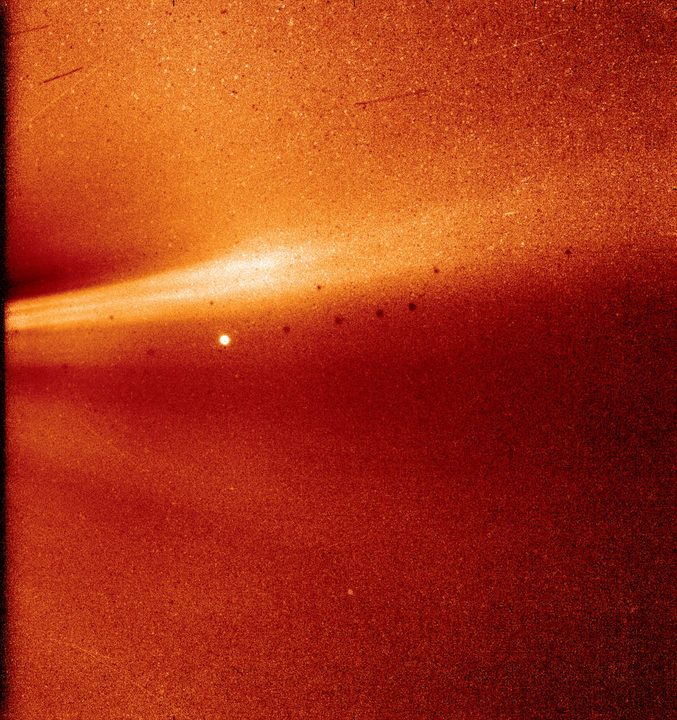
NASA/Naval Research Laboratory/Parker Solar Probe

The mission is just beginning for the Parker Solar Probe — it will complete a total of 24 orbits around the sun over its seven year mission. During the mission the probe will encounter the planet Venus seven times, using a gravity assist maneuver to slow the speed of the probe so that it can get closer to the sun and gather more data. At its closest, the probe should pass within just 3.8 million miles of the sun. The observations gathered from within the corona of the sun will be used to examine questions like why it is that the temperature in the sun’s atmosphere can be so much higher than the temperature on the sun’s surface.

Nour Raouafi, a scientist from the Parker Solar Probe project at the Johns Hopkins University Applied Physics Lab, said that there were a lot of unknowns when working with a probe venturing into extreme conditions: “We don’t know what to expect so close to the sun until we get the data, and we’ll probably see some new phenomena,” he said. “Parker is an exploration mission — the potential for new discoveries is huge.”

Georgina Torbet
Georgina has been the space writer at Digital Trends space writer for six years, covering human space exploration, planetary…
Scientists have found a hidden galaxy inside the Milky Way, and they’re calling it Loki
A lost dwarf galaxy may be hiding inside the Milky Way.
milky-way-hidden-galaxy-loki

Our home galaxy has a secret buried inside. A new study published in the Monthly Notices of the Royal Astronomical Society suggests that the Milky Way swallowed an ancient dwarf galaxy billions of years ago, and its stellar remains are still embedded within ours.

Researchers have named this lost galaxy Loki, after the Norse trickster god, and the name is quite fitting because it remained hidden in plain sight for a very long time.

Read more
NASA aims September launch for Roman space telescope and it’s going to be a huge shift
An earlier target for Roman means one of NASA’s most ambitious observatories is getting close, with the potential to open a huge new era in space discovery
Machine, Wheel, Astronomy

NASA is now aiming to launch the Nancy Grace Roman Space Telescope as soon as early September 2026, a faster timeline than its earlier commitment to fly no later than May 2027. That alone makes this one of the agency’s most important missions to watch over the next few months.

The reason is simple, Roman is built to scan vast parts of the sky with sharp infrared vision.

Read more
Blue Origin successfully re-uses a New Glenn rocket for the first time ever
Blue Origin achieves first New Glenn reflight despite payload setback
Blue Origin

Blue Origin has achieved a major milestone in its spaceflight ambitions by successfully reusing a booster from its heavy-lift New Glenn rocket for the first time. The historic launch, conducted on April 19, marks a significant step forward for Jeff Bezos’ space company as it seeks to compete with rivals like SpaceX in the rapidly evolving commercial launch market.

A Milestone With A Mixed Outcome

Read more