  1. Home
  2. Emerging Tech
  3. News

Things are heating up as Parker Solar Probe makes second flyby of the Sun

Add as a preferred source on Google

Animated Sequence Of Parker Solar Probe Credit: NASA/JHUAPL

Launched in August last year, the Parker Solar Probe is a NASA project to collect data from the searing heat of the Sun’s corona. It is the first probe to be sent so close to the surface of our star, and on its first orbit it made the closest ever approach ever by a man-made craft, coming within 15 million miles of the Sun’s surface.

Recommended Videos

Now NASA has announced the probe has made a second close approach to the Sun and is entering the outbound phase of its second solar orbit. Last week, at 6:40 p.m. EDT on April 4, the probe once again passed within 15 million miles of the Sun while traveling at a breakneck 213,200 miles per hour. The probe achieved this speed as it swept past the Sun at its closest point, called the perihelion.

In total, the “solar encounter” — the phase during which the craft is within 23,250,000 miles of the Sun’s surface, or a quarter of the distance between the Sun and the Earth — began on March 30 and will run for eleven days until April 10.

The team responsible for collecting data from the probe, based at Johns Hopkins University, made contact with the probe using the Deep Space Network (DSN). The DSN is an array of enormous radio antennas which are spread between three facilities in Goldstone, near Barstow, California; near Madrid, Spain; and near Canberra, Australia. The location of these sites allows the DSN to maintain communication with spacecraft even as the planet rotates.

The researchers used the DSN to make contact with the probe for four hours during its perihelion and to monitor its status during this risky part of the mission. The probe sent back a “beacon status A” throughout this time, indicating that it is well and its instruments are collecting data.

“The spacecraft is performing as designed, and it was great to be able to track it during this entire perihelion,” Nickalaus Pinkine, Parker Solar Probe mission operations manager at the Johns Hopkins Applied Physics Laboratory in Laurel, Maryland, said in a statement. “We’re looking forward to getting the science data down from this encounter in the coming weeks so the science teams can continue to explore the mysteries of the corona and the Sun.”

Georgina Torbet
Georgina has been the space writer at Digital Trends space writer for six years, covering human space exploration, planetary…
Edge browser on mobile gets a huge upgrade that makes it a worthy pick over Chrome
Edge mobile gets smarter just before Chrome’s big Gemini moment
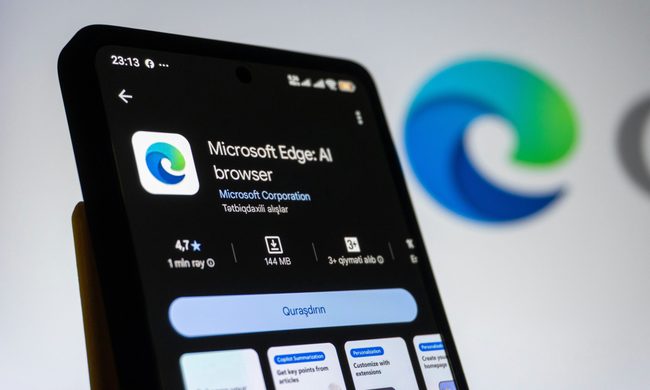
Microsoft Edge on a phone

Chrome is still the default browser for many smartphone users, but Microsoft’s latest Edge update gives them a practical reason to try something else.

Microsoft has announced a major Copilot update for Edge across desktop and mobile. The rollout comes ahead of Google’s Gemini-powered Chrome upgrade for Android, which is expected in June, giving Edge a chance to stand out on phones before Chrome’s next big AI push.

Read more
After flubbing with Siri, Apple plans to host AI agents on the App Store
One problem is about money Apple won't commit to not charging. The other is about AI agents Apple can't figure out how to control. WWDC needs to solve both.
Electronics, Mobile Phone, Phone

Apple is currently facing a Siri problem that has nothing to do with Siri at all. With WWDC 2026 just weeks away, The Information reports the company is actively courting developers to integrate their apps with the new Siri coming in iOS 27. 

The mechanism powering the overhauled Siri, App Intents, is an API that lets Siri execute actions inside third-party apps without you actively opening them, which sounds quite useful, I’d say. However, some of the world’s largest developers are dragging their feet on it, not because it’s tough, but because Apple left the door open on charging for it later.

Read more
EV batteries just need some AI top-up nudge, and they get a big 23% life boost, finds research
Charging fast and lasting long seemed impossible. A new AI trick says otherwise.
EV Charging

EV battery charging technology has always had to find the right balance between charging speed and battery longevity. If the charging speed is too fast, it wears down the battery. If the charging is too slow, nobody is happy. 

Researchers Meng Yuan from Victoria University of Wellington and Changfu Zou from Chalmers University of Technology in Sweden may have cracked this long-standing problem using an AI technique called deep reinforcement learning, and the results are pretty encouraging.

Read more