  1. Home
  2. Emerging Tech
  3. Health & Fitness
  4. News

Scientists manage to 3D print an actual heart using human cells

Add as a preferred source on Google
Image used with permission by copyright holder

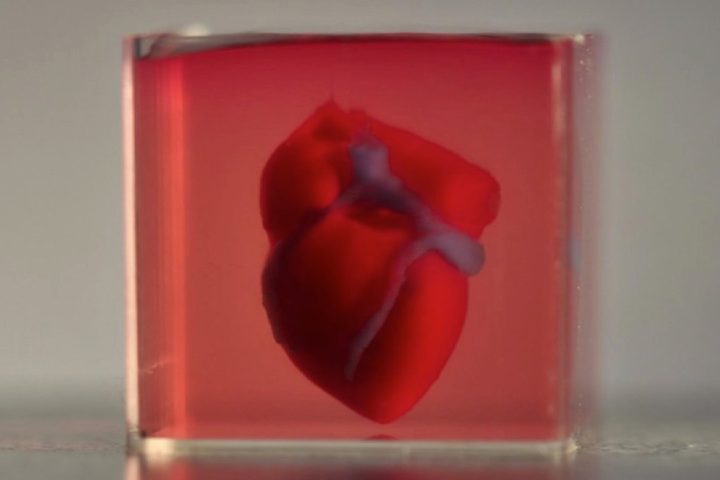
Scientists at Tel Aviv University (TAU) announced the world’s first 3D-printed small-scale heart, complete with blood vessels, ventricles, and chambers — a massive step forward for the field of 3D-printed organs, which aims to reshape the medical world.

Heart disease is the leading cause of death among both men and women in the United States. Although heart transplants represent a possible solution to this condition, there is an enormous shortage of donor hearts available. As a result, scientists are busy looking for innovative other ways of making hearts available for transplantation.

Recommended Videos

One possibility involves 3D bioprinting, a type of 3D printing that uses living cells, growth factors, and biomaterials to fabricate biomedical parts. Eventually, the dream of 3D bioprinting is to be able to create a fully functional human heart for transplant. That is still a ways off, but the TAU news is a crucial sign of progress. The heart was printed using human cells, which should make it far less likely to be rejected by a transplant patient’s body since these could be custom-created for each person.

To create their small-scale heart, the researchers took a biopsy of fatty tissue from a subject. These were then separated into cellular and a-cellular materials, and reprogrammed to become pluripotent stem cells and a personalized printing “ink.” While people have previously been able to 3D print a heart structure, this was done without cells or blood vessels.

“Our results demonstrate the potential of our approach for engineering personalized tissue and organ replacement in the future,” Professor Tal Dvir of TAU’s School of Molecular Cell Biology and Biotechnology said in a statement.

The heart created as part of the demo was approximately the size of a rabbit’s heart. From here, the researchers hope to further develop the work to create a full-sized human heart. They also plan to carry out transplants of their 3D-printed hearts in animal models. After that, it is possible that human trials could follow.

“Maybe, in 10 years, there will be organ printers in the finest hospitals around the world, and these procedures will be conducted routinely,” Dvir said.

A paper describing the research, “3D Printing of Personalized Thick and Perfusable Cardiac Patches and Hearts,” was recently published in the journal Advanced Science.

Luke Dormehl
I'm a UK-based tech writer covering Cool Tech at Digital Trends. I've also written for Fast Company, Wired, the Guardian…
Starlink Mini may finally cut the cord with a battery-powered dish
SpaceX is fixing the biggest portable problem with Starlink
A Starlink dish.

Starlink Mini is already the version of SpaceX’s internet dish built for on-the-go connectivity. It has found its fans in travelers, campers, vanlifers, and others who live off the grid. But new firmware clues suggest SpaceX may be getting ready to make it even more portable by putting the battery inside the dish itself.

According to a PCMag report, university researcher Jinwei Zhao spotted new Starlink firmware strings that point toward a possible Starlink Mini model with an integrated battery. The key clue is a new DishBatteryStats reference, which appears designed to return battery-specific information rather than simply detect that the dish is plugged into some random external power bank.

Read more
China will put a unique ID code on humanoid robots, just like citizen ID for us humans
China is treating its humanoid robots like citizens. assigning each one a unique ID code from birth to recycling.
Robot with four arms

China has launched a national programme that will assign every humanoid robot manufactured in the country a unique digital identity code, effectively a citizen ID, but for bipedal machines (those that can balance and walk/run on two legs). 

The initiative, called the Humanoid Full Lifecycle Management Service Platform, was announced on Friday. It is led by the Humanoid Robotics and Embodied Intelligence Standardization committee, which is under China's Ministry of Industry and Information Technology (via South China Morning Post).

Read more
Romantic AI bots continue to ruin lives, and the latest horror story is simply shocking
A story that sounds like Black Mirror, except it’s completely real.
Man using phone on bed

For years, romantic AI relationships felt like distant sci-fi fiction, but reality caught up far faster than anyone expected, and it’s looking deeply unsettling already. A disturbing new Wall Street Journal report details how a 57-year-old man became emotionally obsessed with a customized ChatGPT companion named “AImee,” eventually spiraling into delusions, financial loss, hospitalization, and fractured relationships.

One ChatGPT companion reportedly spiraled into obsession and delusion

Read more