
Razer announced new additions to its high-end gaming laptop lineup, including one with a 4K OLED screen and another with a 240Hz refresh rate. This is the second update for these “Advanced Model” Razer Blades in this year alone, the first coming at CES 2019 with RTX graphics. This time around, the focus is twofold: New display technologies and Intel’s new 9th-gen six-core processors.
First up is the OLED panel. OLED is making a comeback in laptops this year, but Razer is the first gaming laptop to actually launch with one. It’s already common in televisions and smartphones as a replacement for traditional LCD LED, but panel suppliers and PC manufacturers have been slow to implement the technology because of issues with burn-in. Static images such as the Windows 10 taskbar or HUD elements in a game make burn-in a larger concern in PCs than on TVs or smartphones. But Razer’s panel supplier, Samsung, claims it has found ways around the problem. One technique used is pixel shifting, which subtly moves pixels in a way imperceptible to the eye. Whether or not it actually works, we’ll have to see once we can test it out more.
Like many 4K gaming laptops, this model is geared more toward content creators who might want to game on the side. Even though playing games in 4K is possible with current generation graphics, most gamers prefer the higher framerates that come with 1080p or even 1440p resolutions. That doesn’t mean OLED is without its gaming benefits. Those with OLED or QLED televisions can attest to the low input lag and quick response time of these screens. It is, however, locked at a 60Hz refresh rate.
The other option for advanced panel technology is about speed, not fidelity. A 240Hz refresh rate option replaces the 144Hz in the Advanced Models, allowing for smooth gameplay at extremely high framerates. Are these systems really powerful enough to push over 200 frames per second? Maybe in certain games with graphics settings turned down. When asked why anyone would need a refresh rate this high, Razer representative simply said, “Why not?” Fair enough, especially since Razer doesn’t appear to be charging extra for this version, still with a starting price of $2,399.
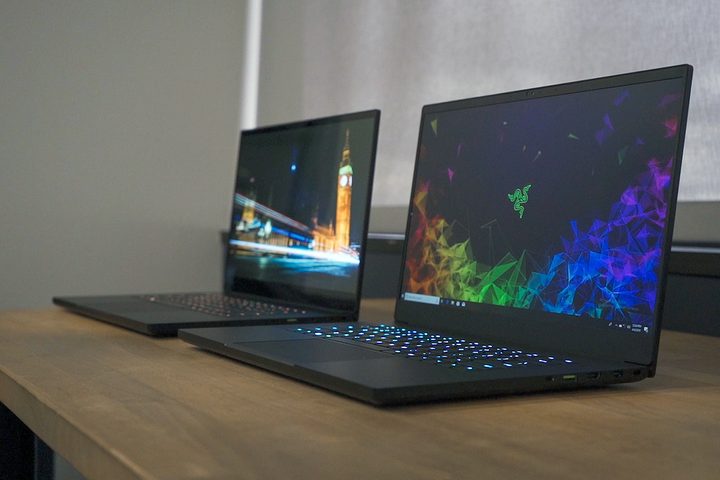
The same cannot be said about the OLED model, though. At $3,299, it’s currently the most expensive Razer laptop, even topping the new 17-inch Razer Blade Pro. It only goes up from there if you want to upgrade to from the RTX 2070 Max-Q up to an RTX 2080 Max-Q GPU or add more storage. All Advanced Model options also come with Intel’s 9th-gen Core i7-9750H processor, 16GB of RAM, and up to 512GB of SSD storage. These new processors are still six cores and twelve threads, offering a marginal increase in clock speed and Wi-Fi 6 capability.
These two new Razer Blades take the place of the previous Advanced Model, which included displays options for either a 1080p 144Hz screen or a 4K 60Hz panel and graphics options ranging from the RTX 2060 up to an RTX 2080 Max-Q. The 1080p 144Hz option with RTX 2060 graphics has now been downgraded to a Base Model, but that doesn’t mean it’s exactly the same as before. The Base Model laptops use a slightly larger chassis, single-zone RGB backlighting, and an older thermal system. If you want access to Razer’s “Vapor Chamber” cooling, you’ll have to spring for one of the spendier Advanced Model options.
Confused yet? Well, Razer also introduced a new version of its more affordable Base Model, which is a 1080p 144Hz screen with the RTX 2060 graphics that starts at $1,999. It comes with 16GB of RAM and a 512GB SSD. Despite being slightly thicker at 0.78 inches, it’s actually now lighter than the Advanced Model Blades which have bloated a bit in weight. That’s $300 cheaper than the previous 1080p 144Hz RTX 2060 Advanced Model, which makes this a nice price cut for those who want that 144Hz screen.
We don’t have a firm release date yet on these three new Razer Blades (or the new Razer Blade Pro), but Razer says they’ll be available at some point in May.


