  1. Home
  2. Emerging Tech
  3. News

Crawler robots and imaging drones will monitor wind turbine blades for damage

Add as a preferred source on Google
Sandia Wind Blade Reliability b roll

When it comes to driving down the cost of wind energy, one simple way of avoiding unnecessary expenditure is to regularly check the blades of wind turbines for damage. By spotting signs of damage early, blades can be kept in service for longer before needing replacement. Unfortunately, that’s a task that’s easier said than done using traditional inspection methods, such as ground-based surveying. Fortunately, researchers at Sandia National Laboratories have another solution — and it involves a combination of blade-crawling robots and flying inspection drones.

Recommended Videos

The crawling inspection robots maneuver from side-to-side up and down turbine blades. While doing this, they use on-board cameras to capture high-fidelity images of the blades, in addition to performing special ultrasonic imaging. This provides unique signatures for each blade which can be analyzed to indicate damage. In total, it provides detailed information about both the surface and interior damage of wind blades.

“This technology potentially allows for advanced non-destructive inspection (NDI) techniques to be economically deployed at both land-based and offshore wind plants to scan for damage in blades,” Josh Paquette, wind energy lead on the project, told Digital Trends. “In this case, we have used water-coupled, phased array ultrasonic technology as it has shown to be particularly promising for wind blade inspections. The crawler can be deployed from the turbine nacelle, positioned in the area of interest, and perform a controlled or possibly automated scan. The results of this scan can then be analyzed by a composite materials expert to determine the extent of any damage that may exist.”
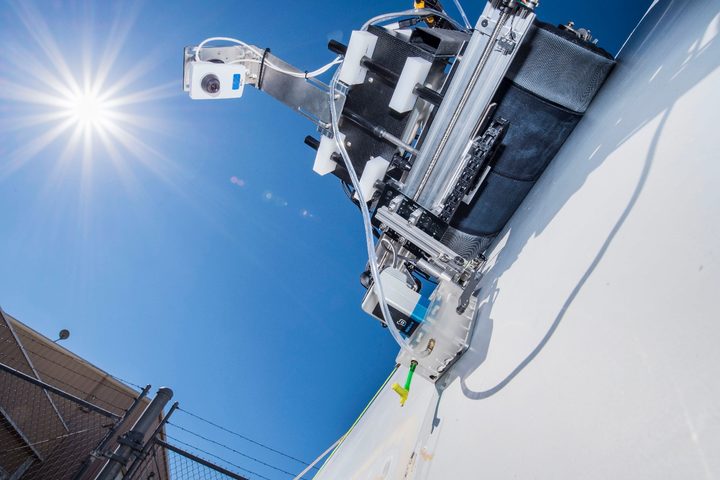
Randy Montoya

A second approach involves using drones equipped with infrared cameras. These UAVs employ the heat from sunlight to detect hidden wind blade damage as deep as half an inch inside a blade.

“The method uses a technique called thermography and scales it down to fit on small commercial drones,” Sandia mechanical engineer Ray Ely told us. “Basically, if you position a blade in the sunlight, the surface will heat up. You can [then] pitch the blade into the shade, and the heat will diffuse into the blade and equalize. However, flaws can disrupt this heat flow and leave the blade surface hotter than expected. A computer on the drone can record information about the size and location of each flaw.”

At present, both of these inspection techniques are proofs-of-concept. The next step will involve deploying them in the field to showcase their effectiveness.

Luke Dormehl
I'm a UK-based tech writer covering Cool Tech at Digital Trends. I've also written for Fast Company, Wired, the Guardian…
This new video editor lets Claude organize, generate, and edit right on your timeline
Laptop running Claude Fable

For years, AI video tools have mostly lived outside the editing process. You generate a clip, download it, import it into your editor, and continue working. A new app called Palmier Pro aims to eliminate some of those extra steps by bringing AI directly into the video timeline.

The newly launched software, available for macOS, is being marketed as a video editor that Claude can use. Instead of treating AI as a separate chatbot or content generator, Palmier is designed to let an AI assistant interact with an active video project and make changes within it.

Read more
MIT experts just made a special memory. When humans forget, robots will just fetch the lost item
MIT’s new robot memory could make lost keys your robot’s problem
A robotic arm.

Robots may be the new best friend for forgetful humans. MIT researchers have developed a long-term memory framework for robots that can help them build a detailed mental model of large, complicated spaces. The system is called DAAAM, short for Describe Anything, Anywhere, Anytime, at Any Moment, and the goal is to let robots remember objects, locations, and details over time.

This might not sound headline-grabbing, though robots are still surprisingly bad at something humans do casually. You may remember that your keys were on the kitchen counter last night, or that a half-finished part was left in a factory bin. However, a robot working beside you would struggle to connect that object and location in a useful way.

Read more
A strange little electric nose may be the missing piece for smart fridges
The carbon nanotube chip detects food, allergens, and spoilage signals at room temperature.
Electronics, Hardware, Printed Circuit Board

UC Berkeley researchers have built an electric nose that can detect gases tied to spoiled food and common allergens more consistently than a human sniff test. The device uses a 16-sensor gas sensor chip that turns reactions with food-related gases into electrical signals.

Kitchen judgment can get messy because food doesn't always look or smell risky before it becomes a problem. Milk, eggs, chicken, fruit, and nuts release different chemical signatures, and people usually have to decide with whatever their nose catches in the moment.

Read more