  1. Home
  2. Emerging Tech
  3. News

Stanford researchers create algorithm that makes wind turbines more efficient

Add as a preferred source on Google
John Dabiri/Stanford

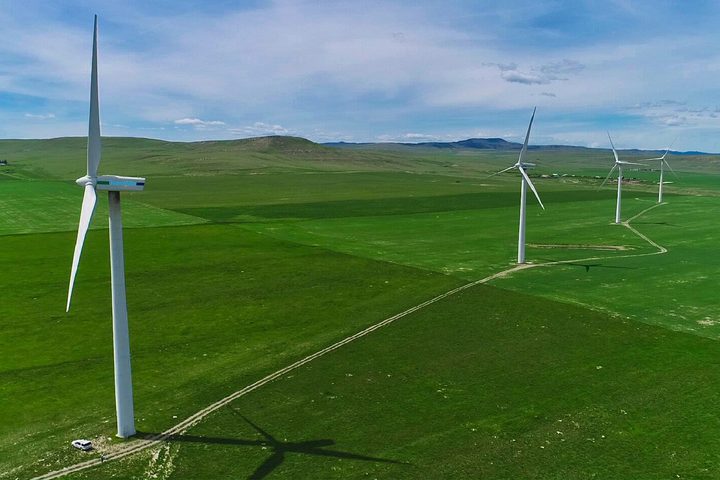
Could an algorithm make wind turbines more productive? It sounds crazy, but the answer turns out to be a resounding “yes.” Researchers at Stanford University recently used a proprietary optimization algorithm to model the most efficient yaw angle for turbines. The yaw mechanism in a wind turbine is used to turn the wind turbine rotor against the wind. To ensure that a turbine produces the maximal amount of electric energy, a yaw drive keeps the rotor facing into the wind as the wind direction changes.

The algorithm developed by the team took into account a half decade of information on wind speed, wind direction, and power generation from six turbines. This data was then combined with a wind model. It suggested that the most efficient way to gather maximal energy from a series of wind turbines would be for the yawing of several of the turbines to be positioned 20 degrees off the wind. This was then tested out on a real Alberta, Canada, wind farm. It illustrated how, by working together, wind turbines can generate more energy by effectively “sharing” the wind.

Recommended Videos

“We’ve demonstrated that the power output of wind farms can be improved by turning some of the turbines so that they’re facing slightly away from the wind,” John Dabiri, a Stanford fluid mechanics expert who worked on the project, told Digital Trends. “This causes the choppy air created by upwind turbines to be deflected away from the downstream turbines. The upwind turbines lose a little power, but the farm as a whole can produce significantly more power.”

The ultimate goal of the “wake steering method” project was to increase the efficiency of wind farm power generation, so that wind energy could play a more vital role in helping wean us off our current reliance on fossil fuels.

“This first project focused on six wind turbines, to demonstrate that the idea works while limiting the risks associated with a new technology,” Dabiri continued. “The next stage will involve tests on larger groups of turbines, including entire wind farms.”

A paper describing the work, titled “Wind farm power optimization through wake steering,” was recently published in the journal Proceedings of the National Academy of Sciences.

Luke Dormehl
I'm a UK-based tech writer covering Cool Tech at Digital Trends. I've also written for Fast Company, Wired, the Guardian…
This new video editor lets Claude organize, generate, and edit right on your timeline
Laptop running Claude Fable

For years, AI video tools have mostly lived outside the editing process. You generate a clip, download it, import it into your editor, and continue working. A new app called Palmier Pro aims to eliminate some of those extra steps by bringing AI directly into the video timeline.

The newly launched software, available for macOS, is being marketed as a video editor that Claude can use. Instead of treating AI as a separate chatbot or content generator, Palmier is designed to let an AI assistant interact with an active video project and make changes within it.

Read more
MIT experts just made a special memory. When humans forget, robots will just fetch the lost item
MIT’s new robot memory could make lost keys your robot’s problem
A robotic arm.

Robots may be the new best friend for forgetful humans. MIT researchers have developed a long-term memory framework for robots that can help them build a detailed mental model of large, complicated spaces. The system is called DAAAM, short for Describe Anything, Anywhere, Anytime, at Any Moment, and the goal is to let robots remember objects, locations, and details over time.

This might not sound headline-grabbing, though robots are still surprisingly bad at something humans do casually. You may remember that your keys were on the kitchen counter last night, or that a half-finished part was left in a factory bin. However, a robot working beside you would struggle to connect that object and location in a useful way.

Read more
A strange little electric nose may be the missing piece for smart fridges
The carbon nanotube chip detects food, allergens, and spoilage signals at room temperature.
Electronics, Hardware, Printed Circuit Board

UC Berkeley researchers have built an electric nose that can detect gases tied to spoiled food and common allergens more consistently than a human sniff test. The device uses a 16-sensor gas sensor chip that turns reactions with food-related gases into electrical signals.

Kitchen judgment can get messy because food doesn't always look or smell risky before it becomes a problem. Milk, eggs, chicken, fruit, and nuts release different chemical signatures, and people usually have to decide with whatever their nose catches in the moment.

Read more