  1. Home
  2. Emerging Tech
  3. News

SpaceX finally knows what caused its Crew Dragon capsule to explode

Add as a preferred source on Google
Dragon
SpaceX

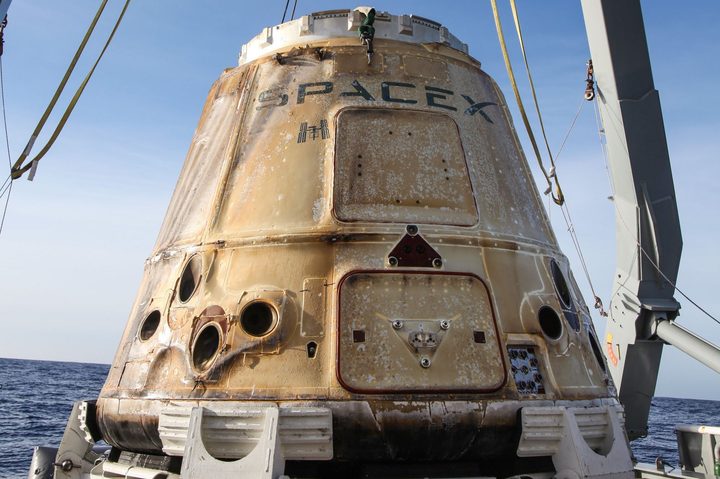
SpaceX and NASA say they finally know what caused its Crew Dragon capsule to explode during an April test of the spacecraft’s thruster system.

The culprit in the April 20 explosion was a leaky valve, which allowed some propellant to leak into high-pressure helium tubes around 100 seconds before the capsule’s thrusters were due to ignite, SpaceX said on Monday.

Recommended Videos

A slug of the propellant, known as nitrogen tetroxide (NTO), ended up in a high-pressure system, SpaceX wrote — resulting in an explosion. SpaceX said it plans to replace all of these valves with burst disks, which it says will “mitigate the risk entirely.”

SpaceX was joined by NASA, the Federal Aviation Administration (FAA), and the National Transportation Safety Board (NTSB) to investigate the explosion over the course of several months. The ground test at Cape Canaveral, Florida initially went well, with the craft successfully firing its Draco thrusters without any issues. The explosion took place as the SpaceX team was getting ready to fire the capsule’s more powerful SuperDraco thrusters.

NASA and SpaceX officials said at a press conference that the investigation was helped by the explosion taking place on the ground, which gave investigators the ability to search a relatively small area for evidence.

“We learned a very valuable lesson on something going forward, one that makes the Crew Dragon a safer vehicle,” said Hans Koenigsman, SpaceX’s vice president of build and flight reliability, according to The Verge.

The Crew Dragon is meant to ferry astronauts between the surface and the International Space Station (ISS). The company had initially planned to start those trips but the end of the summer, but it’s increasingly looking like crewed trips will be delayed until next year.

“My emphasis is really on making sure this is safe,” Koenigsman said. “So, end of the year, I don’t think it’s impossible, but it’s getting increasingly difficult.”

Despite the April explosion, SpaceX has recorded a number of successes as it moves to revolutionize commercial spaceflight. In June, it pulled off a nighttime launch of its Falcon Heavy Rocket, a feat that CEO Elon Musk called SpaceX’s “most difficult launch ever.”

Mathew Katz
Former Digital Trends Contributor
Mathew is a news editor at Digital Trends, specializing in covering all kinds of tech news — from video games to policy. He…
Google wants Gemini to help build the next big scientific breakthrough
Gemini for Science pushes agentic AI deeper into real research workflows
gemini for science

Google is building Gemini deeper into the research workflow, starting with ideas, tests, and scientific literature.

At Google I/O 2026, the company announced Gemini for Science, an experimental suite built around agentic AI science. It targets the manual work behind discovery, including hypothesis building, computational testing, and literature review.

Read more
You can now walk through AI versions of real places with Google’s Project Genie
Text, Logo

Google is pushing its experimental AI world-building project into surprisingly realistic territory. The company announced that Project Genie can now use real-world imagery from Google Street View to generate interactive virtual environments, blending real locations with imaginative AI-generated styles.

At its core, Genie is what Google calls a “world model” — an AI system capable of creating explorable digital environments where AI agents, robots, or even users can interact naturally. Until now, those worlds were mostly synthetic. But with this new update, Genie can anchor itself to real places pulled directly from Street View imagery. This is actually where things start feeling like a glimpse into the future of simulation.

Read more
Google wants to reinvent your TV remote with Gemini and pointer controls
Computer Hardware, Electronics, Hardware

Google is making a bigger play for the living room, and this time, it is not just about what you watch — it is also about how you interact with your TV. At Google I/O 2026, the company revealed a fresh batch of updates for Google TV and Android TV developers, all centered around one idea: TVs are no longer passive screens sitting in the corner of your house. With more than 300 million monthly active devices across Google TV and Android TV, Google clearly sees the television as its next major AI battleground. And Gemini is now at the center of that strategy.

The company says Gemini is already helping users discover content through natural voice interactions. But Google now wants the experience to feel more dynamic and conversational, almost like searching the web — except on your couch. Instead of only surfacing static results, Gemini on Google TV can now respond with a combination of visuals, videos, and text snippets to answer queries. So if someone asks for a thriller with a strong female lead or a documentary about space exploration, Gemini pulls contextual recommendations directly from streaming apps and their metadata.

Read more