  1. Home
  2. Emerging Tech
  3. News

Three new astronauts join the International Space Station crew for Expedition 60

Add as a preferred source on Google

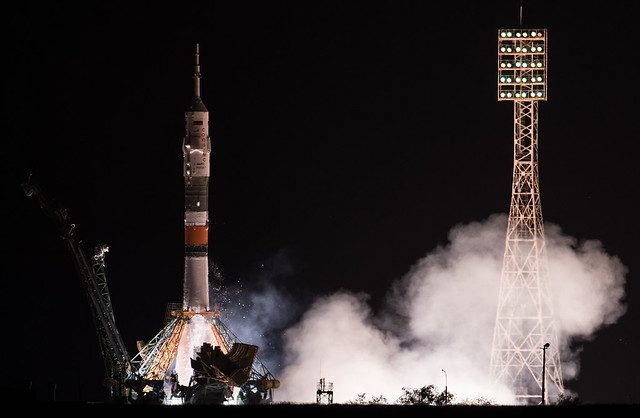
The Soyuz MS-13 rocket is launched with Expedition 60 Soyuz Commander Alexander Skvortsov of Roscosmos, flight engineer Drew Morgan of NASA, and flight engineer Luca Parmitano of ESA (European Space Agency). NASA/Joel Kowsky

Exactly fifty years after Neil Armstrong and Buzz Aldrin set foot on the moon, a new team of astronauts arrived at the International Space Station (ISS) to begin their stay there. The launch took place on Saturday, July 20, 2019 from the Baikonur Cosmodrome in Kazakhstan at 12:28 p.m. ET (9:28 p.m. Baikonur time) to carry the astronauts to the ISS.

Recommended Videos

The Expedition 60 crew includes NASA astronaut Andrew Morgan, Roscosmos astronaut Alexander Skvortsov, and European Space Agency astronaut Luca Parmitano. These three will join NASA’s Nick Hague and Christina Koch and Roscosmos’ Alexey Ovchinin who are already aboard the ISS.

Together, the new crew will spend more than six months on the station, performing scientific experiments and testing space equipment. The scientific research will include “investigations in fields such as biology, Earth science, human research, physical sciences, and technology development,” according to NASA, which will test the ways in which the low gravity environment affect outcomes. The experiments will include growing moss, printing biological tissue, and attempting a process called bio-mining which extracts metals from ores using fungi.

In addition, the crew will also be taking part in the arrival and installation of a second docking port aboard the station. This second dock will be for commercial crew spacecraft, such as those being developed by SpaceX and Boeing. The International Docking Adapter-3 (IDA-3), as it’s known, will be launched in a few days’ time as part of SpaceX Dragon’s 18th commercial resupply services mission on July 24. If you’re interested to see the launch as it happens, you can watch a livestream on NASA’s website.

Upon arrival, the docking port will be removed from the Dragon’s cargo hold using the ISS’s robotic arm, Canadarm2, and put into place. It will be installed over Pressurized Mating Adapter-3, which is part of the Harmony module. Astronauts Hague and Morgan will perform a spacewalk in August to install the docking port, and while they’re out there they will also install a new high-definition camera to monitor the exterior of the station. This is part of an ongoing mission to update the camera systems outside the station.

Georgina Torbet
Georgina has been the space writer at Digital Trends space writer for six years, covering human space exploration, planetary…
DJI’s first 360° drone offers 8K video recording and a freakishly long transmission range
From omnidirectional obstacle sensing to 42 GB of onboard storage, the Avata 360 is DJI doing what DJI does best: raising the bar for everyone else.
DJI Avata 360° drone.

DJI has officially entered the 360° drone arena with the launch of the Avata 360. It’s the company’s first-ever fully immersive FPV drone, and a direct shot at the Antigravity A1, a rival built by an Insta360-incubated brand. Looks like the drone wars just got more interesting. 

What makes the Avata 360 worth looking at?

Read more
I transferred all my chats from other AI apps to Gemini — and it works flawlessly
Google Gemini Graphics Featured

You know that moment when AI assistants like ChatGPT, Gemini, or Claude suddenly lose the plot mid-conversation and start hallucinating like they’re absolutely sure they’re right? Yeah…it’s equal parts funny and painfully annoying. My usual reaction is switching between apps, hoping one of them gets it right. But the real problem is that I have to start over every single time. It feels like I’m stuck in a loop explaining my life story to different AIs, one after the other.

Now with Gemini, I can now jump in from other AI apps without that whole reset conversation. Finally, the Google gods have blessed us. I tried it out expecting the usual hiccups, but it was surprisingly smooth and quick.

Read more
Google expands Search Live globally with voice and camera AI
The feature is now available in 200+ countries with multilingual support
Google Search Live

Google is taking another big step toward turning Search into a full-blown AI assistant. The company has officially expanded Search Live globally, making the feature available in over 200 countries and territories, along with support for dozens of languages.

https://twitter.com/google/status/2037201891130523917

Read more