  1. Home
  2. Emerging Tech
  3. News

SpaceX resupply mission to International Space Station scheduled for next week

Add as a preferred source on Google

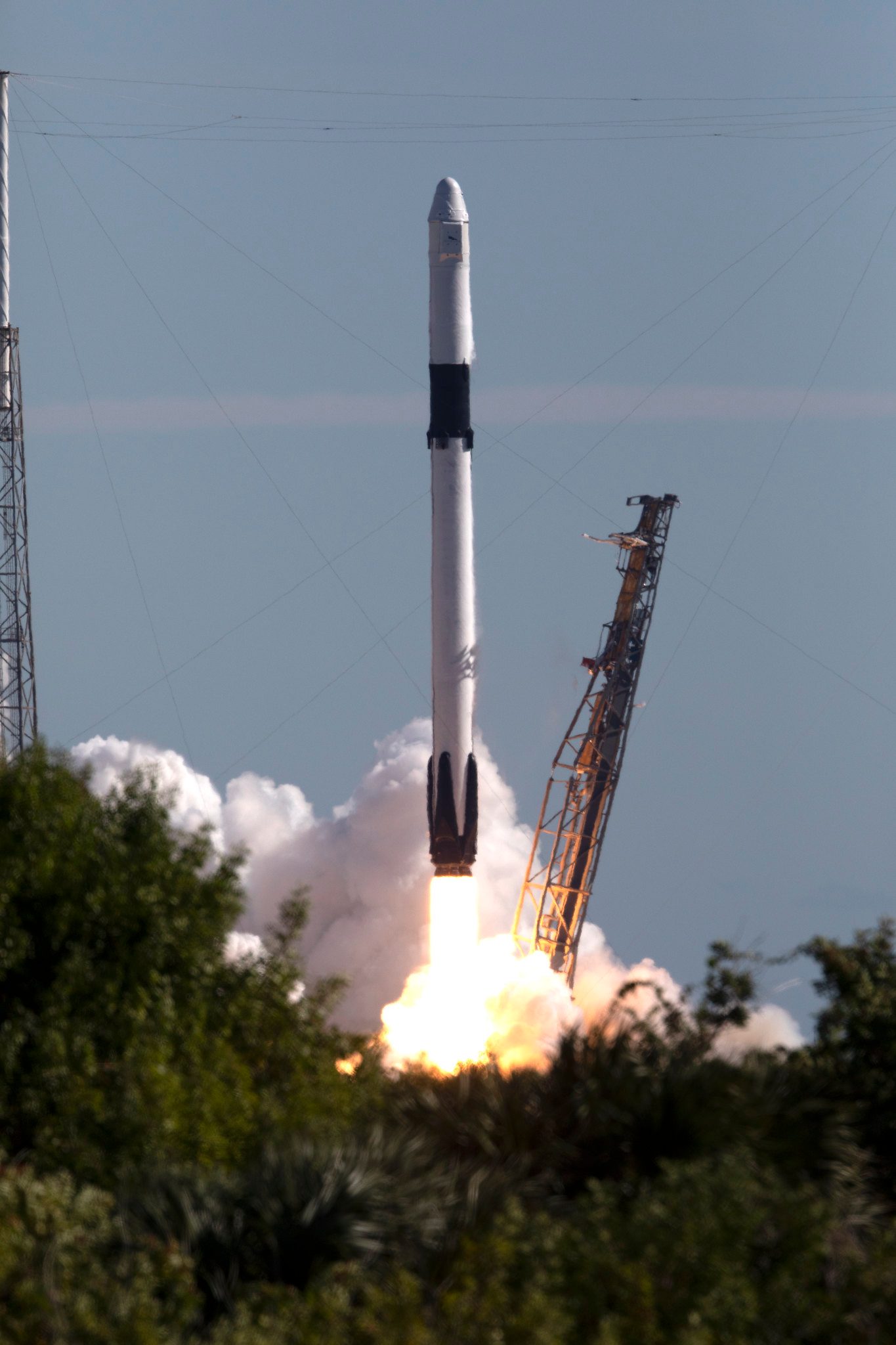
The two-stage Falcon 9 launch vehicle lifts off carrying the SpaceX Dragon resupply spacecraft to the International Space Station for its 16th commercial resupply services mission. NASA

SpaceX will shortly be launching another resupply mission to the International Space Station (ISS).

Recommended Videos

The SpaceX launch is scheduled to take place at 4:21 a.m. EDT on Tuesday, April 30. This will mark SpaceX’s 17th mission as part of the NASA Commercial Resupply Services contract, under which SpaceX delivers food, scientific equipment, and other supplies to the ISS.

The launch will make use of a Dragon reusable spacecraft, launched by a Falcon 9 launch vehicle. The Dragon is reusable in that components used to form the capsule, like the hull, thrusters, propellant tanks, and other structural elements, can be used for multiple launches. Other parts of the capsule, like the heat shield and batteries, must be replaced for each launch.

SpaceX is in the public eye for less than positive reasons lately, as a possible explosion of their new Crew Dragon capsule occurred during testing last week. But this shouldn’t affect the launch of the Dragon spacecraft, which is different from the new Crew Dragon capsule.

The Dragon craft will carry equipment to enable more scientific experiments aboard the ISS, including NASA’s Orbiting Carbon Observatory 3 (OCO-3) and Space Test Program-Houston 6 (STP-H6). The OCO-3 is for measuring and mapping the levels of carbon dioxide on our planet from space, which is important for understanding carbon’s role in climate change. The STP-H6 is a system for tracking and space communications. It uses X-rays instead of the radio wave frequencies which are typically used for communications, generating beams of X-rays which are modulated by an ultraviolet light-emitting diode (LED).

The journey to the ISS will take two days, and on its arrival the craft will be grabbed by the ISS’s robotic arm, controlled by Canadian Space Agency astronaut David Saint-Jacques. Once the craft has been captured, it will be installed at the bottom of the ISS module Harmony.

If you want to watch the launch, live coverage will be available through NASA TV starting on Monday. The relevant events are as follows (all times EDT):

Monday, April 29:

  • 10:30 a.m.  — SpaceX CRS-17 What’s On Board Briefing
  • 1 p.m. — SpaceX CRS-17 Pre-Launch News Conference

Tuesday, April 30:

  • 4 a.m. — Coverage of the Launch of the SpaceX CRS-17 Dragon Cargo Craft Mission to the International Space Station
  • 5:30 a.m. — SpaceX CRS-17 Post-Launch News Conference (time subject to change)
Georgina Torbet
Georgina has been the space writer at Digital Trends space writer for six years, covering human space exploration, planetary…
Google wants Gemini to help build the next big scientific breakthrough
Gemini for Science pushes agentic AI deeper into real research workflows
gemini for science

Google is building Gemini deeper into the research workflow, starting with ideas, tests, and scientific literature.

At Google I/O 2026, the company announced Gemini for Science, an experimental suite built around agentic AI science. It targets the manual work behind discovery, including hypothesis building, computational testing, and literature review.

Read more
You can now walk through AI versions of real places with Google’s Project Genie
Text, Logo

Google is pushing its experimental AI world-building project into surprisingly realistic territory. The company announced that Project Genie can now use real-world imagery from Google Street View to generate interactive virtual environments, blending real locations with imaginative AI-generated styles.

At its core, Genie is what Google calls a “world model” — an AI system capable of creating explorable digital environments where AI agents, robots, or even users can interact naturally. Until now, those worlds were mostly synthetic. But with this new update, Genie can anchor itself to real places pulled directly from Street View imagery. This is actually where things start feeling like a glimpse into the future of simulation.

Read more
Google wants to reinvent your TV remote with Gemini and pointer controls
Computer Hardware, Electronics, Hardware

Google is making a bigger play for the living room, and this time, it is not just about what you watch — it is also about how you interact with your TV. At Google I/O 2026, the company revealed a fresh batch of updates for Google TV and Android TV developers, all centered around one idea: TVs are no longer passive screens sitting in the corner of your house. With more than 300 million monthly active devices across Google TV and Android TV, Google clearly sees the television as its next major AI battleground. And Gemini is now at the center of that strategy.

The company says Gemini is already helping users discover content through natural voice interactions. But Google now wants the experience to feel more dynamic and conversational, almost like searching the web — except on your couch. Instead of only surfacing static results, Gemini on Google TV can now respond with a combination of visuals, videos, and text snippets to answer queries. So if someone asks for a thriller with a strong female lead or a documentary about space exploration, Gemini pulls contextual recommendations directly from streaming apps and their metadata.

Read more