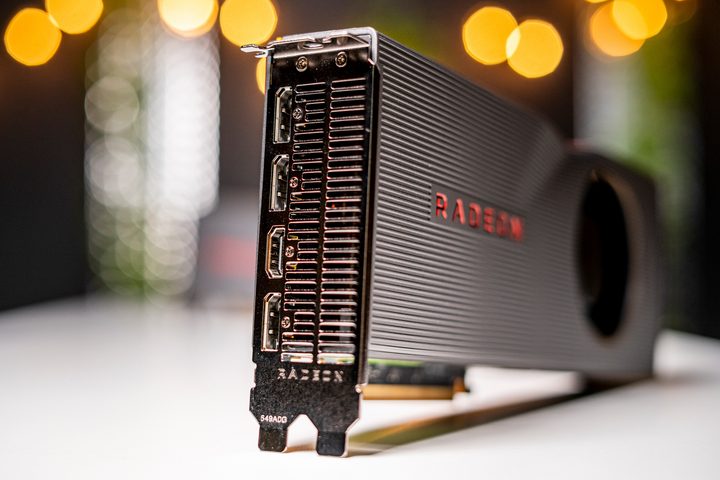
Based on the same 7nm technology that AMD recently brought to its new Radeon 5700 graphics family this year at E3, the new entry-level Radeon 5500 graphics card is built for 1080p gaming. Whereas the 57800 series was designed for 1440p gameplay, the 5500 series is designed to bring responsive gameplay to 1080p gaming, including 60 frames-per-second (fps) on high-end AAA titles and 90 fps performance for esports games. Like its premium sibling, the 5500 series is built on AMD’s Navi platform using the 7nm manufacturing process and the company’s RDNA architecture. AMD’s Radeon 5500 series graphics will be available on both desktops and laptops. With the launch of the Radeon 5500 series, AMD is working with OEM partners to make its graphics cards more accessible. While the 5700 series is now available on Alienware, HP Omen, and Lenovo Legion configurations, systems with Radeon 5500 will be coming in the fourth quarter from Asus, MSI, Gigabyte, ASRock, PowerColor, XFX, and Sapphire.
The Radeon 5500 boasts a design with 22 compute units and 1,408 stream processors that is capable of 5.2 teraflops on desktop or 4.6 teraflops on mobile. The gaming clock speed is 1.448 GHz on mobile or 1.717 GHz on desktop. The card supports up to 8GB of GDDR6 memory on laptops and that amount is doubled for desktops. With support for PCIe 4.0 and GDDR6 memory, AMD claimed that its new 5500 series delivers twice the performance and bandwidth in these key areas as the preceding PCIe 3.0 standard and GGDR5 class memory.
AMD benchmarked performance of the new Radeon 5500 graphics against its older RX480 and rival Nvidia’s GTX 1060 graphics because that is where most users will be upgrading from, according to company executives. The new GPU performs well, delivering a 1.6X performance per watt jump and a 1.7X performance per area boost. The new part gets a 20% absolute performance boost compared to the RX480 while consuming 27% less power. During a web presentation, AMD showed that its new 5500 series is capable of delivering 92 fps on Gears 5, 82 fps on Borderlands 3, and 60 fps on Ghost Recon, performance that places the card well ahead of Nvidia’s GTX 1650, which performed at 61 fps, 61 fps, and 47 fps, respectively. In epic mode on Overwatch, for example, frame rates went as high as 135 fps with the Radeon 5500, compared to just 89 fps on Nvidia’s card. The Radeon 5500M for laptops delivered similar results, and AMD expects its part to deliver up to 30% faster performance than Nvidia’s GTX 1650 Mobile graphics.
As a bonus to gamers who buy an OEM system with 5500 or 5700 graphics, AMD is throwing in either Borderlands 3 or Ghost Recon for free as part of a promotion. 5500 graphics will work with FreeSync, so be sure to pair your new system with a capable monitor for tear-free graphics.
Along with zero-day drivers, AMD is also working with game developers to optimize games for Radeon GPUs, bringing technologies like FidelityFX, Anit-Lag, and image sharpening that debuted on the 5700 series to the new mainstream 5500 graphics. Anti-Lag improves response time by as much as 23%, according to AMD’s tests, and the feature is noted as being important for gamers in the esports arena. Image sharpening also improves graphics rendering details in scene, making game play more visually immersive. As a subtle dig to Nvidia, AMD claimed that it was committed to bringing all of its new graphics features to every member of its Navi graphics family.