  1. Home
  2. Emerging Tech
  3. News

Could Enceladus, the icy moon of Saturn, be capable of supporting life?

Add as a preferred source on Google
 

New research using data from the Cassini probe suggests that Enceladus, the moon of Saturn with an ocean hidden beneath a thick layer of ice, could be capable of supporting life.

Recommended Videos

Cracks in the icy surface of the moon let out plumes of gases and sea spray, and data about these plumes can reveal more about the ocean beneath the ice. “By understanding the composition of the plume, we can learn about what the ocean is like, how it got to be this way and whether it provides environments where life as we know it could survive,” Dr. Christopher Glein of the Southwest Research Institute, lead author of the research, explained in a statement.

“We came up with a new technique for analyzing the plume composition to estimate the concentration of dissolved CO2 in the ocean. This enabled modeling to probe deeper interior processes.”
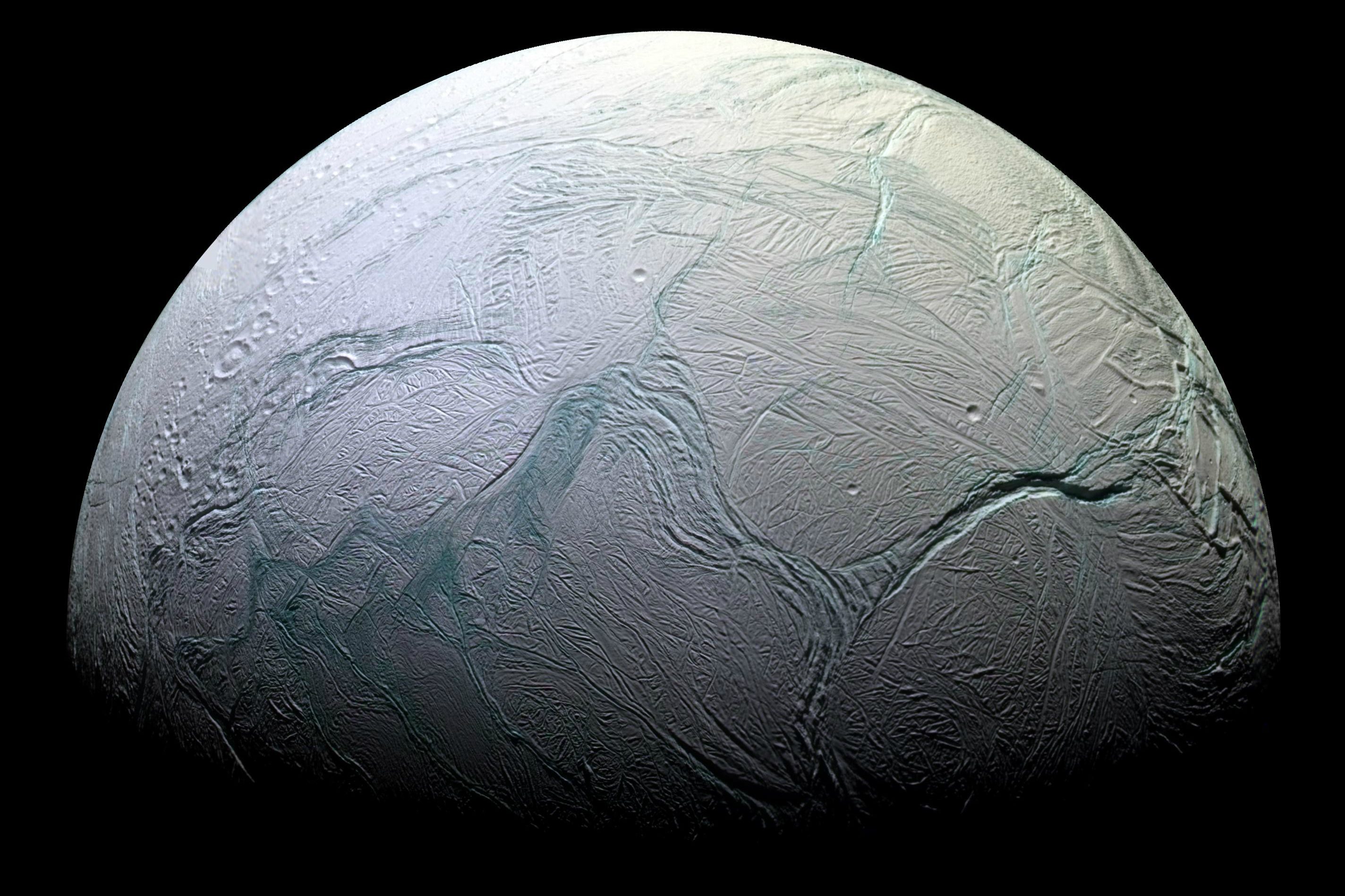
Saturn’s geologically active moon, Enceladus. NASA/JPL

The team found an abundance of carbon dioxide, likely created by chemical reactions on Enceladus’ ocean floor. In addition, there are thought to be hydrothermal vents on the ocean floor which vent hot fluids rich in minerals into the water, similar to those found on the ocean floor on Earth which could have been the starting point of life here.

The big shock of this finding is that it means Enceladus may be capable of supporting life. Although there is no evidence that life is there now, the conditions there could be conducive to the formation of simple lifeforms.

“The dynamic interface of a complex core and seawater could potentially create energy sources that might support life,” said Dr. Hunter Waite, principal investigator of Cassini’s Ion Neutral Mass Spectrometer, an instrument that collected data on the atmospheric composition of Saturn and its moons. “While we have not found evidence of the presence of microbial life in the ocean of Enceladus, the growing evidence for chemical disequilibrium offers a tantalizing hint that habitable conditions could exist beneath the moon’s icy crust.”

The research suggests that the rocky core of Enceladus is more complex than we realized, with what the scientists describe as “a carbonated upper layer and a serpentinized interior.” This core seems to be influencing the carbon dioxide in the ocean through chemical reactions, making the ice moon a hubbub of chemical activity.

“The implications for possible life enabled by a heterogeneous core structure are intriguing,” said Glein. “This model could explain how planetary differentiation and alteration processes create chemical (energy) gradients needed by subsurface life.”

Georgina Torbet
Georgina has been the space writer at Digital Trends space writer for six years, covering human space exploration, planetary…
Robots just ran the Beijing half-marathon faster than the world record holder
humanoid robot running a marathon

A humanoid robot just ran a half-marathon faster than the world record holder. It might not seem impressive at first, but considering last year, the fastest robot at Beijing's humanoid robot half-marathon finished in two hours and 40 minutes, this is a huge achievement. 

As reported by the Associated Press, the winning robot at this year's Beijing half-marathon crossed the finish line in 50 minutes and 26 seconds, comfortably beating the human world record of 57 minutes recently set by Jacob Kiplimo. 

Read more
As if the plate wasn’t already full, AI is about to worsen the global e-waste crisis
New report highlights a rising environmental concern
Stack of graphics cards and motherboards in a landfill site e-waste

AI is already changing how the world works, but it’s also quietly making one of our biggest environmental problems even worse. And no, this isn’t about energy consumption this time. It’s about the hardware. Because every smarter AI model comes with a physical cost.

AI is about to supercharge the e-waste problem

Read more
Smart glasses are finding a surprise niche — Korean drama and theater shows
Urban, Night Life, Person

Every year, millions of people follow Korean content without speaking a word of the language. They stream shows with subtitles, read translated lyrics, and find workarounds. But live theater has always been a different problem — you can't pause or rewind it. That's the problem: a Korean startup thinks it's cracked, and Yuroy Wang was one of the first to try it. The 22-year-old Taipei retail worker is a K-pop fan who loves Korean culture but doesn't speak the language. When he went to see "The Second Chance Convenience Store," a touring play based on a Korean novel that was a bestseller in Taiwan, he expected supertitles. What he got instead was a pair of chunky black-framed AI-powered glasses sitting on his nose, translating the dialogue in real time directly on the lenses. "As soon as I found out they were available, I couldn't wait to try them," he said. Wang is part of a growing audience discovering that smart glasses, a category of tech that has struggled to find mainstream purpose for years, might have just found their calling in the most unexpected of places: live Korean theater.

How do the glasses work?

Read more