  1. Home
  2. Space
  3. News

Hubble observes a giant planet growing as it gobbles up dust and gas

Add as a preferred source on Google

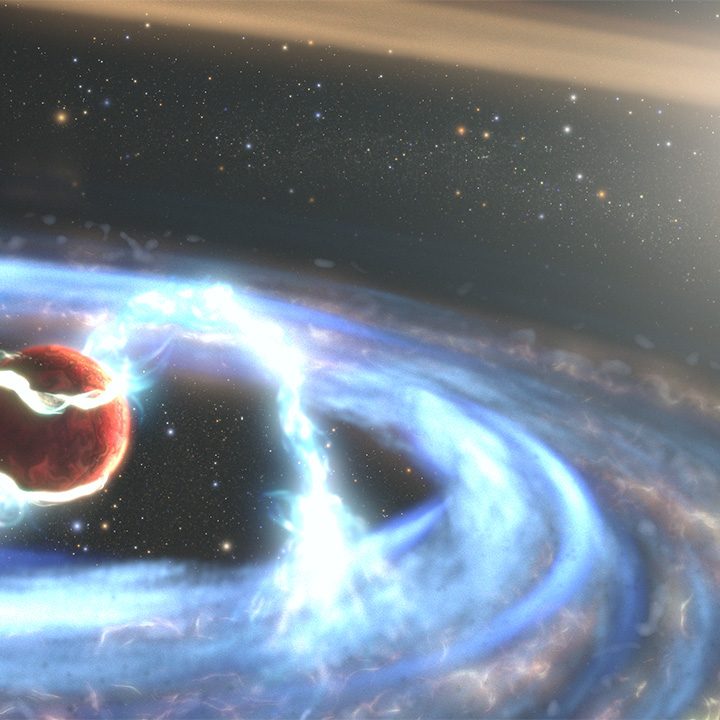
This illustration of the newly forming exoplanet PDS 70b shows how material may be falling onto the giant world as it builds up mass. By employing Hubble’s ultraviolet light (UV) sensitivity, researchers got a unique look at radiation from extremely hot gas falling onto the planet, allowing them to directly measure the planet’s mass growth rate for the first time.
This illustration of the newly forming exoplanet PDS 70b shows how material may be falling onto the giant world as it builds up mass. By employing Hubble’s ultraviolet light (UV) sensitivity, researchers got a unique look at radiation from extremely hot gas falling onto the planet, allowing them to directly measure the planet’s mass growth rate for the first time. SCIENCE: McDonald Observatory–University of Texas, Yifan Zhou (UT) ILLUSTRATION: NASA, ESA, STScI, Joseph Olmsted (STScI)

Planets come in many compositions and sizes, and they can grow considerably larger than even the gas giants in our solar system. One such giant planet, PDS 70b, is two to three times the radius of Jupiter, and around three times its mass as well. Now, Hubble has made a rare direct observation of this planet to learn about how such large planets grow.

Recommended Videos

The planet’s host star, orange dwarf PDS 70, is located 370 light-years away in the constellation of Centaurus, and this is one of the relatively few systems in which a planet has been directly imaged. Most of the time, exoplanets are detected by seeing how light coming from their host star changes, from which the presence of planets can be inferred. But occasionally, a planet is big enough to be seen directly, like the chunky PDS 70b.

Not only could Hubble observe the planet, but it could also see how fast it grows by observing radiation from hot gas which is falling toward it. The planet is moving through a cloud of dust and gas around the star, and it gathers up material as it travels. The researchers believe that although the planet is still growing, it will soon come to the end of its growth phase.

“We just don’t know very much about how giant planets grow,” said one of the researchers, Brendan Bowler of the University of Texas at Austin, in a statement. “This planetary system gives us the first opportunity to witness material falling onto a planet. Our results open up a new area for this research.”

“This system is so exciting because we can witness the formation of a planet,” said another researcher, Yifan Zhou, also of the University of Texas at Austin. “This is the youngest bona fide planet Hubble has ever directly imaged.”

Learning about how this planet is growing can also teach us about how planets like Jupiter formed in our solar system. It too may have grown by scooping up material from a disk of dust and gas.

“Thirty-one years after launch, we’re still finding new ways to use Hubble,” Bowler said. “Yifan’s observing strategy and post-processing technique will open new windows into studying similar systems, or even the same system, repeatedly with Hubble. With future observations, we could potentially discover when the majority of the gas and dust falls onto their planets and if it does so at a constant rate.”

Georgina Torbet
Georgina has been the space writer at Digital Trends space writer for six years, covering human space exploration, planetary…
Stunning close-up footage shows NASA’s moon rocket roaring to space
On its first crewed flight, NASA's lunar rocket displays its awesome power.
NASA's SLS rocket roars skyward at the start of the Artemis II mission on April 1, 2026.

As NASA’s Artemis II astronauts journey back to Earth following their breathtaking close encounter with the moon earlier this week, the space agency has just shared some stunning footage (below) of the rocket launch that sent the crew on its way on April 1.

The close-up tracking shot shows the awesome power of the Space Launch System (SLS) rocket’s four core RS-25 engines together and its two solid rocket boosters as the 98-meter-tall vehicle roars away from the launchpad at the Kennedy Space Center in Florida.

Read more
How to watch NASA’s moon crew splash down at end of historic mission
The Orion spacecraft's final moments before splashdown will be the most perilous of the entire mission.
Earth and the moon as seen from the Orion spacecraft during the Artemis II mission in April 2026.

The Artemis II astronauts have looped around the moon, captured some extraordinary imagery (above), set a slew of records, and are now on their way back to Earth.

The 10-day mission will reach its climax on Friday, April 10, during a dramatic homecoming that will see the Orion spacecraft enter our planet’s atmosphere at a speed of nearly 25,000 miles per hour.

Read more
Notable firsts of the Artemis II moon mission … so far
The Artemis II crew are now on their way home, so let's take a look at the mission's achievements so far.
The moon as seen from the Orion spacecraft during the Artemis II mission.

Having just looped around the moon in a historic flyby of our nearest neighbor, the Artemis II crew are now on their way back to Earth.

NASA’s Victor Glover, Reid Wiseman, and Christina Koch, along with the Canadian Space Agency’s Jeremy Hansen, launched aboard the Orion spacecraft from the Kennedy Space Center on April 1, lifted to space by the mighty SLS rocket.

Read more