
As smart as robot vacuums are, wires are often the bane of their existence. Wires can entangle the wheels and cause the vacuums to become stuck or, worse, the robots catch the wires and unplug electronics or yank them off a shelf. I’ve had this happen on multiple occasions with wired smart lights, and once with my phone charger. Robot vacuums and iPhones do not mix.
There’s hope, though, as iRobot recently announced the j7+, a robot vacuum that can identify obstacles and avoid them with the help of a camera. This includes wires, as well as pet waste and other obstacles. It comes as no real surprise, though; if any company can make a robot vacuum that avoids wires, it’s iRobot.
An outstanding track record
There is a reason iRobot is the market leader. The company takes every bit of data provided by its previous models and uses that information to improve the functionality and navigation of future devices. I own two of the devices (the Roomba i7+ and the Braava Jet) and find myself constantly amazed at how well both work.
Every iteration of Roomba has improved upon the previous generation. New functionality comes with each generation. For instance, suggested cleaning routines are incredibly helpful and originated as a result of iRobot watching how owners used their robot vacuums. Repeated cleaning of specific areas identifies them as spots that get dirty more often, such as around the coffee table or the kitchen table.
Dozens of gradual improvements have resulted in the current operating system, the iRobot Genius 3.0. This system brings never-before-seen levels of A.I. personalization and control to robot vacuums. The system utilizes your phone’s location services to begin cleaning when you leave home and stop when you come home, ensuring a clean floor at all times.
It also provides suggestions once it completes its Smart Map. The Genius 3.0 system makes guesses based on room size and layout to determine what purpose the room might serve. Users can choose these suggestions rather than naming each room individually.
Two more improvements are found in the Cleaning Time Estimates, which give you a rough idea of how long it will take to finish cleaning a given space, as well as the Quiet Drive feature, which turns off the vacuum components of the Roomba until it begins actively working to reduce noise.
The proof is in the pudding, or rather in your Roomba’s ability to avoid the pudding on the floor.
Teaching robots to be better
In a meeting, iRobot shared that the new j7+ will send encrypted photographs of obstacles back to the company. These photographs will then be used to train this model, as well as future Roombas, to be better at obstacle avoidance. It’s an opt-in service users will have to agree to, but not necessary for the bot to function correctly.
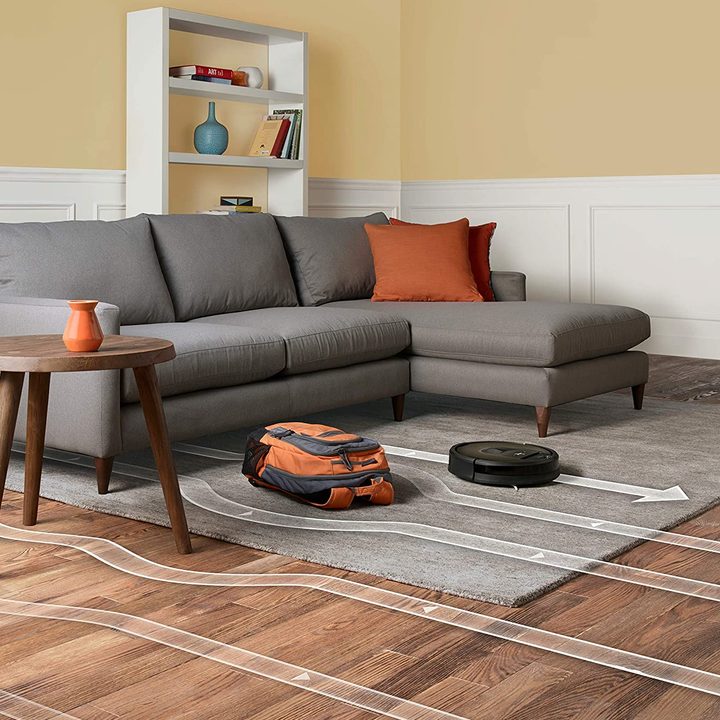
Many of the Roombas on the market today are already fantastic at dodging obstacles in their path. For many people, this comes as a surprise. Most Roombas do not use lidar (light detection and ranging) to navigate through a room, but instead rely on a navigation system called VSLAM (visual simultaneous localization and mapping.)
While lidar is considered the best at navigation, VSLAM uses “sight” to map out a space and move around obstacles. In an interview in 2019, Colin Angle, the CEO and co-founder of iRobot, said he believes vision is the future of robotics.
The cameras and sensors used in VSLAM navigation provide more data overall than lidar. As A.I. processing grows faster and more efficient with time, so will robots’ ability to navigate through a given space. A good example is a couch with empty space underneath it, but a sort of skirt hanging down to the floor. lidar-based navigation systems will see the skirt as an obstacle, while a camera-based navigation system will push through it.
VSLAM devices don’t rely solely on the camera for navigation, but make use of a lot of different sensors: Bump and wall sensors, cliff sensors, and much more.
Of course, any device that sends information back to its parent company will have privacy concerns, but iRobot implements a lot of safety protocols into its devices, and users will likely be able to opt out of sending this data back to the company.
No more yanking cables out of the wall
Few things in life are as exasperating as trying to free a robot vacuum that has become tangled in cords in a narrow space. In an ideal world, everyone’s cable management skills would be able to avoid such issues in the first place, but let’s face it: Most of us have a rat’s nest of cables tucked away behind or to the side of our television.
Thanks to a combination of machine learning, artificial intelligence, and the unique navigation abilities found in the iRobot Roomba j7+, worrying about cables might be a thing of the past. Many of these upgrades can also be applied retroactively to earlier models.
Given the kind of work iRobot has already done in this space, I’m not surprised that it’s leading the charge to avoid cables. Other robot vacuums have used lidar to avoid pet poop, but ultimately, I want my robots to be able to “see” what’s in front of them and move around it — whether that obstacle is a hairball or a hair brush.


