  1. Home
  2. Computing
  3. News

Cyberattacks have nearly doubled since last year, report says

Add as a preferred source on Google

A recent analysis by fraud-buster and cybersecurity company Seon found that cyberattacks have nearly doubled since last year. Given that the number of people using the internet worldwide is creeping upward quite slowly by comparison, that means the odds that you’ll be affected are increasing rapidly. It’s time to double-check your security settings.

The most common cyberattacks reported were ransomware, phishing, and malware. Ransomware refers to software that threatens you with data loss or the sharing of personal information if a payment isn’t made. Malware is similar but takes direct action to gain unauthorized access to your data, storage, and computer-processing power.
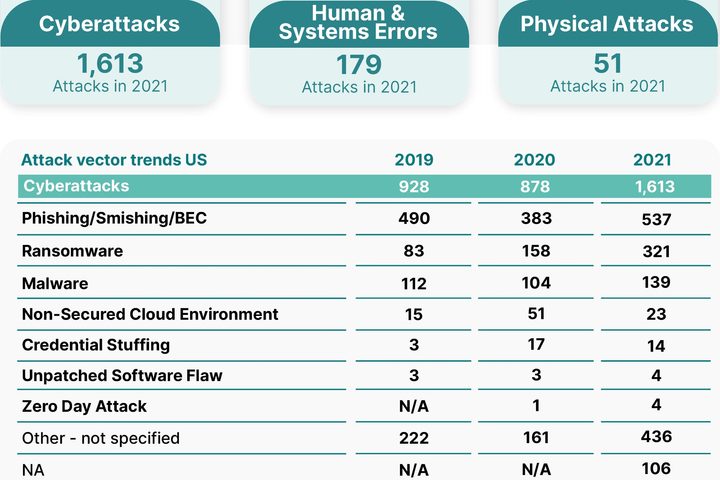
Seon's cyberattack report identifies the top threats.
Image used with permission by copyright holder

Phishing sounds like funny word, but it’s a far more devious scam. It is exactly what it sounds like, fishing for details, but the “ph” soelling was likely inspired by the earlier term phreaking, which was a portmanteau of “phone” and “freak,” which involved hacking of the telephone system. Phishing often takes the form of an email or social media message from someone pretending to be someone else to gather personal information.

Recommended Videos

The fourth most frequent type of cyberattacks include unsecured cloud environments, which thankfully has become less common, dropping by more than 50% and representing less than 1% of the cases noted by Seon. Stolen logins, known as credential stuffing, also accounted for less than 1%.

Software flaws and zero-day attacks barely made a blip. It’s worth noting that 34% of the cyberattacks mentioned were uncategorized so there’s a big margin of error in this report, with some scams likely happening much more frequently. Seon’s full report is available on its website.

Password-free sign-ins are coming soon, which will help greatly, but that doesn’t mean it’s time to ease up on security. As cyberattacks become more frequent, you should shore up your computer defenses.

Some of the best ways to do so are also fairly easy. Keep your operating system updated to the latest version, and also update apps, particularly your browser. Login safety can be improved by choosing stronger passwords, and enabling two-factor authentication.


Alan Truly
Alan Truly is a Writer at Digital Trends, covering computers, laptops, hardware, software, and accessories that stand out as…
Meta’s Ray-Ban Display now types messages from your finger movements
Neural Handwriting is a really cool feature, but Meta opening the Ray-Ban Display to developers is the quiet announcement that turns a clever wearable into a platform with immense possibilities.
Meta Ray-Ban Display and EMG Band.

Six months into its life, the Meta Ray-Ban Display is starting to look less like an experiment, thanks to what is arguably the most significant update Meta has ever pushed for the device. 

The headline feature is Neural Handwriting, which is now available to every Ray-Ban Display owner, having spent its early months in limited access for Messenger and WhatsApp users. 

Read more
Asus unveils the 320W ROG Strix Scar 18 with RTX 5090, but it’s the CPU that steals the show
Asus extracting 81% more CPU wattage from the 2026 Strix SCAR 18 while Nvidia keeps the GPU locked at 175W is the most interesting story in this spec sheet.
Computer, Electronics, Laptop

Asus has announced a new gaming laptop, the ROG Strix Scar 18 (2026), with a claim that it’s the most powerful gaming laptop the company has ever built. 

The main highlight of the device is the 320W of total system power: 145W to the Intel Core Ultra 9 290HX Plus and 175W to the Nvidia GeForce RTX 5090 laptop GPU. While the CPU offers a meaningful upgrade over the 2025 model, the GPU has been borrowed unchanged. 

Read more
ChatGPT will now dole out finance tips if you connect your bank account. I won’t.
ChatGPT can now access your bank account to offer spending analysis and financial planning.
chatgpt-personal-finance

ChatGPT already knows a lot about you. OpenAI now wants to add your finances to that list. The company has launched a personal finance feature for ChatGPT, currently in preview for Pro subscribers in the US at $200 a month. OpenAI says it will expand to Plus users after gathering feedback from this early rollout.

It lets you connect your financial accounts through Plaid, a platform that bridges bank apps with third-party services and works with over 12,000 institutions, including Chase, Fidelity, Schwab, American Express, and more.

Read more