  1. Home
  2. Computing
  3. Space
  4. News

Check out this supercomputer’s stunning image of a supernova remnant

Add as a preferred source on Google

Australia’s newest supercomputer has crunched masses of data to create a stunning image of a supernova remnant.

The supercomputer — named Setonix after Western Australia’s favorite animal, the quokka (Setonix brachyurus) — created the highly detailed image using data collected by ASKAP (Australian Square Kilometre Array) radio telescope, which is operated by CSIRO (Commonwealth Scientific and Industrial Research Organisation), the country’s science agency.

Recommended Videos

Setonix is located at the Pawsey Supercomputing Research Centre in Perth and is a key part of the facility’s recent $70 million upgrade. The supercomputer is being installed in two stages, with the second stage expected to be up and running by the end of 2022.

Dr. Pascal Elahi, Pawsey’s supercomputing applications specialist, said that processing data from ASKAP’s astronomy surveys “is a great way to stress-test the Setonix system and see what is possible.”
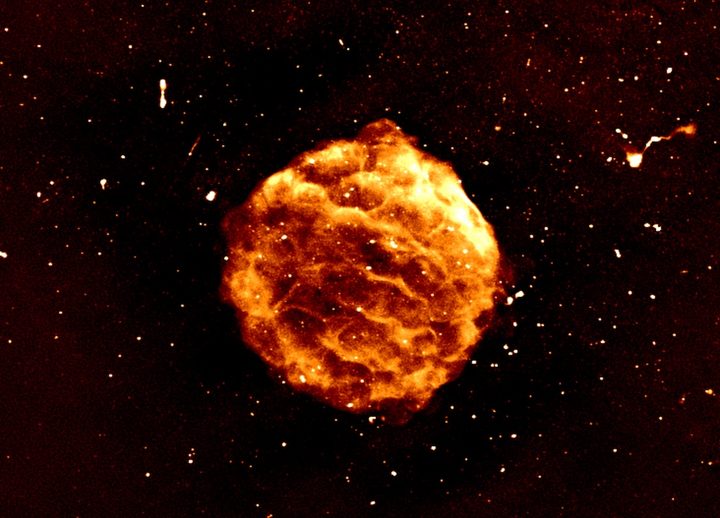
An image of a supernova remnant created by Setonix, Australia's newest supercomputer.
This radio continuum (943.5 MHz) ASKAP image is of the galactic supernova remnant G261.9+5.5, located somewhere between 10,000 and 15,000 light years away. It was originally discovered by CSIRO scientist E. R. Hill in 1967, however not much is known about it. The morphology of the remnant revealed in the ASKAP image will aid in studying the remnant and its surrounding medium in unprecedented detail. Researchers hope to retrieve more information about the remnant’s age, size, and type from this data. Credit: Dr Wasim Raja/CSIRO, Dr Pascal Elah/Pawsey

Dr. Wasim Raja, a researcher on CSIRO’s ASKAP team, said the challenges in imaging a complex object like a supernova remnant (essentially the clouds of material that emerge from the explosion of a huge star at the end of its life) made it the ideal dataset for testing Setonix’s processing software.

“Setonix’s large, shared memory will allow us to use more of our software features and further enhance the quality of our images,” Raja said. “This means we will be able to unearth more from the ASKAP data.”

When the second stage of Setonix is fully deployed, the supercomputer will be up to 30 times more powerful than the combined capability of Pawsey’s earlier systems, Galaxy and Magnus.

The increased processing power means that we can expect even more incredible images from Setonix as ASKAP plans to send it more data from larger and deeper surveys of the sky.

Trevor Mogg
Contributing Editor
Not so many moons ago, Trevor moved from one tea-loving island nation that drives on the left (Britain) to another (Japan)…
AI may have just won a literary prize. My heart weeps seeing it poison our love for books.
updated book and AI photo

I had a hard time processing this news. As someone who has been deeply in love with stories since childhood and who grew up on the works of Arthur Conan Doyle, Terry Pratchett, J.R.R. Tolkien, and other such venerable authors, seeing an AI-written story win a prestigious writing award is hard to digest. 

If you are unaware, the winners for the Commonwealth Short Story Prize for 2026 were announced, and three of the five winning regional stories have been found to be entirely or partially written by AI. Or at least that seems to be the consensus among readers. As a reader and an amateur fiction writer, this hurt me deeper than any other tale of AI corroding our lives.

Read more
Canva and Adobe are coming to Gemini, and they want to make everything chatty
Adobe and Canva are plugging into Google’s assistant, betting that creative work starts with a prompt, not an app icon
Art, Collage, Photography

Canva and Adobe are moving deeper into Google Gemini, giving the assistant a bigger role before users ever open a design app.

Adobe says its "Adobe for creativity" connector is coming to Gemini in the coming weeks, giving users a way to describe tasks and send them through Adobe tools for imaging, design, and video. Canva is already rolling out its Connected App for Gemini in select English-language markets, with full availability coming soon.

Read more
AI can pass the Turing Test in live chats and appear more human than us. I am spooked now
UC San Diego researchers found GPT-4.5 was judged human 73% of the time in live conversations
Image of a human woman next to an AI-generated face with Real or Fake text at the bottom.

AI can pass the Turing Test in live chats, and the latest result lands with a chill. In a UC San Diego study, GPT-4.5 outperformed real participants at convincing judges there was a person on the other side.

The setup was harder to shrug off than a standard benchmark. Judges reacted to real-time exchanges rather than static prompts, then made a fast call based on conversation alone.

Read more