  1. Home
  2. Space
  3. News

This is the remnant of a star that exploded 1,700 years ago

Add as a preferred source on Google

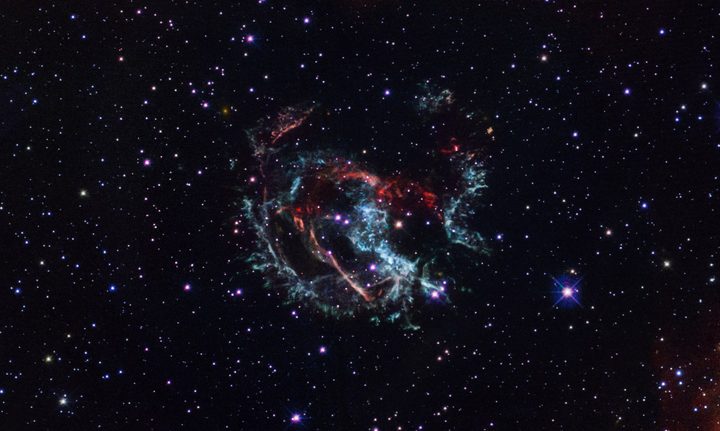
This Hubble Space Telescope portrait reveals the gaseous remains of an exploded massive star that erupted approximately 1,700 years ago.
This Hubble Space Telescope portrait reveals the gaseous remains of an exploded massive star that erupted approximately 1,700 years ago. The stellar corpse, a supernova remnant named 1E 0102.2-7219, met its demise in the Small Magellanic Cloud, a satellite galaxy of our Milky Way. NASA , ESA , STScI, and J. Banovetz and D. Milisavljevic (Purdue University)

When a large star reaches the end of its life, it explodes in an enormous outpouring of energy called a supernova. As the shockwave from the explosion travels out into space, it creates a remnant that can persist for thousands of years. One such remnant has been imaged by the Hubble Space Telescope, and researchers have tracked its origin back to a supernova that occurred 1,700 years ago.

Recommended Videos

To work out the age of remnant 1E 0102.2-7219, the Hubble researchers compared images of it taken 10 years apart. By comparing the two, they could see how clumps of ejecta (or knots) were spreading out over time. And by running this rate backward, they could work out the time at which the supernova must have occurred.

This result differs from previous attempts to pinpoint the age of the remnant, which used data from different cameras. By using data from the same camera, the new result is more accurate.

“A prior study compared images taken years apart with two different cameras on Hubble, the Wide Field Planetary Camera 2 and the Advanced Camera for Surveys (ACS),” research team leader Danny Milisavljevic of Purdue University explained in a statement. “But our study compares data taken with the same camera, the ACS, making the comparison much more robust; the knots were much easier to track using the same instrument. It’s a testament to the longevity of Hubble that we could do such a clean comparison of images taken 10 years apart.”

When the supernova occurred, it also sent the crushed heart of the star — a neutron star — zipping off into space. The researchers estimate that the neutron star is moving at more than 2 million miles per hour.

“That is pretty fast and at the extreme end of how fast we think a neutron star can be moving, even if it got a kick from the supernova explosion,” fellow team leader John Banovetz said.

The researchers have identified an object which might be the neutron star in question, but they aren’t sure if it definitely is the object they’re looking for just yet.

“More recent investigations call into question whether the object is actually the surviving neutron star of the supernova explosion. It is potentially just a compact clump of supernova ejecta that has been lit up, and our results generally support this conclusion,” Banowetz said.

Georgina Torbet
Georgina has been the space writer at Digital Trends space writer for six years, covering human space exploration, planetary…
Scientists have found a hidden galaxy inside the Milky Way, and they’re calling it Loki
A lost dwarf galaxy may be hiding inside the Milky Way.
milky-way-hidden-galaxy-loki

Our home galaxy has a secret buried inside. A new study published in the Monthly Notices of the Royal Astronomical Society suggests that the Milky Way swallowed an ancient dwarf galaxy billions of years ago, and its stellar remains are still embedded within ours.

Researchers have named this lost galaxy Loki, after the Norse trickster god, and the name is quite fitting because it remained hidden in plain sight for a very long time.

Read more
NASA aims September launch for Roman space telescope and it’s going to be a huge shift
An earlier target for Roman means one of NASA’s most ambitious observatories is getting close, with the potential to open a huge new era in space discovery
Machine, Wheel, Astronomy

NASA is now aiming to launch the Nancy Grace Roman Space Telescope as soon as early September 2026, a faster timeline than its earlier commitment to fly no later than May 2027. That alone makes this one of the agency’s most important missions to watch over the next few months.

The reason is simple, Roman is built to scan vast parts of the sky with sharp infrared vision.

Read more
Blue Origin successfully re-uses a New Glenn rocket for the first time ever
Blue Origin achieves first New Glenn reflight despite payload setback
Blue Origin

Blue Origin has achieved a major milestone in its spaceflight ambitions by successfully reusing a booster from its heavy-lift New Glenn rocket for the first time. The historic launch, conducted on April 19, marks a significant step forward for Jeff Bezos’ space company as it seeks to compete with rivals like SpaceX in the rapidly evolving commercial launch market.

A Milestone With A Mixed Outcome

Read more