  1. Home
  2. Space
  3. News

James Webb snapped a picture of an exoplanet for the first time

Add as a preferred source on Google

The James Webb Space Telescope has directly imaged an exoplanet for the first time. This is exciting because it is very rare for exoplanets to be directly imaged, as usually, their existence has to be inferred from other data. By taking an image of a planet outside our solar system, Webb demonstrates how we’ll be able to gather more information than ever before about distant worlds.

There are over 5,000 known exoplanets, but the vast majority of these have been detected using techniques like the transit method, in which the light from a host star dips slightly when a planet passes in front of it, or radial velocity, in which a star is slightly tugged around by the gravity of a planet. In these methods, the existence of a planet is inferred because of the effect that can be observed on a star, so the planet itself isn’t directly observed. In rare cases, however, an exoplanet can be observed directly, particularly if it is a large planet located relatively nearby.
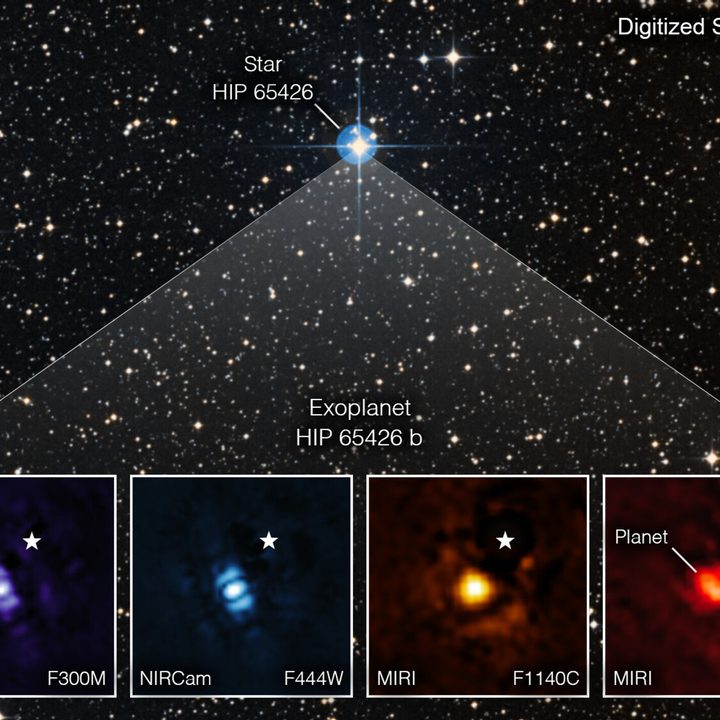
This image shows the exoplanet HIP 65426 b in different bands of infrared light.
This image shows the exoplanet HIP 65426 b in different bands of infrared light, as seen from the James Webb Space Telescope: purple shows the NIRCam instrument’s view at 3.00 micrometers, blue shows the NIRCam instrument’s view at 4.44 micrometers, yellow shows the MIRI instrument’s view at 11.4 micrometers, and red shows the MIRI instrument’s view at 15.5 micrometers. These images look different because of the ways the different Webb instruments capture light. NASA/ESA/CSA, A Carter (UCSC), the ERS 1386 team, and A. Pagan (STScI)

Webb made one such direct observation of the exoplanet HIP 65426 b, and was able to capture an image of the planet using four different filters. Each of these filters corresponds to a different wavelength of light, capturing different features of the planet and its environment. The planet is a big one at between six and 12 times the mass of Jupiter, and it is a relative youngster at just 15 to 20 million years old.

Recommended Videos

“This is a transformative moment, not only for Webb but also for astronomy generally,” said leader of the observations Sasha Hinkley in a statement.

To observe the planet, the researchers needed to block out the light coming from the planet’s host star. As the star is so much brighter than the planet, this light has to be blocked to make it possible to see the planet. This is done with an instrument called a coronagraph, which is a mask that blocks light from a bright source.

“It was really impressive how well the Webb coronagraphs worked to suppress the light of the host star,” Hinkley said.

“Obtaining this image felt like digging for space treasure,” said another of the researchers, Aarynn Carter. “At first all I could see was light from the star, but with careful image processing I was able to remove that light and uncover the planet.”

This finding demonstrates some of Webb’s abilities when it comes to finding and investigating exoplanets. “I think what’s most exciting is that we’ve only just begun,” Carter said. “There are many more images of exoplanets to come that will shape our overall understanding of their physics, chemistry, and formation. We may even discover previously unknown planets, too.”

Georgina Torbet
Georgina has been the space writer at Digital Trends space writer for six years, covering human space exploration, planetary…
Stunning close-up footage shows NASA’s moon rocket roaring to space
On its first crewed flight, NASA's lunar rocket displays its awesome power.
NASA's SLS rocket roars skyward at the start of the Artemis II mission on April 1, 2026.

As NASA’s Artemis II astronauts journey back to Earth following their breathtaking close encounter with the moon earlier this week, the space agency has just shared some stunning footage (below) of the rocket launch that sent the crew on its way on April 1.

The close-up tracking shot shows the awesome power of the Space Launch System (SLS) rocket’s four core RS-25 engines together and its two solid rocket boosters as the 98-meter-tall vehicle roars away from the launchpad at the Kennedy Space Center in Florida.

Read more
How to watch NASA’s moon crew splash down at end of historic mission
The Orion spacecraft's final moments before splashdown will be the most perilous of the entire mission.
Earth and the moon as seen from the Orion spacecraft during the Artemis II mission in April 2026.

The Artemis II astronauts have looped around the moon, captured some extraordinary imagery (above), set a slew of records, and are now on their way back to Earth.

The 10-day mission will reach its climax on Friday, April 10, during a dramatic homecoming that will see the Orion spacecraft enter our planet’s atmosphere at a speed of nearly 25,000 miles per hour.

Read more
Notable firsts of the Artemis II moon mission … so far
The Artemis II crew are now on their way home, so let's take a look at the mission's achievements so far.
The moon as seen from the Orion spacecraft during the Artemis II mission.

Having just looped around the moon in a historic flyby of our nearest neighbor, the Artemis II crew are now on their way back to Earth.

NASA’s Victor Glover, Reid Wiseman, and Christina Koch, along with the Canadian Space Agency’s Jeremy Hansen, launched aboard the Orion spacecraft from the Kennedy Space Center on April 1, lifted to space by the mighty SLS rocket.

Read more