
Asus has found itself in the crosshairs lately as its reputation has been questioned by a few big names in the PC hardware space. Due to reported problems with overvolting and Ryzen processors burning up as a result, some owners of Asus products may be asking themselves if their components are safe to use.
The company has now issued an official statement to address the problem. In the meantime, it appears that many buyers are choosing to return their Asus motherboards. But is the controversy surrounding Asus really to blame here?
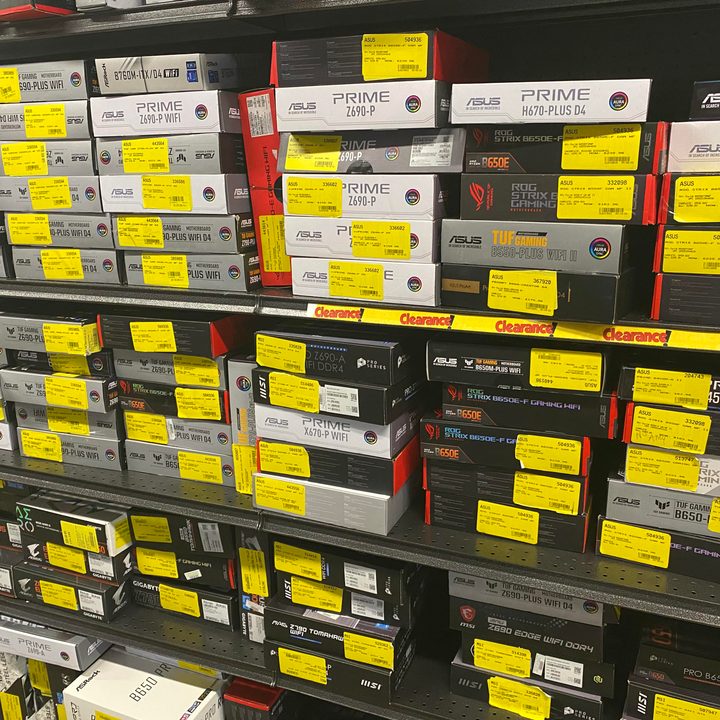
The picture above shows a Micro Center shelf filled with Asus motherboards. The ones with yellow tags are open box returns, meaning that a previous customer bought the board and opened it, but then chose to return it within the allowed time frame (usually 30 days). That’s a whole lot of returns; it’s no wonder that the Reddit user who took the picture captioned it “Asus mobo (motherboard) fallout on display at Micro Center.”
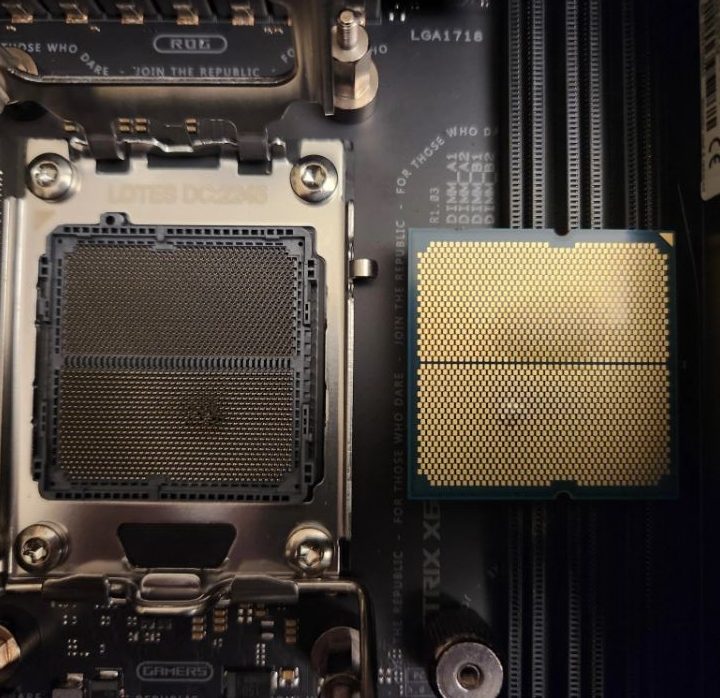
At first glance, this looks grim indeed. We reported a few weeks ago that some users have had problems with their Ryzen 7000 processors on Asus motherboards. In one instance of the issue, a Redditor reported that they found their Ryzen 7 7800X3D processor dead, with a visible bulge and a burn mark left behind on the motherboard. Another user said that they had a similar problem with the Ryzen 9 7950X3D. Neither user overclocked anything except the memory through AMD EXPO.
Both reports have one thing in common — an Asus motherboard. Further reports then followed. Nobody expects that one of the best processors would break down so quickly and so fully, so this was bad news for Asus (and the affected customers).
The affected user sent their hardware to the YouTube channel called Gamers Nexus. The YouTubers weren’t happy with Asus, essentially slamming it for publishing faulty BIOS updates that allowed Ryzen 7000 processors to operate at unsafe voltages. Gamers Nexus also claimed that Asus pushed a BIOS update for the Crosshair X670E Extreme motherboard that essentially voided its warranty. Lastly, Asus is said to have repeatedly encouraged users to stick to default memory profiles by disabling AMD EXPO on its AM5 motherboards.
When the overvolting issues first started cropping up, Asus was silent. Now, however, in the midst of these controversies, it has posted an official statement about the BIOS updates and warranty coverage for Asus AM5 motherboards.
“We want to address the concerns that have been raised by our users about whether recent BIOS updates will impact the warranty of ASUS AM5 motherboards,” said Asus. “We would like to reassure our customers that both beta and fully validated BIOS updates for ASUS AM5 motherboards are covered by the original manufacturer’s warranty. We would also like to confirm the following points:
- The ASUS AM5 motherboard warranty also covers all AMD EXPO, Intel XMP, and DOCP memory configurations.
- All recent BIOS updates follow the latest AMD voltage guidelines for AMD Ryzen 7000 series processors.”
This is a big change from Asus; one might call it a 180-degree turn. Now, Asus is seemingly going above and beyond by even including something that’s not usually covered by warranty — EXPO profiles are considered overclocking, so most of Asus’ competition excludes them.
Now, the question is as follows: Is Asus hastily retreating to save face because of the massive number of returns, as suggested by the Reddit post? The answer is tricky, but the photo of the Micro Center shelf is also misleading.
Most of the motherboards in the picture are Intel Z690 models. That implies no connection to the ongoing AMD Ryzen 7000 controversy. It could be that many customers suddenly lost trust in the brand due to the issues, but it could also be due to the fact that Micro Center sells motherboard and CPU bundles, and a recent change made many people return their old boards.
The bundle used to include a Z690 motherboard and a Core i7-13700K, but Micro Center has reportedly swapped that to a Z790 motherboard and allowed users to return their Z690 models for a quick upgrade. That would certainly explain the large number of returns. Ultimately, it might be a bit of both — the promotion largely explains it, but it’s hard to deny that this kind of bad press might leave a mark on Asus’ reputation that will last for a while.


