
Apple’s unexpected “Scary Fast” event has wrapped, and the 30-minute presentation was packed full of announcements. Headlining the showcase was Apple’s new M3 chip, which is showing up in a variety of devices in just a week from now.
We have the lowdown on everything Apple announced at its unprecedented fall event, which kicks off the third generation of Apple’s silicon with two major product updates.
M3 family of chips
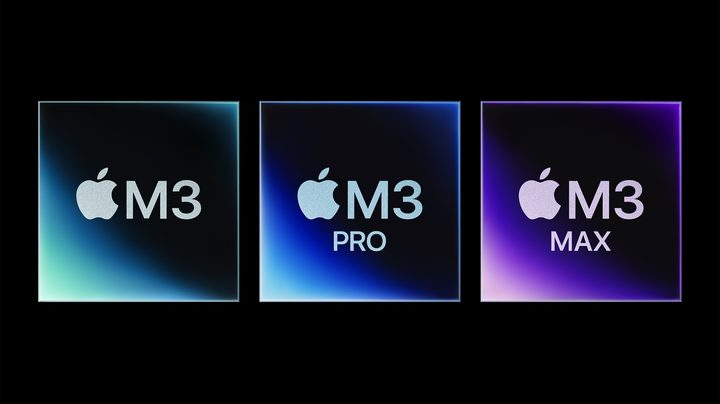
The biggest news out of the event was Apple’s family of M3 chips. We expected to see the M3 at the event, but Apple went ahead and announced the M3 Pro and M3 Max as well — something it’s never done before.
We’ll get to the products these chips will show up in shortly, but the M3 represents more than a minor refresh to Apple’s lineup. It’s the first desktop chip to sport a 3nm process, offering a huge node advantage over the M1 and M2. This chip was, reportedly, supposed to launch last year, but it seems Apple gave it more time to incubate in order to secure more supply.
In terms of improvements, Apple says the chips come with a faster CPU, along with a GPU with an entirely new architecture. That architecture is built around Dynamic Caching, which Apple says offers a huge boost to GPU performance. Along with hardware-accelerated ray tracing and mesh shader support — both first for Apple GPUs — the M3 is said to offer 60% faster graphics performance than the M1.
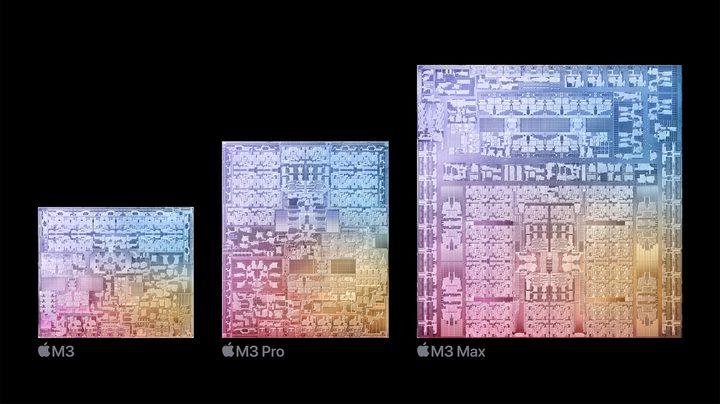
It’s the process that changing here. Like the M2, the M3 offers an eight-core CPU and either an eight-core or 10-core GPU. The M3 Pro sports an 18-core GPU and 12-core CPU, while the M3 Max goes up to a 16-core CPU and 40-core GPU. Apple also increased memory capacity for the M3 Max, with support for up to 128GB of Unified Memory now.
14-inch MacBook Pro M3

Finally, Apple is killing its 13-inch MacBook Pro. If you’re not up to speed, Apple has offered the 13-inch MacBook Pro alongside the 13-inch MacBook Air for the last two generations, with both sporting the same processor. That’s led to a situation where both machines offer identical performance, forcing the 13-inch MacBook Pro into an awkward spot.
That’s over now. The 14-inch MacBook Pro has the base M3 as an option, and it will replace the 13-inch MacBook Pro M2. The bump in screen size also comes with a bump in price, with the MacBook Pro starting at $1,600 with the M3. Compared to the 13-inch MacBook Pro with M1, Apple says the M3 model offers 60% faster render performance in Final Cut Pro, 40% faster code compilation, and 40% faster spreadsheet performance.
Apple didn’t announce an update to the MacBook Air with the M3. It’ll be interesting to see how pricing shakes out if the M3 ever makes it to the MacBook Air, but for now, the 14-inch MacBook Pro remains the only way you can get the M3 in a laptop.
The 14-inch MacBook Pro M3 is available to order now, and it will be released on November 7.
14-inch and 16-inch MacBook Pro with M3 Pro/Max
Apple will also offer the 14-inch MacBook Pro with the M3 Pro and M3 Max, along with a 16-inch model that exclusively uses one of the Pro or Max chips. These start at $2,000 for the 14-inch model and $2,500 for the 16-inch model, both with the M3 Pro.
There are a few updates to these models outside of the M3, though. Exclusive to the M3 Pro and M3 Max models, Apple is offering the new Space Black color option. These models are also available in silver, while the 14-inch MacBook Pro with M3 is available in silver and Space Gray.
Apple also improved the Liquid Retina XDR display in these laptops. With HDR, the display can now sustain up 1,000 nits of brightness, while peaking at 1,600 nits. And in SDR, the screen is capable of up to 600 nits, which Apple claims is 20% brighter than before.
Finally, Apple is claiming up to 22 hours of battery life in the MacBook Pro with M3. We expect that battery life will be lower with the M3 Pro and M3 Max, but Apple is already in a league of its own when it comes to laptop battery life.
Like the 14-inch MacBook Pro, you can order these models now, with units shipping on November 7.
24-inch iMac M3

Apple is finally updating the 24-inch iMac. It’s now available with the M3, offering what should be a massive upgrade over the previous model. Apple says the 24-inch iMac with M3 is up to twice as fast as the previous version, and it starts at the same price of $1,300.
Thankfully, Apple didn’t mess too much with the format of the iMac with M1, which has claimed a spot on our list of the best desktop computers for years. It’s available in the same seven-color options as before, with matching accessories, and Apple kept the 4.5K Retina display that’s capable of up to 500 nits of brightness.
There are some changes outside of the chip, though. Apple has bolstered connectivity with Wi-Fi 6E and Bluetooth 5.3, and there is access to up to four USB-C ports, two of which support Thunderbolt. The base model with an 8-core GPU is still limited to two USB-C ports, however.
The 24-inch iMac M3 is available to buy now starting at $1,300 with an 8-core GPU. Apple is also offering a version with a 10-core GPU for $1,500. The desktop will be available at retailers on November 7.


