  1. Home
  2. Space
  3. News

See images of the tilted Odysseus lander on the moon

Add as a preferred source on Google

The first lunar landing by a U.S. entity in 50 years was celebrated last week, but the lander from Intuitive Machines, named Odysseus, has had a challenging time as it landed at a tilted angle. New images released by the company show the damage that the Odysseus lander incurred during landing and sitting tilted on the moon’s surface, but the company stressed that it considered the mission a success as it was able to perform a controlled soft landing and get science data from all of its payloads.

The lander is expected to run out of power within a few hours, but there is a possibility the company will be able to power it back on in a couple of weeks once the lunar night ends.
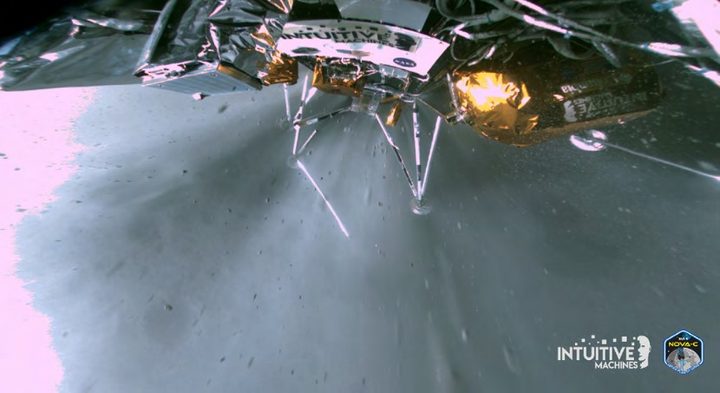
This image retrieved from the lander on February 27 captures Odysseus’ landing strut duringlanding on February 22nd performing its primary task, absorbing first contact with the lunar surface. Meanwhile, the lander’s liquid methane and liquid oxygen engine is still throttling, which provided stability. The Company believes the two insights captured in this image enabled Odysseus to gently lean into the lunar surface, preserving the ability to return scientific data.
This image retrieved from the lander on February 27 captures Odysseus’ landing strut during landing on February 22nd performing its primary task, absorbing first contact with the lunar surface. Meanwhile, the lander’s liquid methane and liquid oxygen engine is still throttling, which provided stability. Intuitive Machines

The image shows the damage to the landing leg on the left side of the image here. It also shows the cloud of dust and rocks that were thrown up by the lander’s engines interacting with the moon’s surface in a known phenomenon called a plume effect. The damage to the leg seems to have occurred as the mission touched down around one mile from the planned landing site in an area with higher elevation, the company said in a briefing, causing the lander to come in faster than planned and making it skid across the surface.
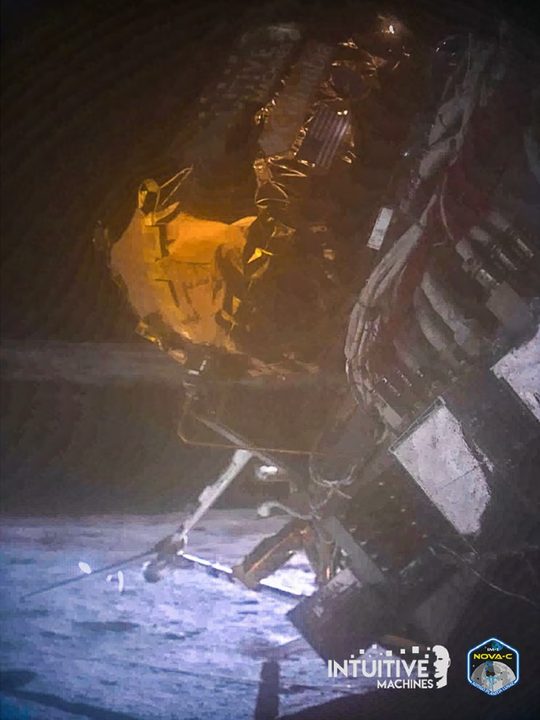
Taken on February 27th, flight controllers commanded Odysseus to capture a new imageusing its narrow-field-of-view camera. Previous attempts to send photos from landing and the days following returned unusable imagery. After successfully transmitting the image to Earth, flight controllers received additional insight into Odysseus’ position on the lunar surface
Taken on February 27th, flight controllers commanded Odysseus to capture a new image using its narrow-field-of-view camera. Previous attempts to send photos from landing and the days following returned unusable imagery. Intuitive Machines

The image shows how the Odysseus lander came to rest on the moon’s surface, tilted at an angle of around 30%. The large gold foil item is a helium tank.

Recommended Videos

The lander was not entirely on its side, as originally thought. It was “more upright than we initially thought,” Steve Altemus, chief executive officer and co-founder of Intuitive Machines, said in the briefing. “We did land upright, we captured data, then we tilted over slowly in about two seconds and came to rest either on the opposite helium tank or a computer shelf and were able to communicate all six [NASA] payloads back, plus all six commercial payloads.”

The lander had communications problems in the first few days of landing, but the team eventually got a small amount of data from the various NASA payloads on board. “Instead of ending up with a few bytes of data, which was the baseline goal for us, we’ve got over 50MB of data,” said Sue Lederer, CLPS project scientist at NASA Johnson.

The mission had a variety of challenges, including a drift in the control of the spacecraft using its engines, which had to be patched, and ending up in the wrong orbit before landing, which required a correction maneuver. Despite difficulties with the landing and communications, however, NASA and Intuitive Machines say that the mission was a success. Altemus described the mission as a pathfinder and stressed that “the whole idea of this mission was not to live as long as you could on the surface. This mission was intended as a scout.”

Georgina Torbet
Georgina has been the space writer at Digital Trends space writer for six years, covering human space exploration, planetary…
Astronauts reportedly took shelter after work on Russia’s leaky ISS module triggered concerns
The ISS really picked a stressful time to start leaking again
The International Space Station.

Astronauts aboard the International Space Station reportedly took precautionary shelter measures after maintenance work on a long-troubled Russian module raised fresh safety concerns about air leaks aboard the orbiting laboratory.

According to reports, the incident involved Russia’s Zvezda service module, which has experienced recurring air leak problems for several years. During repair work and pressure tests connected to the leak investigation, astronauts were instructed to isolate themselves in safer sections of the ISS as engineers monitored the station’s integrity and pressure stability.

Read more
Blue Origin’s massive New Glenn rocket explodes in a fiery blaze during tests
The incident leaves NASA's Moon Base ambitions and Amazon's Kuiper constellation without their primary launch vehicle at the worst possible moment.
Explosion, Fire, Nuclear Explosion

Blue Origin's New Glenn rocket exploded during a static fire test at Launch Complex 36 in Cape Canaveral, Florida. The incident took place on the night of May 28, 2026. 

The explosion was captured on a live stream by NASASpaceflight.com and footage of the explosion spread rapidly across X. The Space Launch Complex 45 has confirmed in an official statement (shared by Spaceflight Now on X) that all personnel have been accounted for and there have been no injuries or fatalities.

Read more
Orbot Robotics’ space robot has four arms, but its Goro physique has a purpose
This four-armed robot could make routine space-station work easier for astronauts
Robot with four arms

Helios is a new four-armed robot from Zurich-based Orbit Robotics, and at first glance, it reminded me of Goro from Mortal Kombat. But unlike the prince from Outworld, Helios is not built for combat. It is designed to help astronauts on space stations with the repetitive, time-consuming work that keeps life in space running.

Orbit Robotics says that in microgravity, legs are not much help. Instead of walking or standing, Helios needs to move through tight station interiors, hold itself steady, and handle cargo, tools, or equipment. Its four-arm design turns extra limbs into both mobility aids and working hands.

Read more