  1. Home
  2. Computing
  3. News

A surprising new competitor to Google Docs just made its debut

Add as a preferred source on Google
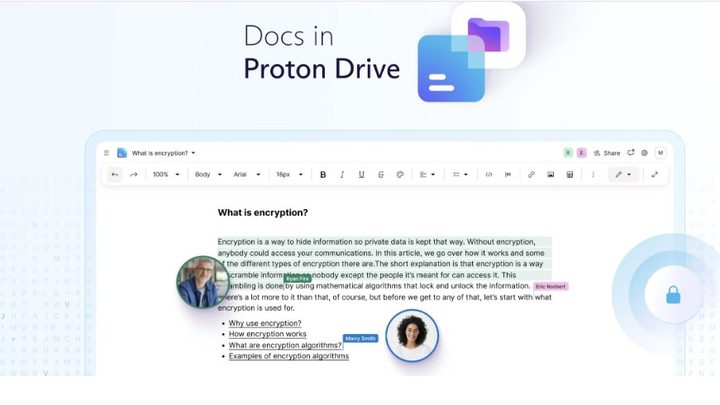
Preview of Proton Docs.
Proton

Proton, known for its popular email client, has always made it clear that it takes user privacy seriously. And that’s the defining feature of a new piece of software in its lineup calle dProton Docs, which the company announced in a blog post on Wednesday.

The latest addition launching today promises to push the envelope and encrypt the file, cursor movements, and keystrokes.

Recommended Videos

Proton Docs (found inside Proton Drive) has the features you would find in Google Docs, such as the formatting toolbar at the top, rich text options, file names, paths, commenting, multimedia support, white pages, and live indicators to see who is also looking at the file. Proton Docs will also support file types such as Microsoft .docx and the option to add images. Inviting others to work on the file is possible, but if they lack a Proton account, they will be encouraged to create one since link-based sharing is not supported.

Proton now has another jewel in its crown to help users feel that their data and files are safe using end-to-end encryption (E2EE). However, Proton Docs is not yet available as a standalone app; it is only available online. There is no information about when the app will launch or what operating systems are needed. But there is hope that an app will arrive (Proton Drive was first available only through your web browser, with the app coming later).

This launch comes only a few weeks after the company debuted some improved sharing features in Proton Drive. It’s not open-source yet, but Proton confirms it will be soon so users can check their security claims. The acquisition of Standard Notes did play an essential role in the creation of Proton Docs since it was a joint project with the team from Standard Notes.

You can use the free tier without restriction until you hit the 5GB limit; after that, you must upgrade to a paid account. Google Docs remains the more popular choice for the time being, but we’ll see how much of a dent Proton Docs will make in future comparisons.

Judy Sanhz
Computing Writer
Judy Sanhz is a Digital Trends computing writer covering all computing news. Loves all operating systems and devices.
Google wants your app code so badly, it’s willing to pay for it
Google is paying for app code, and the reason is exactly what you think.
Google Logo

Google has been quietly reaching out to Android developers with an offer to buy access to their code. As reported by 404 Media, the company sent emails to a select group of Google Play developers, inviting them to join what it calls a "confidential content offer pilot." 

The email frames it as a revenue opportunity, saying developers can "get paid for sharing the code powering your apps, as well as your archived projects." Google adds that developers retain their intellectual property rights and that the license is non-exclusive.

Read more
Nvidia confirms more RTX Spark processors are coming with N2X and N3 series lined up
Huang confirming a multi-generation roadmap before the first device has even shipped is the clearest signal yet that this is a decade-long commitment.
nvidia-rtx-spark

The PC and laptop industry has run on Intel and AMD silicon so long that most people don’t even question whether these are the only options. 

Nvidia just answered that question at Computex 2026, in the form of the RTX Spark superchip, and Jensen Huang’s comments about what comes next suggest that it wasn’t a one-time experiment. 

Read more
AI fitness coach senses the muscle mechanics as you exercise and prevents rookie injuries
Most fitness apps offer encouragement dressed up as coaching, but BioCoach offers anatomy-specific corrections, and I could see it becoming a smartphone app real soon.
Woman exercises with her Apple Watch and Dexcom G7.

During the pandemic, the US Consumer Product Safety Commission recorded a 48% spike in at-home exercise injuries. You might think that the culprit was bad equipment, but it was bad form. People had no coach around to correct it.  

Researchers at Drexel University and Michigan State University have built a prototype that addresses exactly that problem, in real time, using your phone camera, and there’s real potential for it to become a legitimate fitness app in future (via Tech Xplore).

Read more