  1. Home
  2. Space
  3. News

James Webb takes rare direct image of a nearby super-Jupiter

Add as a preferred source on Google
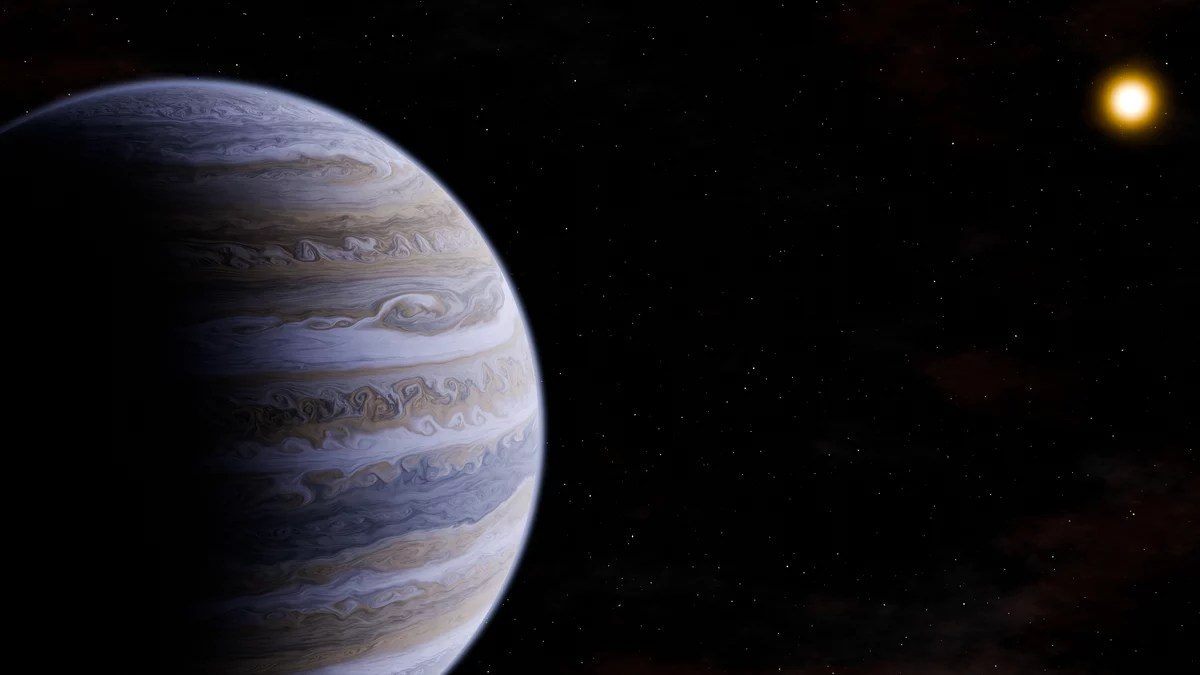
Artist’s impression of a cold gas giant orbiting a red dwarf. Only a point of light is visible on the JWST/MIRI images. Nevertheless, the initial analysis suggests the presence of a gaseous planet that may have properties similar to Jupiter.
Artist’s impression of a cold gas giant orbiting a red dwarf. Only a point of light is visible on the JWST/MIRI images. Nevertheless, the initial analysis suggests the presence of a gaseous planet that may have properties similar to Jupiter. T. Müller (MPIA/HdA)

Even with huge ground-based observatories and the latest technology in space-based telescopes, it’s still relatively rare for astronomers to take an image of an exoplanet. Planets outside our solar system are so far away and so small and dim compared to the stars they orbit that it’s extremely difficult to study them directly. That’s why most observations of exoplanets are made by studying their host stars. Now, though, the James Webb Space Telescope has directly imaged a gas giant — and it’s one of the coldest exoplanets observed so far.

The planet, named Epsilon Indi Ab, is located 12 light-years away and has an estimated temperature of just 35 degrees Fahrenheit (2 degrees Celsius). The fact it is so cool compared to most exoplanets meant that Webb’s sensitive instruments were needed to study it.

Recommended Videos

“Cold planets are very faint, and most of their emission is in the mid-infrared,” explained lead researcher Elisabeth Matthews of the Max Planck Institute for Astronomy in Germany. “Webb is ideally suited to conduct mid-infrared imaging, which is extremely hard to do from the ground. We also needed good spatial resolution to separate the planet and the star in our images, and the large Webb mirror is extremely helpful in this aspect.”
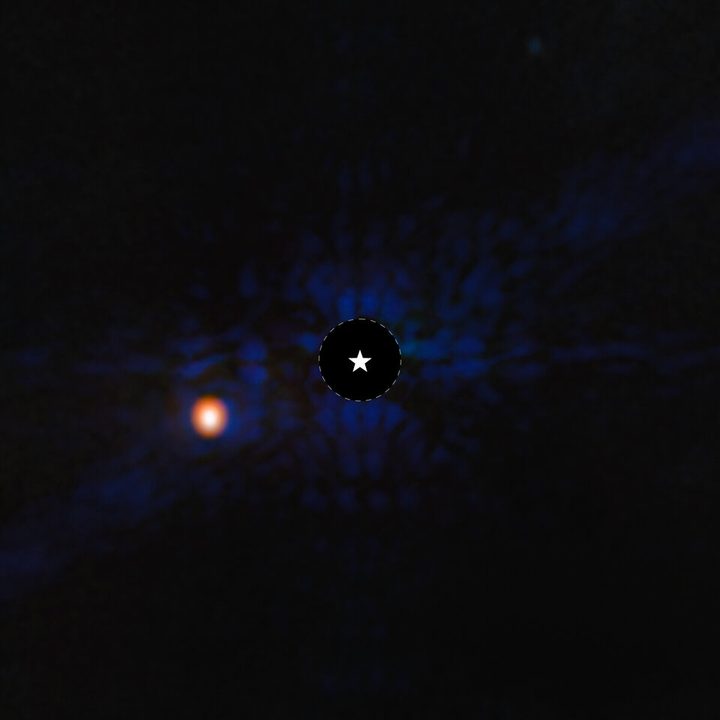
The gas-giant exoplanet Epsilon Indi Ab imaged using the MIRI instrument on NASA’s Webb telescope. A star symbol marks the location of the host star, whose light has been blocked by MIRI’s coronagraph, resulting in the dark circle with a dashed white line. The planet is to the left of the star.
The gas-giant exoplanet Epsilon Indi Ab imaged using the MIRI instrument on NASA’s Webb telescope. A star symbol marks the location of the host star, whose light has been blocked by MIRI’s coronagraph, resulting in the dark circle with a dashed white line. The planet is to the left of the star. NASA, ESA, CSA, STScI, E. Matthews (Max Planck Institute for Astronomy)

The image of the planet, seen above, was taken by Webb’s MIRI instrument. This has a tool called a coronagraph, which is a disk that blocks out light from very bright sources (in this case, the planet’s host star) so that nearby dimmer objects (like the planet) can be observed. It was also possible to make this rare direct observation of the planet because it is so nearby to us, relatively speaking, so there was more visible separation between the planet and the star.

The planet is rather similar to Jupiter, though a little warmer and a little larger. There are some indications that it could have a cloudy atmosphere, or it could have lots of heavy elements like carbon. But the researchers want to collect more data using spectrographs to get a better look at the planet’s atmosphere before drawing conclusions.

Studying the planet could help astronomers understand more about the gas giants in our own solar system, as well as the many exoplanets that are farther away and are too faint and distant to be observed in this manner.

“Astronomers have been imagining planets in this system for decades; fictional planets orbiting Epsilon Indi have been the sites of ‘Star Trek’ episodes, novels, and video games like Halo,” said team member Caroline Morley of the University of Texas at Austin. “It’s exciting to actually see a planet there ourselves, and begin to measure its properties.”

The research is published in the journal Nature.

Georgina Torbet
Georgina has been the space writer at Digital Trends space writer for six years, covering human space exploration, planetary…
Stunning close-up footage shows NASA’s moon rocket roaring to space
On its first crewed flight, NASA's lunar rocket displays its awesome power.
NASA's SLS rocket roars skyward at the start of the Artemis II mission on April 1, 2026.

As NASA’s Artemis II astronauts journey back to Earth following their breathtaking close encounter with the moon earlier this week, the space agency has just shared some stunning footage (below) of the rocket launch that sent the crew on its way on April 1.

The close-up tracking shot shows the awesome power of the Space Launch System (SLS) rocket’s four core RS-25 engines together and its two solid rocket boosters as the 98-meter-tall vehicle roars away from the launchpad at the Kennedy Space Center in Florida.

Read more
How to watch NASA’s moon crew splash down at end of historic mission
The Orion spacecraft's final moments before splashdown will be the most perilous of the entire mission.
Earth and the moon as seen from the Orion spacecraft during the Artemis II mission in April 2026.

The Artemis II astronauts have looped around the moon, captured some extraordinary imagery (above), set a slew of records, and are now on their way back to Earth.

The 10-day mission will reach its climax on Friday, April 10, during a dramatic homecoming that will see the Orion spacecraft enter our planet’s atmosphere at a speed of nearly 25,000 miles per hour.

Read more
Notable firsts of the Artemis II moon mission … so far
The Artemis II crew are now on their way home, so let's take a look at the mission's achievements so far.
The moon as seen from the Orion spacecraft during the Artemis II mission.

Having just looped around the moon in a historic flyby of our nearest neighbor, the Artemis II crew are now on their way back to Earth.

NASA’s Victor Glover, Reid Wiseman, and Christina Koch, along with the Canadian Space Agency’s Jeremy Hansen, launched aboard the Orion spacecraft from the Kennedy Space Center on April 1, lifted to space by the mighty SLS rocket.

Read more